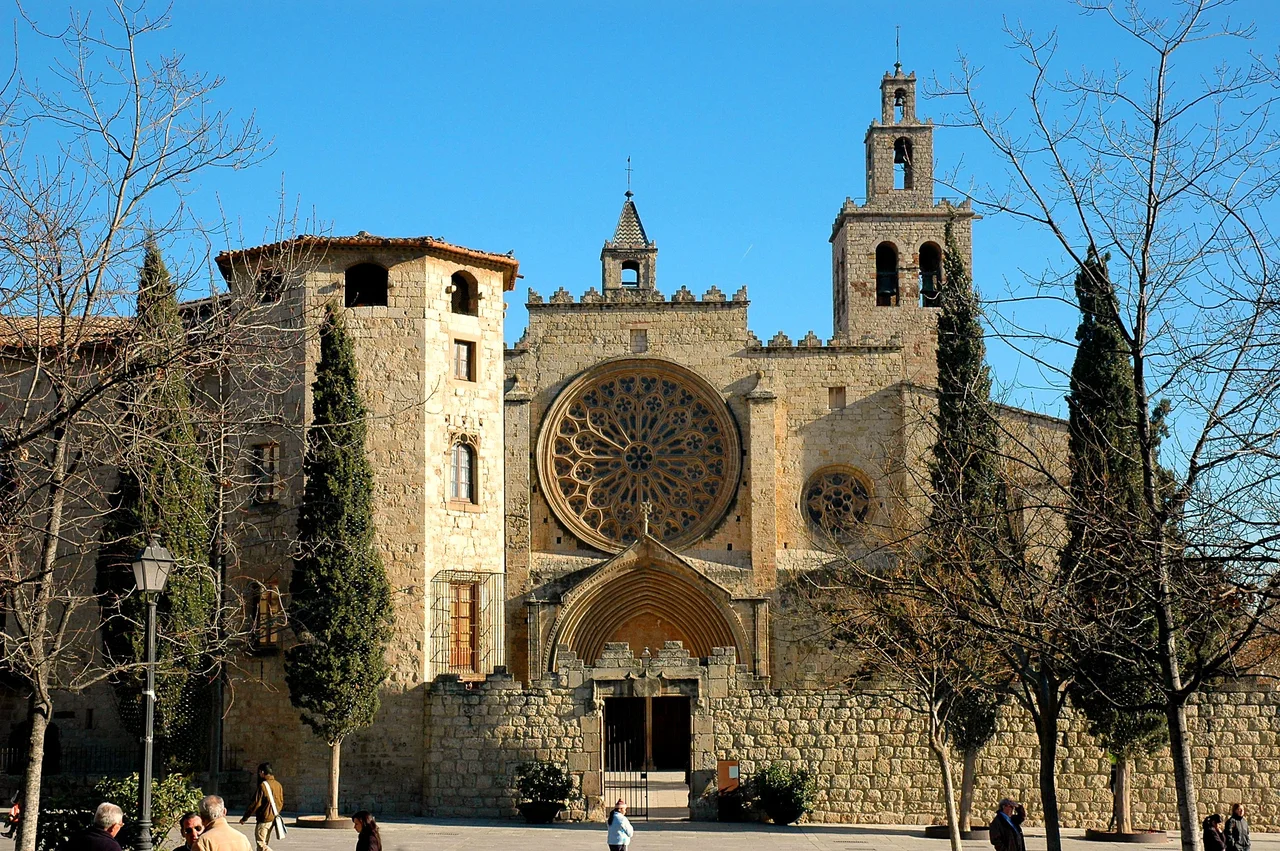

Monastery of Sant Cugat
Step into the cloister of Sant Cugat and you enter a garden ringed by stone that will not stay silent. Pairs of slender columns march around a square arcade, and atop each pair sits a carved capital: lions and griffins, twisting foliage, scenes lifted from the Bible, all worked in the twelfth century and worn smooth by nine hundred years of hands and weather. This is the heart of a Benedictine abbey that was, for centuries, the most important monastery in the county of Barcelona, and its history is far bloodier and stranger than its serene courtyard suggests.
A Martyr's Ground
The abbey rose from a grave. Its name honours Cucuphas, in Catalan Sant Cugat, an early Christian killed for his faith in the persecutions of the late Roman Empire, and a fifth-century church was built to hold his remains. In the ninth century that shrine was joined to a fortification, and the union of the two became the seed of the monastery. The town that grew up around it, Sant Cugat del Vallès, took the martyr's name as its own. From these beginnings the community would spend some five hundred years under near-constant construction, expanding and rebuilding until the fourteenth century. The new monastery begun in the mid-twelfth century was not finished until 1337, and work on its fortifications started only in 1350, so that for the better part of half a millennium the sound of masons was as much a fixture of the place as the sound of prayer.
The Year 985
Then came catastrophe. In 985 the armies of al-Mansur, the formidable warlord of Córdoba, marched on Barcelona and sacked it, and the monastery lay in their path. The raid was devastating. Abbot Joan and twelve of his monks were killed, and the archives, the accumulated memory of the house, were destroyed. It is easy to read past a line like that, but these were thirteen men who had chosen a life of prayer and study and who died in the ruin of it. The community did not disappear. From 986 onward, Abbot Odó rebuilt and enlarged the monastery, and out of the wreckage the abbey began its long climb toward power.
Stone That Tells Stories
The monastery's glory is its architecture, and above all that Romanesque cloister, built in the twelfth century and stretching more than thirty metres on a side. It was the work of the master sculptor Arnau Cadell and his workshop, who gave each pair of columns a capital finely carved with everything from animals to biblical episodes. In the sixteenth century a second storey was added above. The church attached to it takes a different voice entirely: Gothic rather than Romanesque, with a tall nave, two aisles, and a great rose window some eight metres across, kin to those of the cathedrals of Barcelona and Tarragona. Inside hangs a Gothic altarpiece, the retaule de Tots els Sants, painted in 1375 by Pere Serra.
Power, Ruin, and Return
At its height the abbey ruled a small empire of the spirit, holding sway over other monasteries scattered across Catalonia, from Santa Cecília de Montserrat to Sant Pau del Camp in Barcelona. Power drew conflict, and not only from outside. In the late eleventh century, Count Ramon Berenguer II placed Sant Cugat under the distant French abbey of Saint-Pons-de-Thomières in the Languedoc, and the arrangement threw the community into turmoil; the incoming abbot expelled the monks who resisted him, until the bishop of Barcelona intervened and pulled the monastery back into his own diocese. In the early eighteenth century, during the War of the Spanish Succession, troops of the Archduke Charles occupied and damaged the buildings, and repairs dragged on until 1789. Worse came in 1835, when the monks left for good and the great house fell empty and silent. Restoration began in 1851, and in 1931 the monastery was declared a national monument. Today it stands preserved, its cloister once again a place where visitors walk slowly, reading the stories carved in stone.
From the Air
The monastery sits at 41.4743 N, 2.0855 E, in Sant Cugat del Valles, on the inland side of the Collserola hills that separate the town from Barcelona to the southeast. From 2,500-4,000 ft AGL the abbey's bulk and its octagonal bell tower stand out amid the town, with the wooded Collserola ridge and the Tibidabo summit as reference points toward the coast. Sabadell (LELL) lies just to the north and is the closest field; Barcelona-El Prat (LEBL) is southwest beyond the city, and Girona (LEGE) up the coast to the northeast. The Valles basin generally offers good visibility away from summer haze.
Nearby Stories
- Santes Creus 6.6 km away
- Torre dels Escipions 7.3 km away
- Cave of Saint Ignatius 11 km away
- Cervera 11 km away
- El Celler de Can Roca 47 km away
- Tarragona Amphitheatre 57 km away
- Fageda d'en Jordà 84 km away
- Cap de Formentor 145 km away