_-_36.jpg)
Santes Creus
The Cistercian monks who built Santes Creus owned almost nothing. They slept on straw mattresses laid on the floor of a bare stone hall, kept their church free of ornament, and grew their own food in a quiet valley of the Gaia river. Yet buried in the middle of all that austerity lies a king who conquered a Mediterranean kingdom. Peter III of Aragon, called Peter the Great, who seized the crown of Sicily, chose these humble monks as his eternal company, and his stone coffin rests on a slab of purple Roman porphyry. Santes Creus is where two opposite ideas of glory meet.
An Order That Fled the World
The monastery was founded in 1168 by monks of the Cistercian order, reformers who believed the church had grown too comfortable and set out to build lives of deliberate hardship. Their creed shows in the architecture. The church, begun in 1174 and finished around 1225, follows a plain Latin-cross plan; inside, the walls are almost naked, stripped of the paintings and gilding that filled other medieval churches. The great dormitory where the monks slept runs some 46 metres long, a single undivided hall with no partitions, no comforts, and a ceiling of stone arches springing from the walls. The chapter house next door is a model of Cistercian calm, a square room carried on four columns, its nine vaults catching the morning light through three east-facing windows. Everything here was designed to quiet the self.
The Kings Who Came to the Quiet
For all their retreat from the world, the Cistercians drew the powerful to them. The kings of the Crown of Aragon made Santes Creus a royal pantheon, and the first to be laid here was Peter III, called the Great. He had won Sicily and defied a pope who excommunicated him for it; when he died in 1285, his son and successor James II honored the resting place his father had chosen. Between 1291 and 1307 the master Bartomeu de Girona built the tomb, a carved shrine ringed with the images of saints, set beneath a soaring Gothic canopy and raised upon a bath of blood-red Roman porphyry, the hardest and most imperial of ancient stones. James II reserved his own place in the same church. His marble mausoleum, carved by Bertran Riquer between 1313 and 1315, shows him and his queen, Blanche of Anjou, lying side by side, a king and his wife dressed, tellingly, in the plain habits of Cistercian monks.
The Admiral at the King's Feet
One more grave belongs to a man who spent his life at sea. Roger de Lluria, the admiral who commanded the fleets of the Crown of Aragon and was reputed never to have lost a naval battle, lies buried at the feet of the king he served. It is a medieval arrangement full of meaning, loyalty rewarded with nearness to royalty even in death. Centuries later, when scholars opened the admiral's tomb, they found the bones of several people and none that were certainly his, a small mystery layered onto a monument already dense with them. The soldier and the sovereign keep company still, beneath the same silent vaults.
Stone That Learned to Bloom
The monastery did not stay entirely austere. When King James II ordered the old cloister torn down and rebuilt, the master mason Reynard of Fonoll, and after him his pupil Guillem de Seguer, carved a Gothic masterpiece that broke the Cistercian rule against decoration. The window tracery shifts from English Geometric patterns to native Catalan designs, and the clustered columns bloom with capitals of leaves, animals, human faces, and scenes from the Bible. It is as if, after generations of restraint, the stone finally allowed itself to flower. Today the golden-limestone complex sits in the hamlet of Santes Creus, one of three great Cistercian houses on the Ruta del Cister and a waypoint on the Catalan road to Santiago. Pilgrims and travelers still pass through, drawn by the same strange marriage of humility and grandeur that has defined it for more than eight centuries.
From the Air
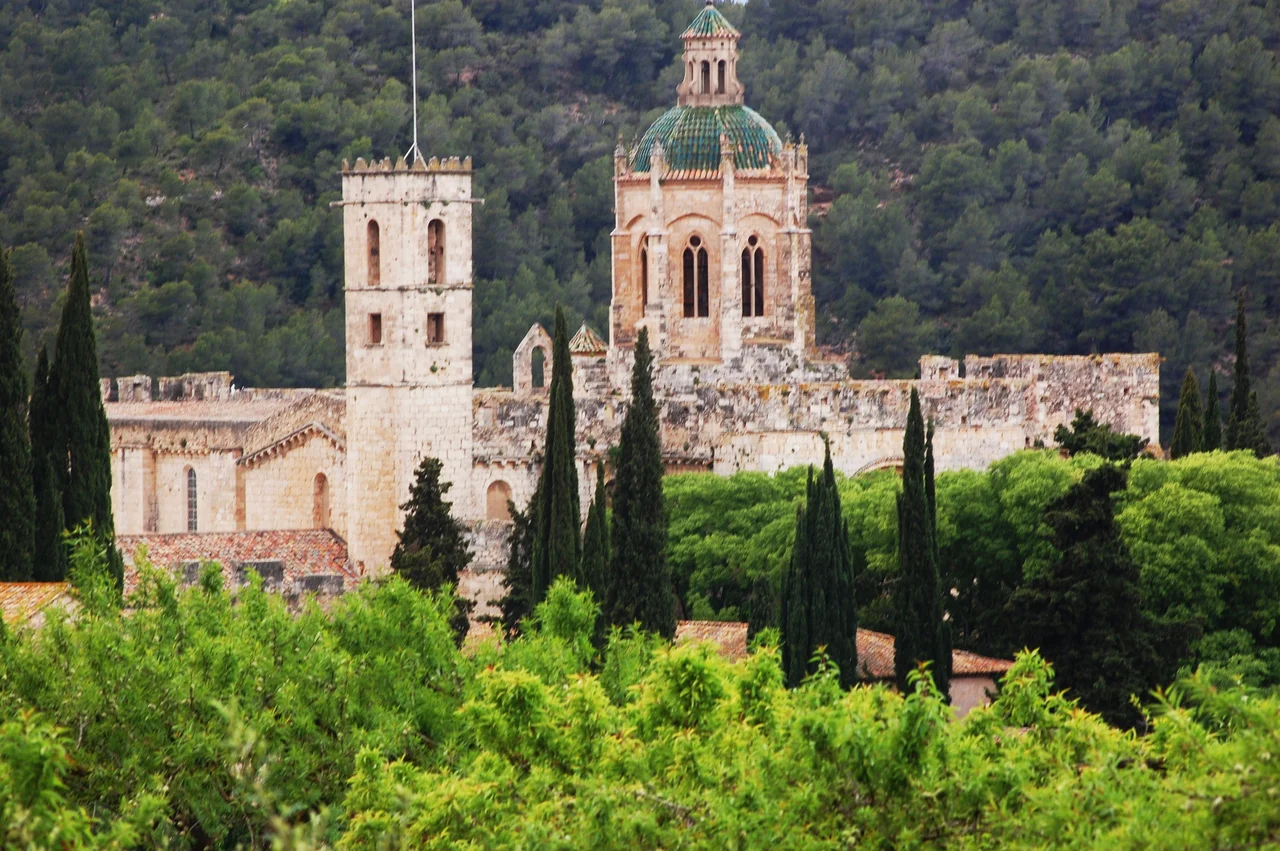
Santes Creus sits at 41.35 N, 1.36 E in the Gaia river valley of inland Tarragona, about 42 km northeast of Reus (LERS) and roughly 90 km southwest of Barcelona-El Prat (LEBL); Lleida-Alguaire (LEDA) lies some 85 km to the west. From 3,000 to 5,000 feet the monastery is a compact honey-colored complex set among vineyards and low wooded hills, its church crowned by an octagonal Gothic drum and Baroque lantern that stand out against the surrounding farmland. The Costa Daurada's dry, clear air makes the site easy to pick out on most days; morning light warms the limestone to gold.
Nearby Stories
- Siege of Tarragona (1811) 2.5 km away
- Cervera 3.4 km away
- Freixenet 3.9 km away
- Roca dels Moros 7.6 km away
- Cave of Saint Ignatius 9.1 km away
- Miravet 14 km away
- Battle of Almenar (1082) 19 km away
- Sa Calobra 168 km away