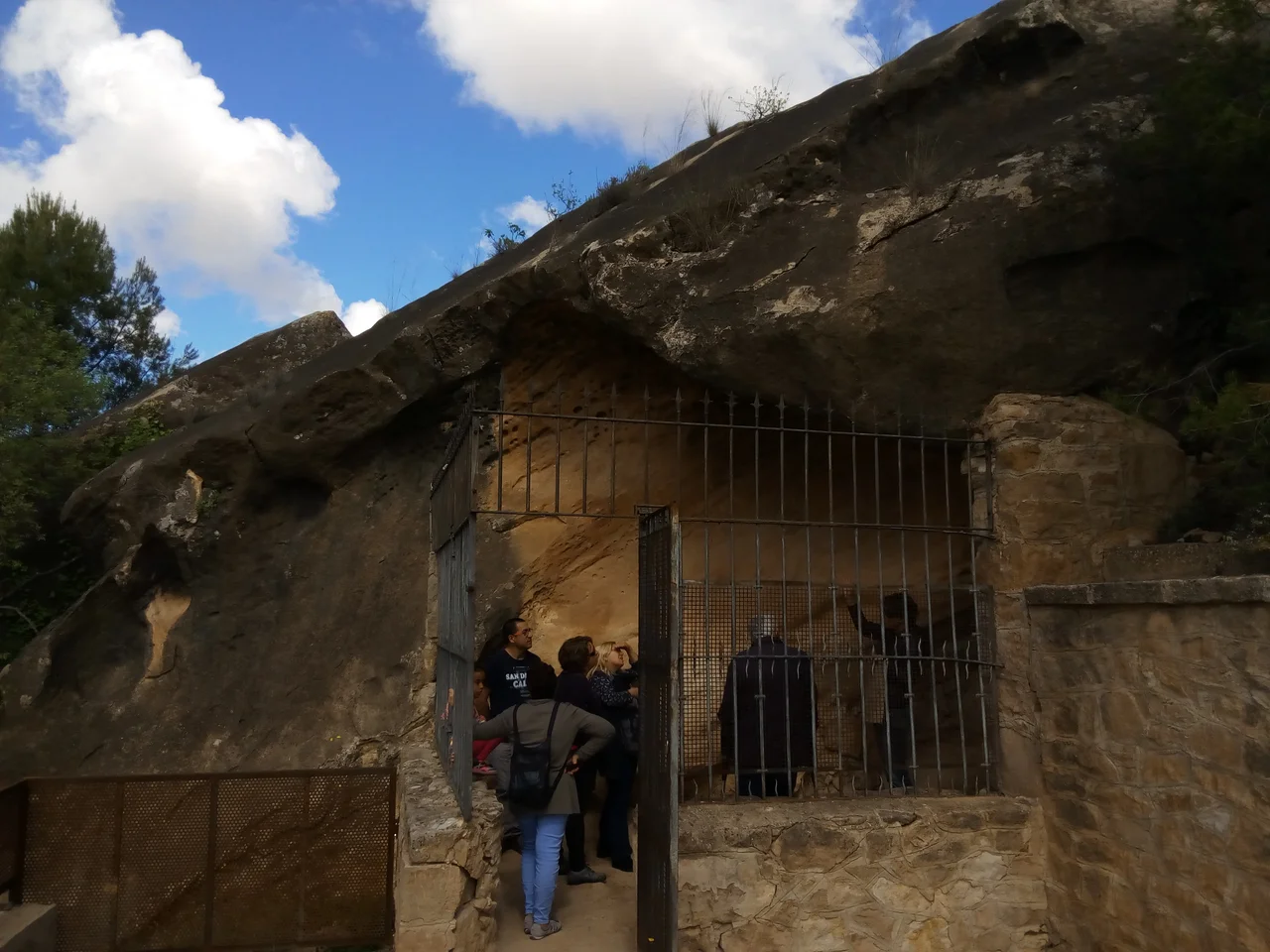

Roca dels Moros
On a low rock shelter outside the village of El Cogul, a group of women is caught mid-movement, their skirts flaring, their bodies rendered in worn red and black pigment thousands of years ago. Around them cluster animals, and among the figures a small male form. People have argued about this scene for more than a century. Is it a fertility rite? A gathering of women who simply came together, children in tow? The painters left no explanation, only the image itself, still legible on the stone that the locals have long called the Roca dels Moros, the Rock of the Moors.
The Dance on the Rock
The paintings belong to two ancient traditions layered on one wall. Some figures are Levantine rock art, the naturalistic style found across the eastern Iberian mountains, and others are Iberian schematic art, more abstract and symbolic. The most famous panel is the group of women, long read as dancers performing a reproductive ceremony around the central male figure. That reading is no longer the only one. Scholars have suggested these could just as easily be women of some social standing, gathered to socialize, their children nearby, showing affection and friendship toward one another. The stone does not settle the question. What it preserves is something rarer than certainty: the sense of real people, alive and in company, pressed into pigment before writing existed to name them.
A Priest's Discovery
The site slipped back into public memory in 1908, when the village rector of El Cogul, Ramon Huguet, recognized what the shelter held and published a report the same year. It was a fitting rediscovery for a place that had always been about faith. The rock had drawn people to it as a sanctuary for a very long time, and the priest who brought it to scholarly attention was, in a sense, only the latest in a line of visitors who found the spot worth honoring. Since 1998 the paintings have been protected as part of the Rock Art of the Iberian Mediterranean Basin, a UNESCO World Heritage Site catalogued under reference 874.
Written in Two Scripts
Long after the last prehistoric painter set down a brush, people kept coming to the rock, and some of them left words. Inscriptions survive here in Northeastern Iberian script and in the Latin alphabet, and one of them is an ex-voto, an offering made in fulfillment of a vow. Those inscriptions matter because they show continuity. The shelter was not painted once and forgotten. It remained a place of pilgrimage and devotion into Iberian and Roman times, its meaning handed down across cultures and languages that had nothing else in common. Few sites let you read, on a single face of stone, the handwriting of so many centuries.
Whose Hands?
Because the ancient artists are anonymous, every generation projects its own assumptions onto them, and for a long time the default assumption was male. Yet the scene at El Cogul is overwhelmingly about women, and the writer Felix Rodrigo Mora proposed a quieter possibility: that women themselves painted it. There is no way to prove who held the pigment. But the suggestion reframes the whole panel. Instead of women observed and depicted by others, we may be looking at women who chose to record their own gathering, their own bodies, their own bond. Either way, the figures resist being treated as curiosities. They were somebody's mothers, daughters, neighbors.
The Route of Rock Art
The shelter no longer stands alone. Conservation work has been carried out under the Museu d'Arqueologia de Catalunya, and a visitors center now interprets the paintings and links El Cogul into a wider route of rock art connecting similar sites across Catalonia. Just beside the shelter lies a further trace of the human presence here: the Saladar tombs, a small cemetery of graves carved directly into the rock. Together they turn a single painted wall into a layered landscape of the dead and the remembered, where prehistoric dancers, Iberian pilgrims, and Roman worshippers all left something of themselves on the same quiet hillside.
From the Air
The Roca dels Moros sits at 41.465N, 0.697E, in the low limestone country of Les Garrigues near El Cogul, southeast of Lleida. It is a small ground feature best located by the surrounding patchwork of olive groves and dry farmland rather than from the air directly. Lleida-Alguaire (LEDA) lies about 20nm north-northwest, Reus (LERS) roughly 30nm southeast, and Barcelona (LEBL) about 75nm east-northeast. A recommended viewing altitude of 3,000 to 5,000 feet over the Garrigues plateau gives the clearest sense of the terraced valleys that hide the shelter.
Nearby Stories
- Poblet Abbey 2.9 km away
- Corbera d'Ebre 7.5 km away
- Battle of Almenar (1082) 16 km away
- Siege of Tarragona (1811) 16 km away
- Cervera 18 km away
- Morella 58 km away
- Battle of Belchite (1937) 64 km away
- Zaragoza Barracks Bombing 72 km away