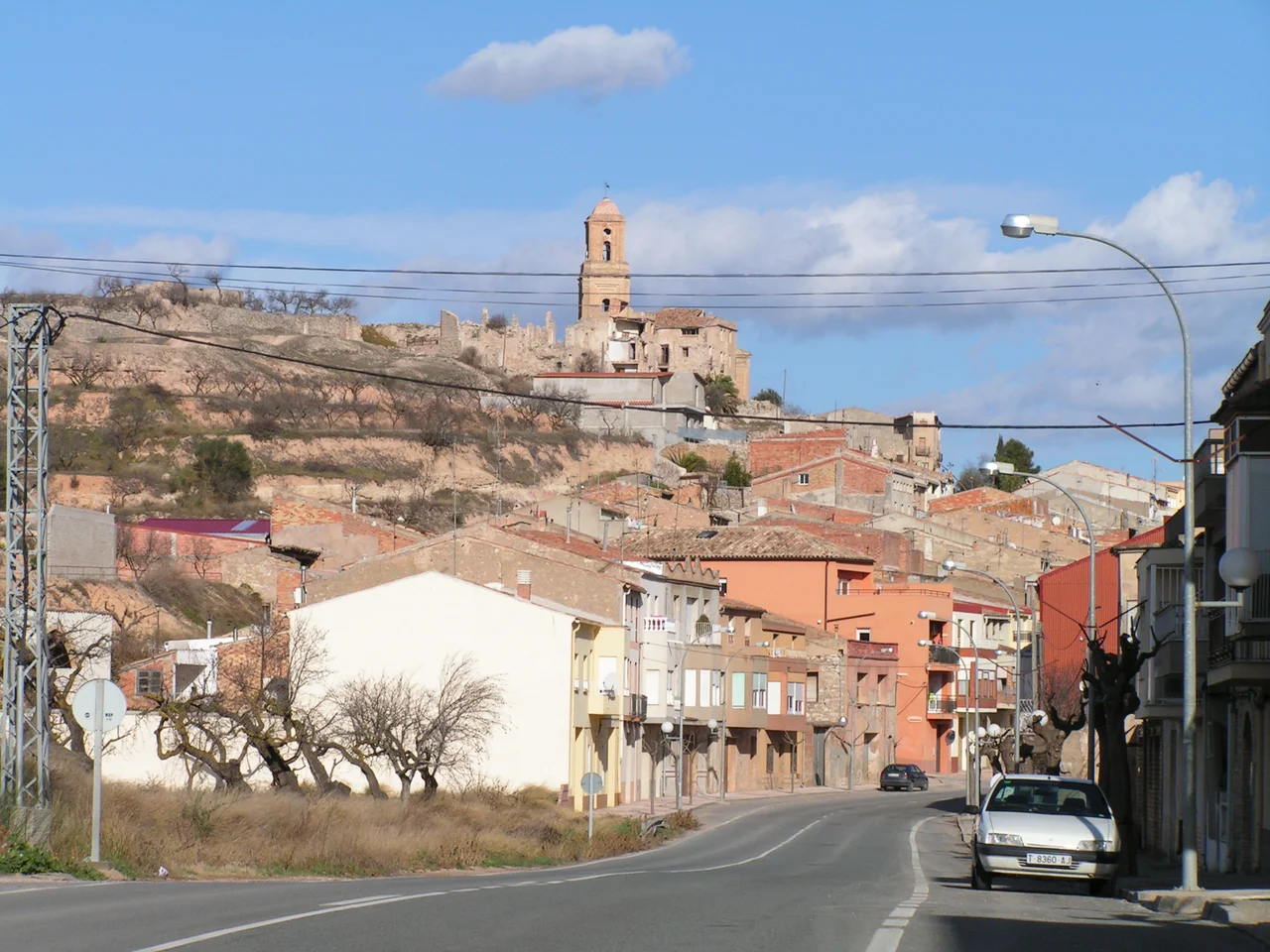

Corbera d'Ebre
On a hill above the rebuilt town of Corbera d'Ebre, a dead village still stands. Roofless houses, a gutted church, streets that lead nowhere—this is the Poble Vell, the Old Town, and it has been left in ruins on purpose. In the autumn of 1938 the Battle of the Ebro reduced Corbera to rubble. When the fighting finally moved on, the survivors rebuilt their lives on the lower ground but left the shattered upper town exactly as the war had made it: a stone memorial to the longest and bloodiest battle of the Spanish Civil War.
The Village Left in Ruins
Corbera d'Ebre had the terrible luck to sit in the path of the Battle of the Ebro, which raged from 25 July to 16 November 1938 across these hills of Terra Alta. The town was destroyed completely. Afterward, its residents rebuilt the lower part and returned to ordinary life, but the upper town—the Poble Vell, crowned by its old hilltop church—was deliberately kept as it was: broken walls open to the sky, at once a warning and a remembrance. The gutted church still rises over empty naves and has become the emblem of the whole preserved village. Today Corbera holds one of five interpretation centres run by COMEBE, a public consortium including the Catalan government, founded in 2001 to recover the historical memory of the battle. Marked paths thread the old ruins and the surrounding countryside, guiding visitors across ground where a 115-day battle once churned.
The Longest Battle
The Battle of the Ebro was the largest and most decisive engagement of the Spanish Civil War, and one of the most ruinous. In late July 1938, six fully equipped Republican divisions crossed the Ebro River in a bold offensive that at first caught Franco's forces off guard. But the initiative did not hold. The front hardened, and for months the two sides ground against each other across the ridges and river valleys of this region, in a battle measured not in days but in the slow attrition of men. When it ended in November, the Republic had spent an army it could not replace, and the war would be lost within months. These quiet vineyards and dry hills were, for a single terrible season, among the most lethal places in Europe.
The Men from Far Away
Among those who fought here were volunteers from across the world, drawn to Spain to resist the rise of fascism. At the end of March 1938, the Lincoln-Washington Battalion—American members of the International Brigades—was retreating from Belchite, where it had lost 400 of some 500 men, and camped near Corbera. They did not know the town had fallen into Francoist hands at noon on 2 April. Several Americans passing through were captured and executed, among them the battalion's commander, Major Robert Merriman, and his second-in-command, David Doran. Command passed to Milt Wolff, who would be the last leader of the Lincoln Battalion. The survivors regrouped on the banks of the Ebro, their ranks slowly refilling to around 700 men—Spanish and foreign together—to take part in the great river crossing that opened the battle. They had come a long way to die on these hillsides, and many of them did.
Withdrawal and Memory
By early September the Lincoln Battalion was back in the vicinity of Corbera, and by late September it was gone. On 21 September 1938, before the League of Nations in Geneva, the Spanish prime minister Juan Negrín announced that the Republic would unilaterally withdraw all its international volunteers—a diplomatic gesture that sent the foreign fighters home even as the battle still raged. Corbera's own war ended not long after, in ruin. In the decades since, the hills have returned to the work they knew before: this is one of the twelve municipalities of the Terra Alta wine region, its slopes patterned with vines. But the Poble Vell remains on its height, unrepaired and unforgotten, so that anyone who climbs to it stands inside the exact shape the war left behind.
From the Air
Corbera d'Ebre lies at 41.08°N, 0.48°E in the Terra Alta hills, a few kilometres west of the Ebro and its Civil War battlegrounds. From 4,000–6,000 ft AGL, look for the modern lower town with the roofless ruins of the Poble Vell climbing the hill above it, the gutted church at the summit the clearest marker, all set among terraced vineyards. Reus (LERS) lies about 45 km to the east-southeast and Lleida-Alguaire (LEDA) to the north, with Barcelona (LEBL) the main gateway on the coast; the town of Gandesa sits just to the southwest. Clear winter mornings give the sharpest view of the hilltop ruins.
Nearby Stories
- Poblet Natural Park 5.2 km away
- Amposta 9.1 km away
- Reus 13 km away
- Morella 20 km away
- Mequinenza 20 km away
- Battle of Morella 48 km away
- Zaragoza Barracks Bombing 82 km away
- Banyalbufar 174 km away