
Morella
From a distance Morella looks less like a town than a single sculpted hill. Red-roofed houses spiral up the slopes inside a ring of medieval walls, and above them all a castle clings to the bare rock at the summit. That crag is the whole story. Everyone wanted it - Iberians, Greeks, Romans, Moors, and at last Christians each held this fortified height in their turn - and for a town of barely 2,500 people in the mountains of Castellón, Morella has watched a staggering amount of history pass through its gates.
The Hill Everyone Wanted
The rock has drawn people since the deepest past. Cave paintings and Bronze Age graves in the surrounding hills mark habitation from the earliest times, and the town's very name descends from the Arabic Maurela. One after another, the powers of the western Mediterranean took the fortified summit and held it, each leaving the hill a little more layered than they found it. To climb Morella's streets today - up from the gates, past the church, toward the castle on its crown - is to climb through those centuries stacked one directly atop the next.
Four Wars on One Rock
A fortress this commanding was fought over again and again. Morella saw fierce combat in the War of the Spanish Succession, in the Napoleonic Wars, in the 19th-century Carlist Wars, and once more in the Spanish Civil War of the 1930s. In 1938 Franco's forces seized the town - but the fighting did not truly end there. Republican guerrillas held out in the surrounding mountains for nearly two more decades, still active as late as 1956, long after the war was officially declared over. The hill that made Morella worth taking also made it stubbornly hard to fully subdue.
Emptying and Returning
Peace brought a quieter kind of loss. Through Franco's long dictatorship, from 1939 to 1975, Morella's people drained away toward the cities in search of work, and the population fell sharply. Only with the return of democracy did the town begin to recover. Today tourism is its main livelihood, drawing visitors up the N-232 from the coast to walk the walls and the castle, and Morella has been quietly building a case for UNESCO World Heritage status - hoping to see its long, embattled survival formally set down and protected.
The Dance of Death
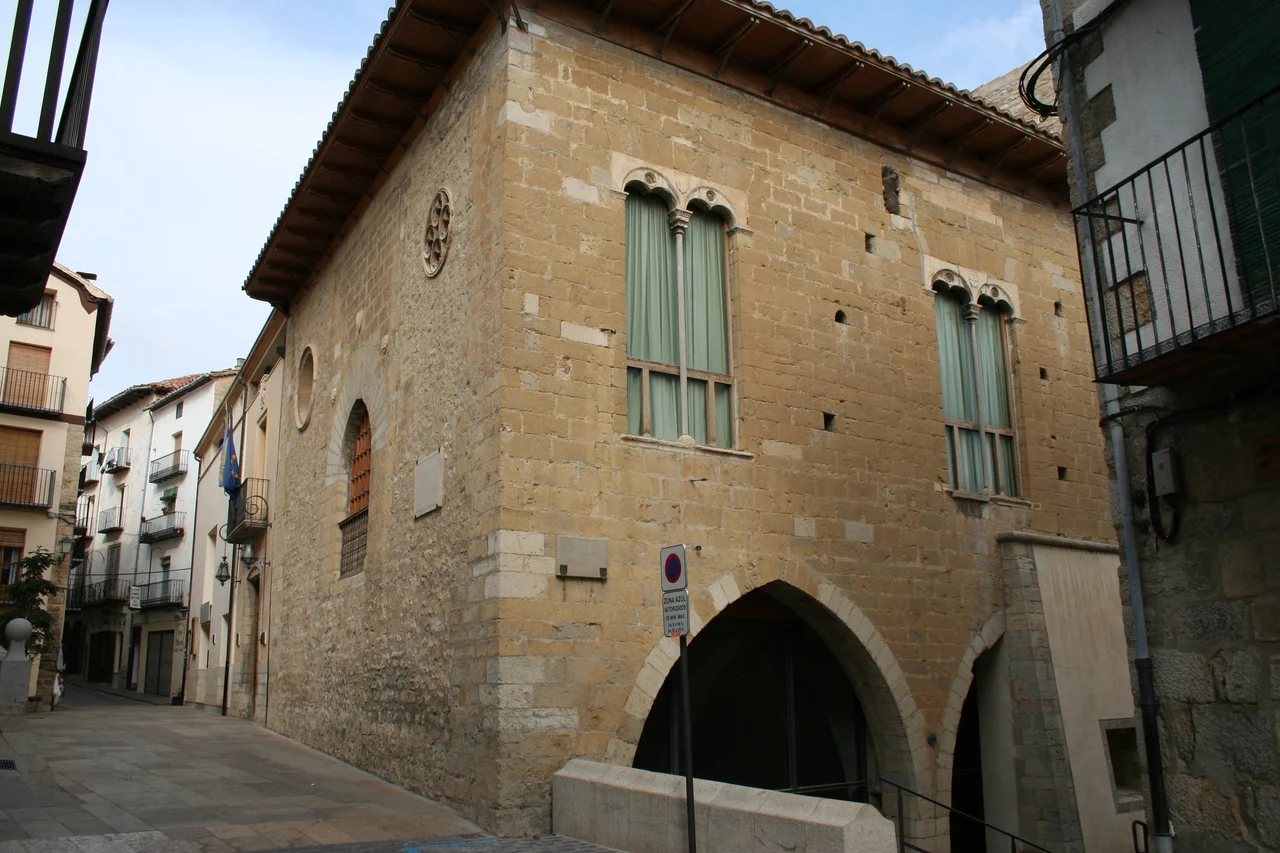
For its size, Morella is astonishingly rich in monuments. In the Convent de Sant Francesc, a Gothic fresco known as the Dansa de la Mort - the Dance of Death - still spreads across a wall, its grim procession a medieval reminder that rank and riches end the same way for everyone. The great church of Santa María la Mayor rises near the heart of the town. And on the outskirts, the tall arches of the Santa Llúcia aqueduct stride across a ravine, carrying water toward the walled streets as they have for centuries.
Wool, Truffles, and Honey
Morella has always made things. The town has herded sheep since at least the 13th century, and though the mills have long gone quiet, its distinctive striped woolen blankets are still sold through the streets, alongside knitwear made the old way. The mountains give up other treasures too: black truffles, in season from February into early March, and honey from the high meadows. Sit down to eat and you may be handed a flaó - the local pastry of cinnamon, cheese, and almonds, a small, sweet summary of a town that has always lived off its hills.
From the Air
Morella sits at about 40.62°N, 0.10°W, a walled town wrapped around a castle-topped crag in the rugged Maestrat highlands inland from the Castellón coast - one of the most photogenic hilltop silhouettes in eastern Spain, and unmistakable on a low, deliberate pass. This is broken, mountainous terrain, so keep generous clearance and expect turbulence near the ridges. Valencia (LEVC) lies well to the south and Alicante-Elche (LEAL) farther down the Mediterranean. Inland visibility is frequently excellent, though winter can settle haze or low cloud into the valleys below the town.
Nearby Stories
- Benicarló 6.2 km away
- Siege of Gandesa (1938) 12 km away
- Ilercavonia 13 km away
- Penyagolosa 27 km away
- Teruel 33 km away
- Battle of Belchite (1937) 38 km away
- Battle of Teruel 51 km away
- Corbera d'Ebre 56 km away