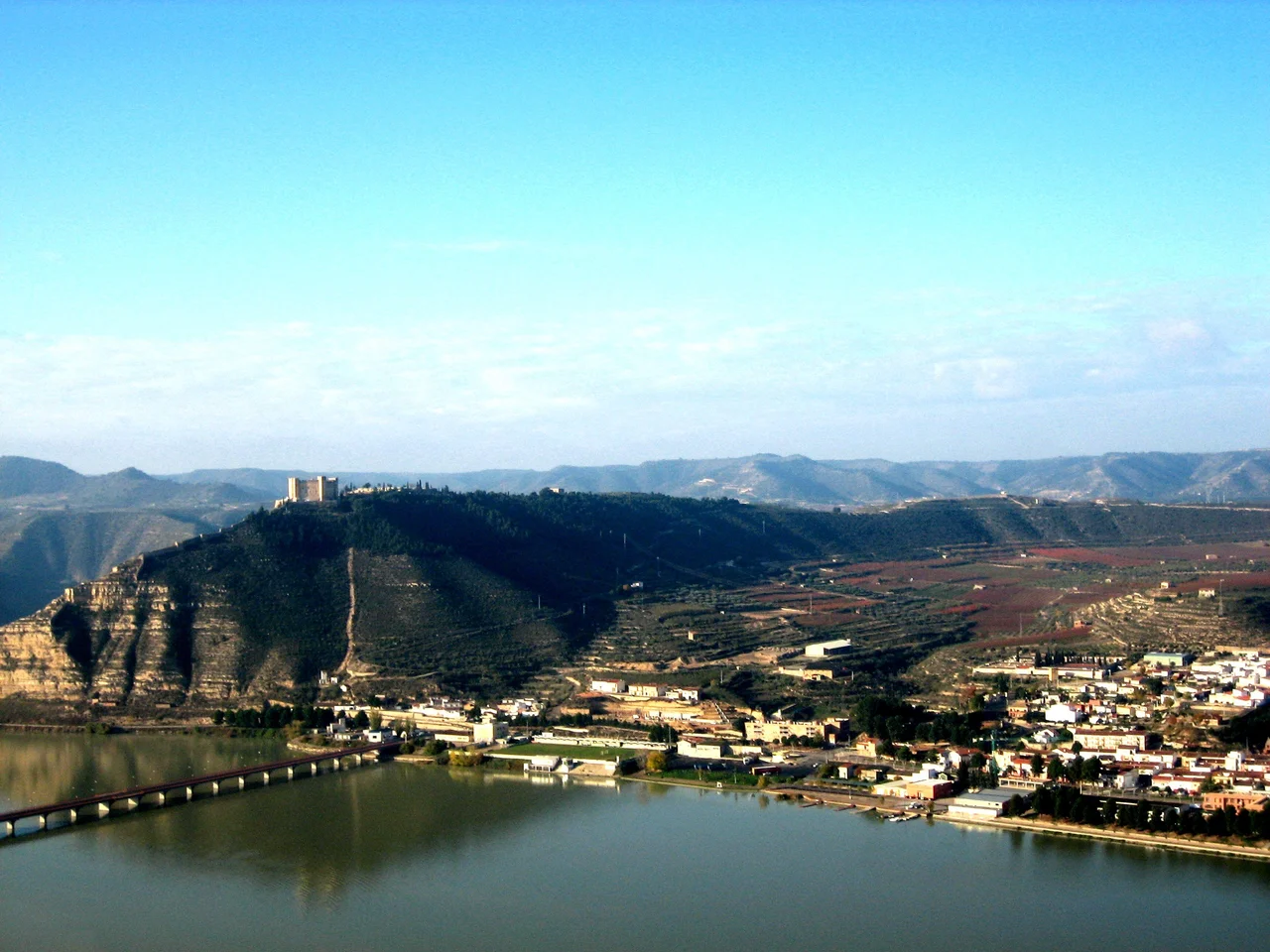

Mequinenza
Some towns stay put for two thousand years. Mequinenza moved. In the 1960s, the rising waters of a new reservoir swallowed the old streets where miners and boatmen had lived, and the people carried their town a few kilometers uphill and started again. What they left behind is still down there, a submerged memory beneath the surface the locals call the Mar de Aragón, the Sea of Aragon. Above it stands a castle that has watched armies come and go since the Romans called this place Octogesa.
Where Three Rivers Braid
Mequinenza sits at one of the great watery crossroads of the Iberian interior. The Segre falls into the Ebro here, and the Cinca joins them nearby, three rivers braiding into one broad channel between the Mequinenza Dam and the Riba-roja reservoir. That reservoir, the Mar de Aragón, was built between 1957 and 1964 and holds more than 1.5 billion cubic meters of water. The location has always mattered. The ancient Iberian city of Octogesa stood near here, and in June of 49 BC it figured in the Battle of Ilerda, when the armies of Julius Caesar and Pompey the Great maneuvered for control of the Ebro. Long before Rome, people left their marks: excavations at Los Castellets, Vallfera, and Riols traced settlement back through the Urnfield culture to the final Neolithic.
Miknasa of the Olives
The town owes its name to a Berber tribe. When the Miknasa settled here in the early 700s, they called it Miknasa al-Zaytun, Miknasa of the Olives, the same root that names the Moroccan city of Meknes. The geographer Al-Idrisi described a small place with a fortress of strong aspect, standing at the frontier of al-Andalus. That frontier held for centuries. Alfonso the Battler failed to take it in 1133, and the Almoravids clawed it back before a Catalan-Aragonese army finally won the town for good on 24 October 1149. The Moncada family later held it as a manor and raised the castle whose walls still crown the ridge, even as the villages beneath remained largely Muslim for generations after the conquest.
A Name on the Arc de Triomphe
Walk beneath the Arc de Triomphe in Paris and you will find Mequinenza carved among Napoleon's victories. The reason lies in the spring of 1810. General Louis-Gabriel Suchet, needing the Ebro for supply, sent roughly 16,000 men against a garrison of about 1,200 under Colonel Manuel Carbón. The town fell first, then Suchet turned his sixteen guns on the castle. Carbón's defenders fought through the night of 7 June, destroying three French pieces before the walls began to crumble. At ten the next morning, with roughly 500 men left, the garrison raised the white flag and marched out with the honors of war. The French Mequinenza did not last. In 1814 the Flemish-born adventurer Juan Van Halen helped win it back for Spain.
The Bloodiest Crossing
In the summer of 1938, the Spanish Civil War came to the hills above town. On the morning of 25 July, the 42nd Republican Division began crossing the Ebro here as part of the great Battle of the Ebro, aiming to seize a bridgehead and cut the road toward Maella. The fighting at the heights known as the Auts became some of the bloodiest of the entire battle. The Republican side counted roughly 3,000 casualties, and many of the soldiers belonged to the Quinta del Biberón, the baby-bottle draft, boys barely old enough to shave. Sixty years later, on 8 August 1998, the survivors returned to unveil a monument on the Alto de los Auts. Its plaque reads simply: To all those who lost, who were all.
Coal, Water, and a Town Reborn
For a century, Mequinenza ran on coal. The Carbonífera del Ebro company, founded in 1880, made the town the epicenter of a mining basin, and workers poured in from Asturias, Andalusia, Murcia, and Galicia. Between 1900 and 1920 the population nearly doubled, and mining colonies with names like Virgen del Pilar housed hundreds of families. Then the water came. When the Mar de Aragón filled, the old riverside town went under, and its residents built a new Mequinenza on higher ground. That new town has traded pickaxes for paddles and mountain bikes, becoming a hub for active tourism, fishing, and film. The submerged streets remain below, a drowned chapter that the living town has never quite let go of.
From the Air
Mequinenza lies at 41.374N, 0.303E, where the Segre and Cinca feed the Ebro into the long silver ribbon of the Mar de Aragon reservoir. From 6,000 to 9,000 feet the confluence and the dam are unmistakable, with the castle ridge standing above the water on the north bank. Reus (LERS) sits about 55nm to the southeast and Lleida-Alguaire (LEDA) roughly 25nm north-northeast; Barcelona (LEBL) is about 90nm east. Clear inland-Aragon skies usually give excellent visibility over the reservoir's distinctive branching shape.
Nearby Stories
- Serra de Montsant Natural Park 16 km away
- Palauet de la muralla de Balaguer 17 km away
- Miracle of Calanda 22 km away
- Vandellòs I nuclear incident 24 km away
- Battle of Belchite (1937) 35 km away
- Battle of Almenar (1082) 36 km away
- Zaragoza Barracks Bombing 43 km away
- Teruel 107 km away