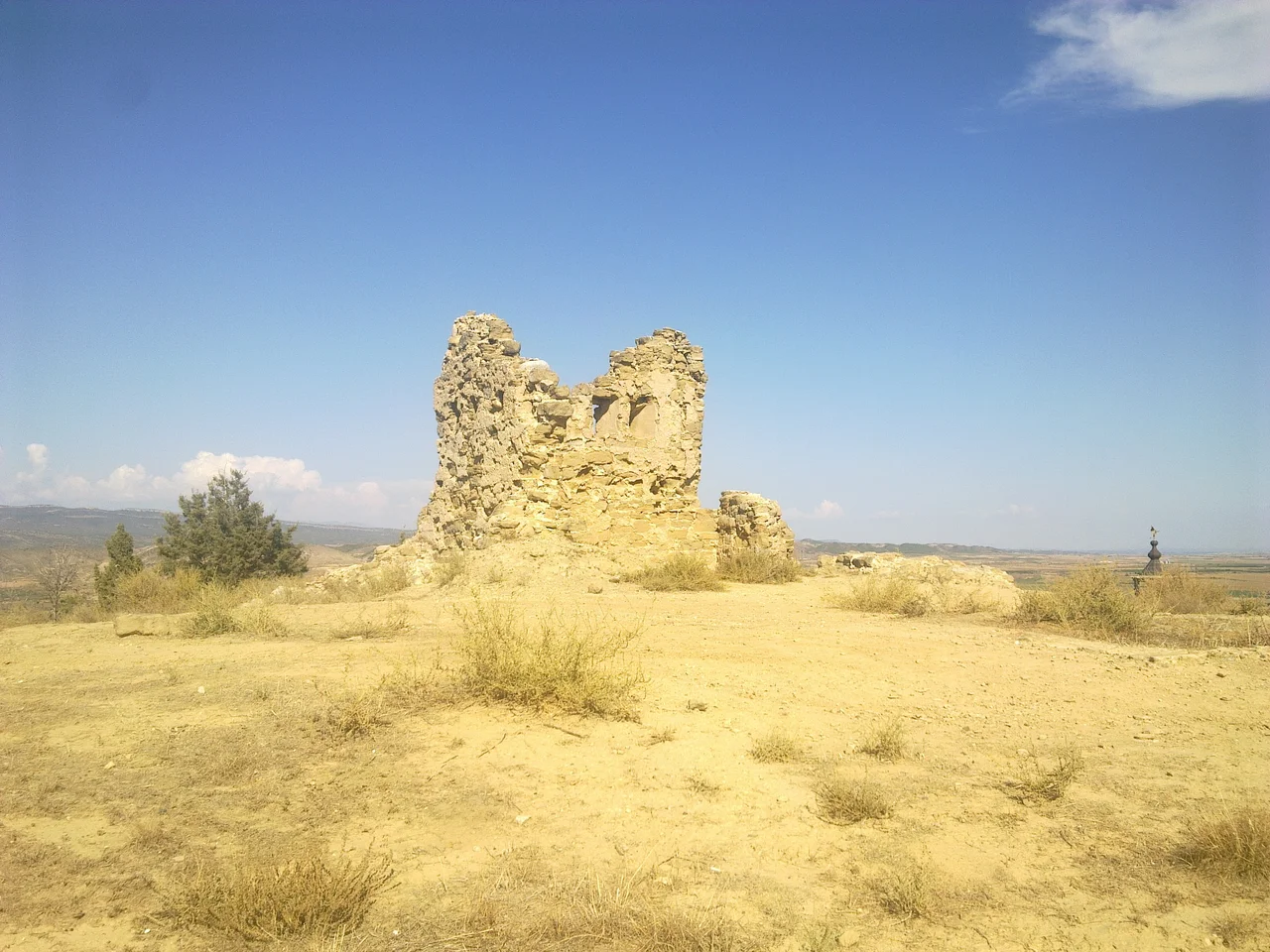

Battle of Almenar (1082)
The legend remembers El Cid as the sword of Christian Spain. History remembers that at Almenar, in the summer of 1082, he drew that sword for a Muslim king, against an army of Christian counts. Rodrigo Diaz de Vivar, the exiled Castilian knight the Arabs called al-sayyid, the lord, was by then the most feared soldier on the Ebro frontier, and he served the Muslim ruler of Zaragoza. When the rival Muslim kingdom of Lleida gathered nearly every count of Catalonia to its side and besieged a border castle, it was El Cid who rode to relieve it, and the field outside Almenar that ended in a rout no one had bet on.
A Sword for Hire
Exiled from his native Castile, Rodrigo Diaz entered the service of the Muslim taifa of Zaragoza in the summer of 1081, and quickly became its most valuable weapon. His epithet, El Cid, came from the Arabic for lord, a mark of the respect he won on both sides of a border where loyalty followed politics and pay more often than faith. This was the real frontier world behind the later legend, one in which a Christian warlord could become the trusted right hand of a Muslim emir, and in which the sharpest divisions were sometimes between one Muslim brother and another.
Brother Against Brother
The war grew out of a family quarrel. In the autumn of 1081 the ailing ruler al-Muqtadir split his realm between two sons: al-Mutamin took the western portion around Zaragoza, and al-Mundhir the eastern part based on Lleida. The brothers were soon enemies. Al-Mundhir allied with King Sancho Ramirez of Aragon and Navarre against al-Mutamin, and the allies threatened Monzon in the north of al-Mutamin's lands. El Cid's answer was a display of stunning speed and nerve. He marched seventy-five kilometres in a single day toward Monzon, negotiated the city's submission, and pressed on to take Tamarite, brushing aside the threats of King Sancho, who had sworn El Cid would never have Monzon and then declined to stop him.
The Counts Ride to Lleida's Side
The spark was a fortress. When El Cid and al-Mutamin refortified Almenar, only twenty kilometres from Lleida, al-Mundhir took it as a challenge he could not ignore, and he built a coalition to match. Almost every county of Catalonia joined him save Pallars: Barcelona, Cerdanya, Besalu, Empuries, Roussillon, a brother of the count of Urgell, and the governor of Carcassonne. Their fear was less of Lleida than of Zaragoza, whose expansion under El Cid's generalship unsettled the whole frontier. Count Berenguer Ramon II of Barcelona had a further reason to come: he had inherited the tribute of Lleida and, with it, the obligation to defend the city that paid him.
Water Running Short
While El Cid was away forcing another castle to submit, al-Mundhir and his Catalan allies marched on Almenar and besieged it, and the siege dragged on long enough that the garrison began to run short of water. Learning of the danger, El Cid sent urgent word to al-Mutamin, who left Zaragoza and joined him at Tamarite, a short march northeast of Almenar. Even then El Cid preferred cunning to battle. He talked al-Mutamin out of an immediate attack and instead sent envoys offering the besiegers money to lift the siege and go home. He judged, shrewdly, that the Catalans stood to gain no territory and might take the bribe, and he seems to have hoped to avoid shedding the blood of fellow Christians. The offer was refused. So he marched.
The Rout and the Ransom
The two armies met just outside Almenar. It began with frontal charges and turned almost at once into a rout of the besiegers; al-Mundhir fled the field, and Count Berenguer Ramon II of Barcelona was taken captive, the day's greatest prize. The number of dead and captured, one chronicle says, was enormous. The prisoners were carried to al-Mutamin at Tamarite and released five days later, most likely for a heavy ransom or a peace treaty. Zaragoza welcomed its victorious army in celebration, and al-Mutamin heaped gold, silver, and jewels on El Cid, who was thereafter regarded as second only to the emir himself. A poem written soon after by a monk in Berenguer Ramon's own territory quietly savoured the count's humiliation. Almenar itself would pass to the Aragonese eleven years later, in 1093, but its moment in the sun belonged to a Castilian exile fighting under a Muslim banner.
From the Air
Almenar lies at 41.80 N, 0.57 E, on the plain north of Lleida near the modern airport. The village and its castle hill sit amid irrigated farmland, with the low ridgelines of the Segre-Cinca frontier spreading around. Lleida-Alguaire (LEDA) is very close, only about 10 to 15 km south, making it by far the nearest field; Reus (LERS) lies roughly 100 km southeast and Barcelona (LEBL) about 150 km east. The fortified cathedral hill of Lleida, crowned by the Seu Vella, is a useful landmark just to the south. Best viewed from 3,000 to 4,000 feet in the clear, dry air of the plain; winter fog can settle low over the fields.
Nearby Stories
- Tremp Formation 11 km away
- Poblet Abbey 12 km away
- FiraTàrrega 13 km away
- Roca dels Moros 14 km away
- Montsec Range 20 km away
- Castle of Loarre 61 km away
- Battle of Belchite (1937) 66 km away
- Zaragoza Barracks Bombing 73 km away