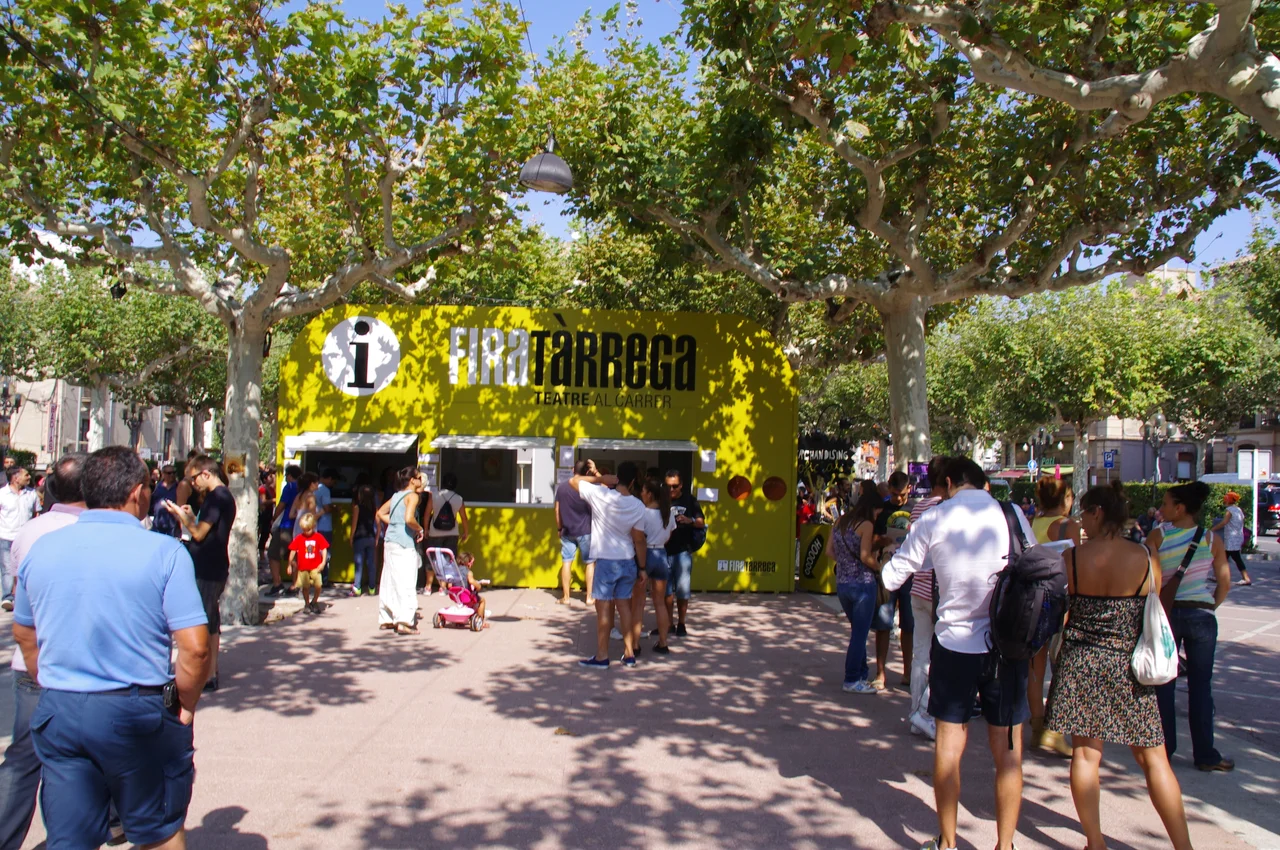

FiraTàrrega
For one long weekend every September, the medieval streets of Tarrega stop belonging to the townspeople and start belonging to the performers. Acrobats work the squares, unconventional companies stage shows in doorways and alleys, and an audience of thousands is pulled along from scene to scene until the spectators become part of the spectacle. This is FiraTarrega, held on the second weekend of the month since 1981, and it is two things at once: a joyous street party that swallows an entire town, and one of Europe's serious marketplaces for the performing arts. The genius of the place is that most visitors never notice the second thing happening inside the first.
The Town Becomes a Stage
Tarrega was, in a sense, built for this. Its compact medieval layout let the organizers concentrate the venues in the center, so the shows cluster tightly and the crowds funnel between them rather than scattering. The result is a density that turns geography into dramaturgy. The emphasis falls on street arts and on the visual and the unconventional, the kinds of performance that need open air and a passing public rather than a darkened hall. Audiences do not sit and wait; they walk, gather, and press in close, and in doing so they stop being onlookers. Bunched together in narrow streets and small plazas, they become protagonists of the event, part of the picture every company is composing.
Born With a Democracy
The timing of FiraTarrega's birth was no accident. It first appeared in 1981, in the early years after Franco, when the restoration of democratic town councils gave Spain back its public squares as places for people to gather and celebrate. Reclaiming the street was itself a political act, and a festival of open-air theatre was a fitting way to do it. The initiative came from the town's mayor, Eugeni Nadal, who wanted to turn the local festival into a grand civic fiesta and put the whole town in service of a single project. He had powerful allies: Xavier Fabregas, who ran cinema and theatre for the Generalitat de Catalunya, and Joan Font, director of the pioneering company Comediants. The idea, as Nadal framed it, was a confluence: to turn the town's ordinary local festival into a grand fiesta, to draw the townspeople in as participants rather than spectators, and to put the whole of Tarrega at the service of a single concrete project, the theatre. In the mood of those first democratic years, the ambition did not seem outsized at all.
A Catalan New Wave
The fair rode a remarkable wave. Around 1980, Catalonia produced an extraordinary burst of theatrical energy, a cluster of companies that would go on to international fame. Comediants had formed in 1978, Vol Ras in 1980; La Vella Dixieland and El Tricicle were finding their feet; and at the start of the decade came La Fura dels Baus and La Cubana, troupes whose ferocious, immersive spectacles rewrote what a performance could be. FiraTarrega gave this new generation a shop window. Positioned near the big cities but far enough away that people had to stay, it became a place where companies could show what they were doing to audiences and to each other, and where a young troupe might catch the eye that changed its future.
A Market Wearing a Fiesta's Clothes
Beneath the fire and the stilts runs a working economy. FiraTarrega's stated purpose is to boost the performing arts market and open doors to the wider world for the companies who appear here, accompanying emergent artists, encouraging training, and knitting together the transnational networks along which street shows travel and get produced. Programmers, producers, and agents move through the crowds doing the quiet business of the trade. The fair's stated aims are frankly practical: to accompany and promote emerging artists, to encourage training in artistic creation and cultural management, and to weave the strategic alliances through which street productions get built and booked across borders. The calendar helps everything along: falling at the end of summer, on the last weekend before schools go back, it catches a country in a holiday mood. That is the enduring trick of the place, a serious international fair disguised as the best party a small Catalan town throws all year.
From the Air
Tarrega sits at 41.646 N, 1.139 E, on the plain of the Urgell in the interior of Catalonia, roughly midway between Lleida and Barcelona. From 3,000-5,000 feet AGL the town core stands out amid a patchwork of irrigated farmland, with the long ridge of the Montsec range to the north and the hills toward Cervera to the east. Nearest airport is Lleida-Alguaire (LEDA) to the west; Barcelona-El Prat (LEBL) lies to the east and Reus (LERS) to the south. The flat Urgell plain offers wide, easy sightlines in clear weather.
Nearby Stories
- Battles of El Bruch 2.1 km away
- Món Casteller Human Tower Museum of Catalonia 3.1 km away
- L'Aplec del Caragol 7.5 km away
- Autódromo de Sitges-Terramar 8 km away
- National Day of Catalonia 26 km away
- Patum de Berga 31 km away
- Miravet 31 km away
- Battle of Graus 49 km away