
Battles of El Bruch
According to the story Catalans have told for two centuries, a French army was routed here by a boy with a drum. As Napoleon's soldiers pushed toward El Bruc in the summer of 1808, a young drummer beat his instrument in the passes below Montserrat, and the mountain's serrated rock walls caught the sound and threw it back, multiplied and rolling, until the French were convinced a vast army waited in the hills ahead. They turned and fled. The drummer, remembered as Isidre Lluçà i Casanoves, may be more legend than history. The battles themselves were entirely real, and against every expectation, the Catalans won them both.
A Peninsula in Revolt
In May 1808, Napoleon's maneuvering had cleared the way for his brother to take the Spanish throne, and Madrid erupted in fury. The Dos de Mayo uprising was crushed in the capital, but it lit a fire across the whole Iberian Peninsula, and ordinary Spaniards took up arms against French occupation in what became the Peninsular War. Catalonia was no exception. The French held Barcelona and needed to keep their supply roads open toward Lleida and Zaragoza, which meant pushing westward through the rugged country around Montserrat. Standing in their way were not professional armies but the sometent, the traditional Catalan militia of villagers who mustered at the sound of the church bells, stiffened by a few hundred foreign soldiers who had left the Barcelona garrison. For the French, the country here was a nightmare of steep passes and hidden defenders who knew every path, the opposite of the open ground where Napoleon's tactics excelled.
The Sixth of June
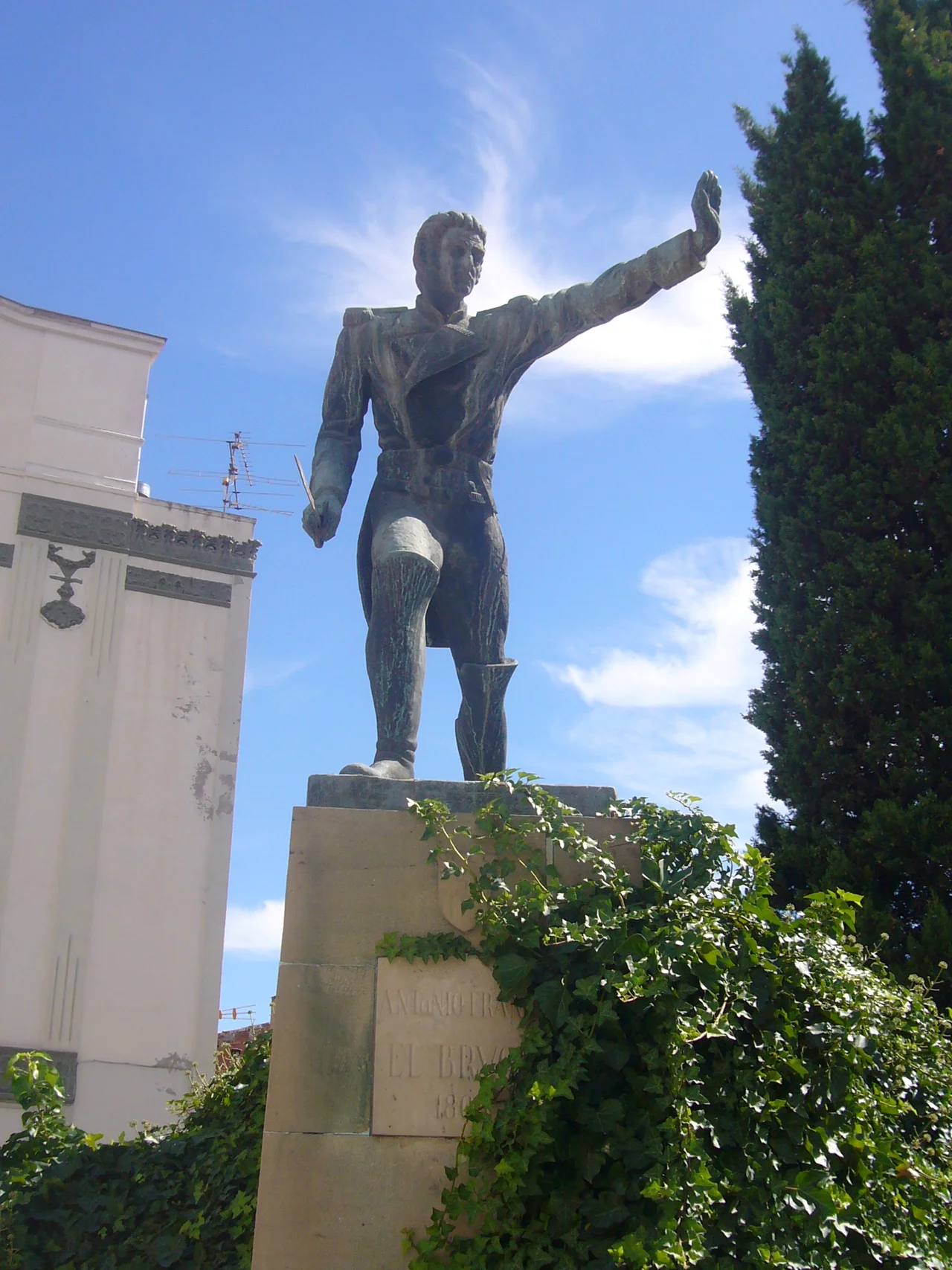
On 4 June, a French column of 3,800 men under Brigadier General François de Schwarz marched out of Barcelona. A heavy rainstorm turned the roads to mud and slowed them badly, and that delay proved decisive. It gave the Catalan defenders time to gather, roughly two thousand strong, a mix of village militia, sometent volunteers, and Swiss and Walloon troops from the city garrison, all under General Antoni Franch i Estalella. They took up positions along the narrow Bruc Pass and waited. When the French arrived, the defenders held, and the attackers broke. Schwarz's column was thrown back toward Barcelona having lost 360 dead, 800 wounded, and 60 prisoners, along with a captured gun. Most stinging of all, the Catalans seized a French Imperial Eagle, the gilded standard Napoleon's regiments were sworn to defend to the death.
The Drum in the Mountains
How did farmers and militiamen scatter a column of Napoleon's army? The answer Catalonia chose to remember was a boy and a drum. In the retelling, the echo of a lone drummer rebounding off Montserrat's jagged peaks made the French believe an enormous force was bearing down on them. Whether or not any single drummer decided the day, the legend fastened onto something real. Montserrat's strange, saw-toothed silhouette dominates this landscape, and the mountain had long been a spiritual heart of Catalonia. Tying the victory to that peak made El Bruc more than a skirmish. It became proof that the land itself had risen to defend its people. The drummer, later given the name Isidre Lluçà i Casanoves, became a folk hero, and locals still say his echo lingers among the rocks.
The Fourteenth, and After
The French were not finished. On 14 June a second and larger force under General of Division Joseph Chabran marched on El Bruc, but the Catalans, now led by Joan Baget, defeated and repelled them again. The frustrated French managed only to set fire to several buildings in the village before withdrawing. The next day the defenders harried the retreating column back toward Barcelona, inflicting more than 500 casualties. Two improvised victories in a single week had humbled a modern army. From here Catalan resistance shifted toward conventional warfare, and the fighting moved on to the grinding siege of Girona. El Bruc gave the wider Spanish revolt something priceless in its opening weeks: proof that Napoleon's soldiers, thought invincible, could be beaten by determined people defending their own ground.
From the Air
El Bruc sits at 41.58°N, 1.780°E, at the eastern foot of Montserrat, roughly 45 km northwest of Barcelona. The unmistakable landmark is Montserrat itself, its serrated grey pinnacles rising abruptly from the plain just west of the battlefield. Best appreciated from 2,500–4,000 ft AGL, giving a clear line on both the mountain and the old Bruc Pass road below. Sabadell (LELL) lies about 25 km east, Barcelona-El Prat (LEBL) some 45 km southeast on the coast, and Girona (LEGE) about 90 km northeast. Terrain rises sharply toward Montserrat; watch for mountain turbulence and afternoon cloud building on the peaks.
Nearby Stories
- Cau Ferrat Museum 13 km away
- Món Casteller Human Tower Museum of Catalonia 14 km away
- Cervera 15 km away
- Castle of Cardona 22 km away
- El Celler de Can Roca 34 km away
- Tremp Formation 41 km away
- Fageda d'en Jordà 64 km away
- Cap de Formentor 163 km away