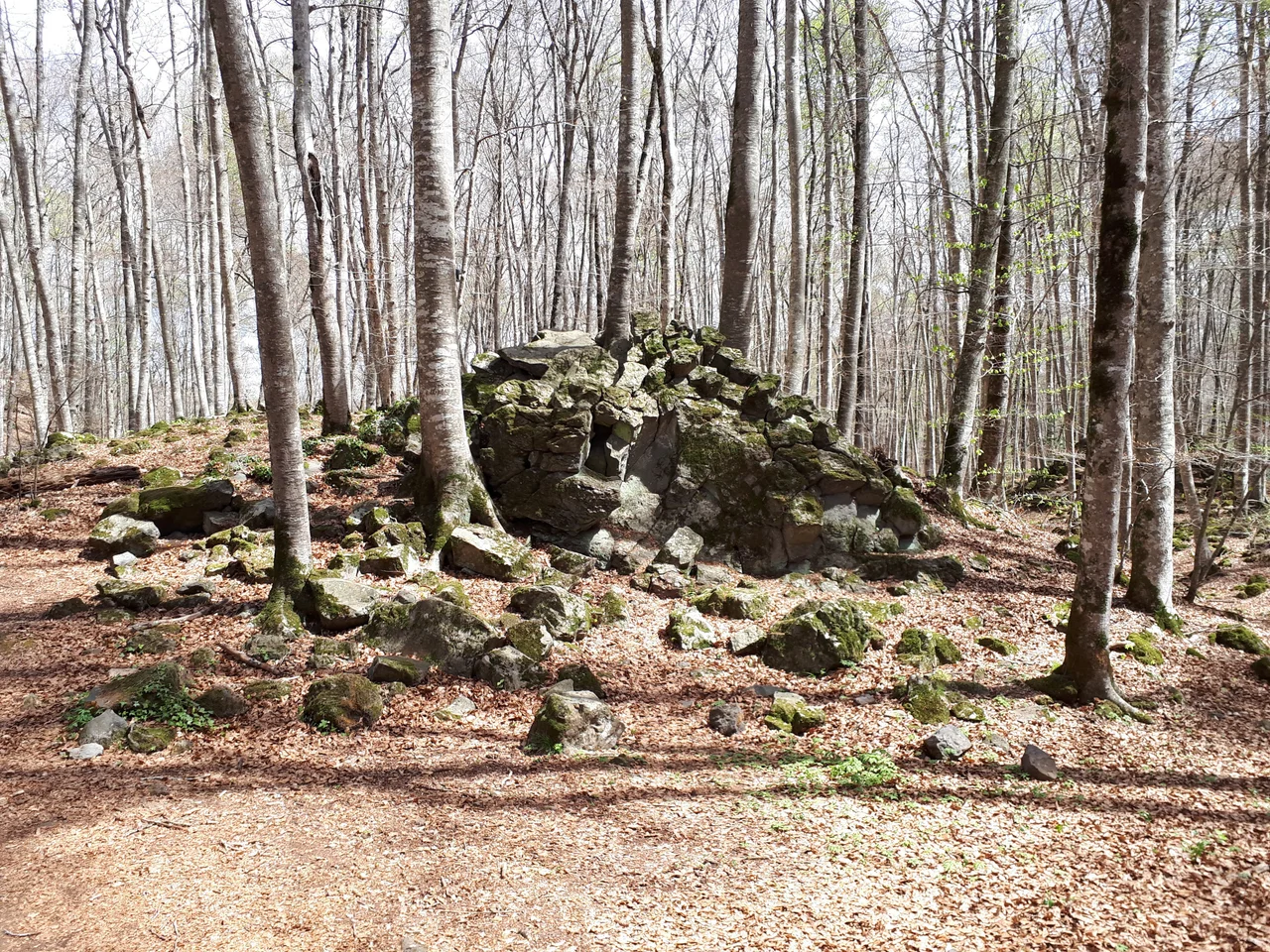

Fageda d'en Jordà
Beech forests belong to cool mountain slopes. This one lies almost flat, its silver trunks rooted in stone that was once molten. The Fageda d'en Jordà grows on a lava flow, a cooled river of rock that poured from the volcano called Croscat and then, over thousands of years, gathered enough soil to raise a forest. Walk into it and the ground rolls beneath the trees in low green mounds, the surface of an eruption frozen mid-motion and softened by moss and centuries of fallen leaves. It is a woodland that has no business existing where it does.
A Forest on Frozen Fire
What makes this beech wood so unusual is not the trees but the floor beneath them. It grows on a hardened lava flow from the Croscat volcano, at an altitude of only 550 to 650 meters, low for a beech forest in the Mediterranean part of the Iberian Peninsula. Across roughly 4.8 square kilometers, the ground is dimpled with tossols, small volcanic spatter cones that can rise more than 20 meters, so the woodland undulates in a way no ordinary forest does. The beech, Fagus sylvatica, would normally demand higher, cooler ground. Here the porous volcanic rock holds moisture, the local air stays damp, and the trees flourish anyway. The result is a genuine rarity: a lowland hall of beech standing on the frozen bones of an eruption.
The Poet's Grove
Part of the forest's fame is literary. The Catalan poet Joan Maragall wrote a well-known poem about this exact place, La fageda d'en Jordà, and a monolith raised in his honor now marks the main entrance beside the Can Serra car park, at kilometer 4 of the road from Olot to Santa Pau. The forest is protected from the very noise it inspired against. Motor vehicles are banned inside, so the only ways through are on foot, on horseback, or in an old horse-drawn carriage you can hire at kilometer 7. That silence is the point. Filtered green light, the creak of trunks, the soft give of mossy volcanic ground underfoot: the fageda is a place built for slow attention, exactly as the poet found it more than a century ago.
Among Forty Volcanoes
The forest sits inside one of Europe's most striking volcanic landscapes. It spreads across parts of the municipalities of Santa Pau, Olot, and Les Preses, about 5.5 kilometers from Olot, within the Garrotxa Volcanic Zone natural park, ringed by several of the region's more than 40 volcanoes. This is a dormant land, not a dead one, its cones long since softened by vegetation. The climate is generous by Mediterranean standards, with 900 to 1,000 millimeters of rain a year and a cool, humid air that carries something of the Atlantic. The beeches thrive on slightly north-facing ground and recent reddish clays and andosols, volcanic soils that hold water where the surrounding lowlands would run dry. In autumn the canopy turns copper and gold; in summer it stays deep and shaded while the plains beyond it bake. It is a pocket of northern forest surviving exactly where the map says it should not.
The Farmhouse and the Cooperative
The forest takes its name from the Can Jordà farmhouse at one edge, and the human story here is as quietly remarkable as the geology. That farmhouse is now a conservation center devoted to plants in danger of vanishing, cultivating threatened fruit trees and dwindling crops, among them certain varieties of buckwheat. Nearby, within the forest itself, works the La Fageda cooperative, which produces dairy foods and was founded to give meaningful, paid work to people with intellectual disabilities and mental illness. It has grown into one of Catalonia's best-loved social enterprises, its yogurts sold across the region. The pairing feels exactly right for this place. A forest thrives against the odds on cooled lava, and beneath its canopy people build good work and good food against the odds as well, each rooted in ground that had every reason to stay barren.
From the Air
The Fageda d'en Jordà lies at 42.15°N, 2.514°E in the Garrotxa volcanic zone of inland Catalonia, just southeast of Olot. Recommended viewing altitude is 3,000-5,000 ft AGL. From the air the forest reads as a dense, low canopy on flat ground; the best navigation reference is the nearby Croscat volcano, whose deeply quarried red-and-black cone is unmistakable, along with the town of Olot to the northwest and Santa Pau to the south. Nearest airport is Girona-Costa Brava (LEGE), about 40 km east; Barcelona-El Prat (LEBL) and Sabadell (LELL) lie farther southwest. This is high-rainfall country, so expect frequent cloud; best visibility on clear days after weather passes.
Nearby Stories
- Dan-Air Flight 1903 15 km away
- Patum de Berga 22 km away
- Cave of Saint Ignatius 26 km away
- Abbey of Saint-Martin-du-Canigou 27 km away
- Château de Montségur 61 km away
- Langlois Bridge at Arles 186 km away
- Cala Morell Settlement 207 km away
- Arles Amphitheatre 212 km away