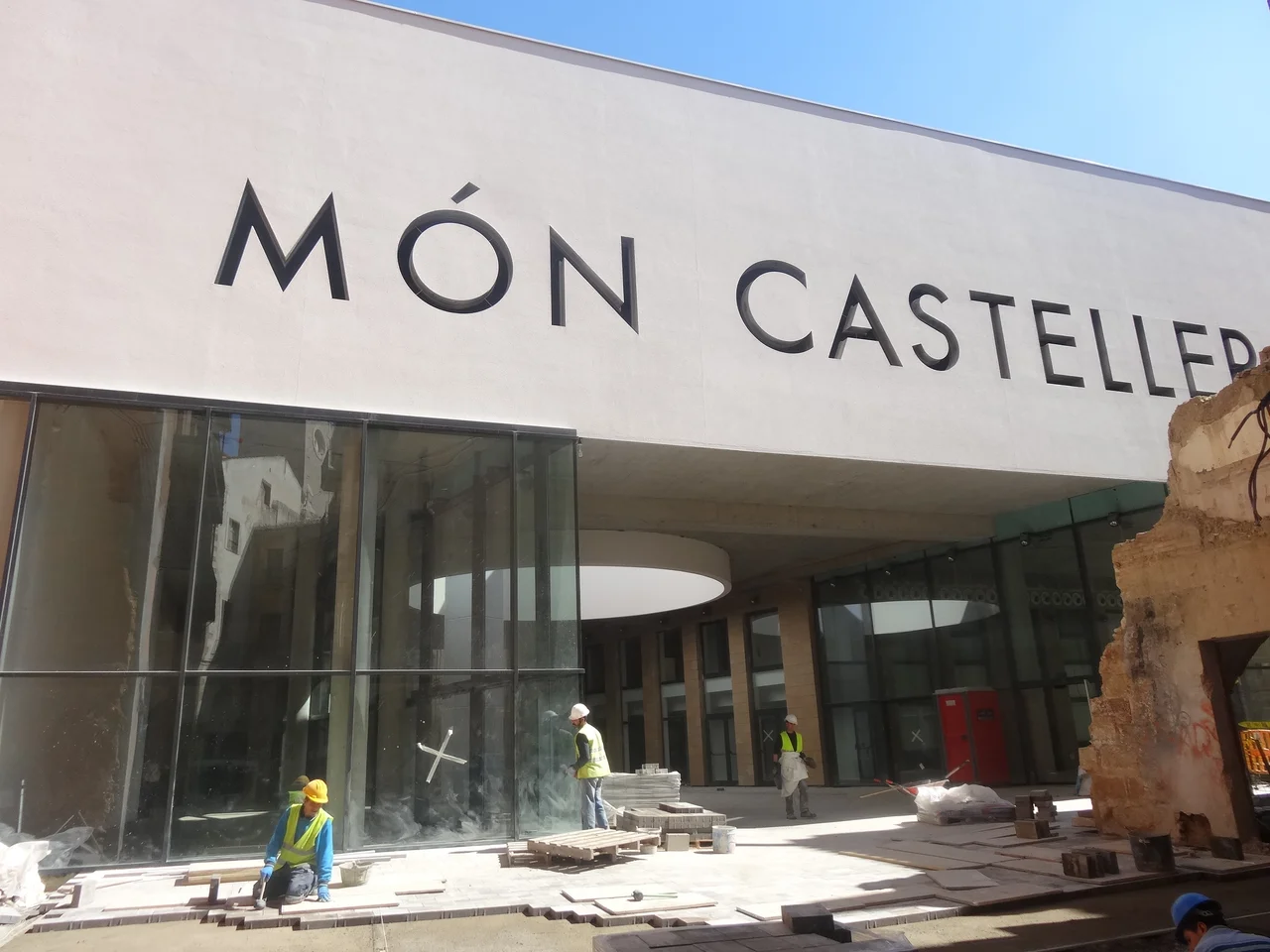

Món Casteller Human Tower Museum of Catalonia
The child at the very top is called the enxaneta, and when they scramble up over the shoulders of strangers, past the eighth and ninth levels, and throw one hand toward the sky, the whole crowd below holds its breath. This is a castell, a human tower raised body upon body until people become architecture. The tradition was born in the streets of Valls, an inland Catalan town its own castellers call the 'zero point.' In 2023, after nearly half a century of false starts, Valls finally opened a museum equal to it: Món Casteller, built on the very square where the towers first rose.
Zero Point
Valls sits in the hills of the Alt Camp, of which it is the capital, and castellers everywhere trace their tradition back to its Plaça del Blat. Human towers have climbed into the air above that square for generations, crowds packing themselves into the dense base called the pinya so that others can climb their shoulders. The spirit of the practice is captured in four Catalan words, força, equilibri, valor i seny, meaning 'strength, balance, courage and good sense,' a motto drawn from Josep Anselm Clavé's 1867 poem about the young tower-builders of Valls. In 2010, UNESCO recognized the castells as Intangible Cultural Heritage of Humanity, confirming what Valls had always claimed: that something extraordinary began here.
Half a Century of False Starts
The museum took almost as much patience as a ten-level tower. The idea belonged first to Pere Català Roca, a Valls historian and photographer who was campaigning for a human-tower center as far back as the late 1950s. Exhibitions followed in 1964 and 1968, and he pressed the cause again at the 1977 Congress of Catalan Culture. A board met for the first time in 1978. Then came the wandering years: a permanent display opened in the Can Segarra building in 1985 only to close two seasons later over structural faults, and later plans drifted to an old military barracks and then to a site outside town entirely. Not until 2013 did the project come home, back to the Plaça del Blat, the zero point itself.
Raising the Building
Even the construction became a casteller act. In 2014, twenty-nine aging properties on the site were taken down by hand, one by one, to clear the ground. When the work was formally launched on 27 March 2015, there was no lone official with a golden shovel; instead forty-five human-tower groups gathered on the spot and raised thirty-four pillars at once, and an aerial-dance company performed high on fifteen-meter scaffolding, turning the values of the castell into choreography. Only then did the builders begin the shell of the museum that would rise where those towers had just stood.
A Tower in Three Acts
The finished building refuses to be a sealed box. It threads between two arcaded medieval squares, the Plaça del Blat and the Plaça de l'Oli, preserving the old streets' continuity while opening a new circular plaza in their midst. Above it stands a twenty-meter pillar of light, a lighthouse whose colors shift to echo the different shirts worn by rival colles. Inside, the exhibition unfolds as 'a tower in three acts': the courage and vertigo of the enxaneta, the balance and good sense that hold a tower together, and finally the burst of joy when it stands complete and comes safely down. From the roof terrace, visitors look out toward the tallest bell tower in Catalonia.
The Weight and the Trust
What the museum ultimately tries to bottle is not a fact but a feeling. A castell only holds because hundreds of people trust one another completely: the crowd pressed shoulder to shoulder in the base, the climbers stacked above them, and the child at the very top who cannot succeed unless everyone below has held firm. It is a portrait of a whole community in a single upright act, which is why the tradition matters far beyond the sport of it. Món Casteller sets that idea at the heart of Valls, a few steps from where the first towers rose, so that visitors leave understanding why a town would spend half a century determined to honor a thing built of nothing but people.
From the Air
Món Casteller stands at about 41.284°N, 1.248°E in the old town of Valls, inland from the Tarragona coast. Look for the town's dense medieval core and the tall bell tower of Sant Joan, said to be the highest in Catalonia, which rises beside the museum and its 20-meter pillar of light. Reus (LERS) lies roughly 20 km to the south-southwest, Barcelona (LEBL) about 80 km to the northeast, and Lleida-Alguaire (LEDA) inland to the northwest. A viewing altitude of 2,000 to 3,000 feet shows Valls set among the vineyards and hills of the Alt Camp; clear, dry days offer the sharpest look at the compact town center.
Nearby Stories
- Autódromo de Sitges-Terramar 2.7 km away
- Battles of El Bruch 11 km away
- Vallbona Abbey 13 km away
- L'Aplec del Caragol 16 km away
- Tortosa Cathedral 22 km away
- Miravet 22 km away
- Vandellòs I nuclear incident 31 km away
- Sa Calobra 152 km away