
L'Aplec del Caragol
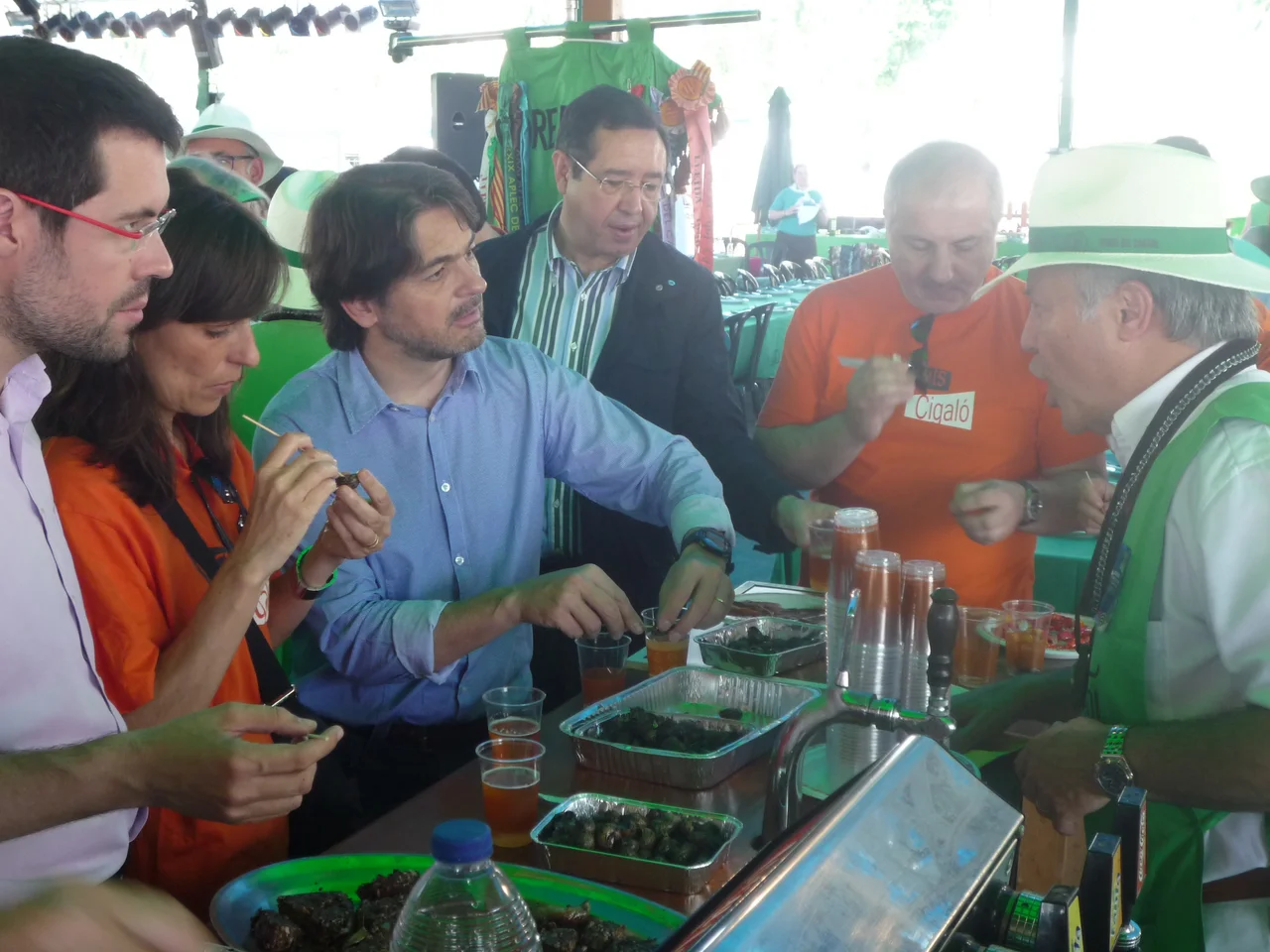
On a May weekend, the poplar groves along the Segre fill with woodsmoke, garlic, and the low hum of a city at play, and at the center of it all sits the humble snail. This is L'Aplec del Caragol, Lleida's great snail gathering, where hundreds of clubs pitch their stands along the river and the city's riverside park to cook, eat, sing, and parade. In 2010, some 200,000 visitors came and twelve tons of snails were eaten, shipped in from Spain, North Africa, and South America to meet the appetite. It is a feast, a music festival, and a civic ritual folded into a single weekend, and it has been growing for more than forty years.
Twelve Tons of Snails
The snail is the undisputed protagonist. Across the festival grounds, the local clubs, the colles, set up their cooking stations and prepare the caracoles the way Lleida likes them, drawing crowds that measure in the hundreds of thousands. The scale is almost hard to picture: twelve tons of snails consumed over a single weekend, sourced from three continents because no single region could supply enough. Around the cooking, the air carries garlic, grilled meat, and wine, and the eating is unhurried and communal, families and friends elbow to elbow at long tables. Cooking snails for a crowd this size is its own kind of engineering, and the smell of it, garlic and woodsmoke drifting through the poplars, becomes the unmistakable signature of the Aplec weekend. It is gastronomy as public celebration rather than fine dining, a dish that most of the world overlooks turned into the heart of a city's biggest party.
From Eighteen Clubs to a City-Wide Rite
The Aplec was born in 1980, when about twelve clubs put together an event with a parade through Lleida. Its mother club was the Order of the Caragol, which gathered a group of eighteen clubs to spend a day on the shore of the Segre and asked the city council for permission to hold the gathering in the poplar grove by the river in the Cappont neighborhood. That first year drew roughly 300 club members and 4,000 visitors. The idea caught almost immediately. By the following Aplec, 34 clubs and 2,300 participants had registered, and in 1981 a second, autumn version, the Aplequet, appeared on the first weekend of October, gathering as many as sixty clubs in tribute to the celebration's one-day origins.
More Than a Meal
Snails may be the excuse, but the Aplec has always been about far more than food. The weekend fills with concerts, brass bands, and the raucous charanga music that follows the crowds through the streets, alongside parades and the towering castells, the human towers that are one of Catalonia's proudest traditions. Music runs deep in the event's history: by its fourth year the festival had recorded an album of Lleida folk songs, including one written for the snail itself, and a new edition followed in 1990. In 1986 the Aplec was folded into Lleida's Festa Major, and in 1997 it added its first Cultural Week and its first Caragol Rock, bringing bands like Terrorvision to the riverside.
A Record and a Return
The festival has never been shy about spectacle. On 8 May 1988, a week before that year's Aplec, Lleida claimed a place in the Guinness Book of Records by assembling the world's largest tray of snails. Six years later, in 1994, the gathering held its first democratic assembly, a sign of how thoroughly the loose collection of clubs had grown into a lasting institution. Like nearly every communal celebration, it went quiet during the pandemic, pausing across 2020 and 2021, before the crowds returned to the poplar groves. What began as a single day on the riverbank had, by then, become a fixture of the Lleida calendar, an event the whole city measured its spring against. Four decades on, the Aplec remains what it started as: a city gathering by its river to cook, to sing, and to make an unlikely delicacy the centerpiece of its year.
From the Air
L'Aplec del Caragol takes place at 41.61 N, 0.63 E along the Segre in Lleida, on the riverside park and poplar groves near the Cappont side of the river. From the air in May, look for the festival's dense grid of stands and tents strung along both banks, with the Seu Vella cathedral crowning the hill just to the north as the fixed landmark. Lleida-Alguaire (LEDA) is the nearest field, about 15 km northwest; Reus (LERS) lies roughly 90 km southeast and Barcelona (LEBL) about 150 km east. Late-spring afternoons over the Segre plain are typically clear and warm, ideal for picking out the river and the old town from 3,000 to 4,000 feet.
Nearby Stories
- Vallbona Abbey 6 km away
- Món Casteller Human Tower Museum of Catalonia 16 km away
- Serra de Montsant Natural Park 24 km away
- Roca dels Bous (archaeological site) 27 km away
- Tremp Formation 31 km away
- Battle of Belchite (1937) 63 km away
- Zaragoza Barracks Bombing 73 km away
- Castle of Loarre 74 km away