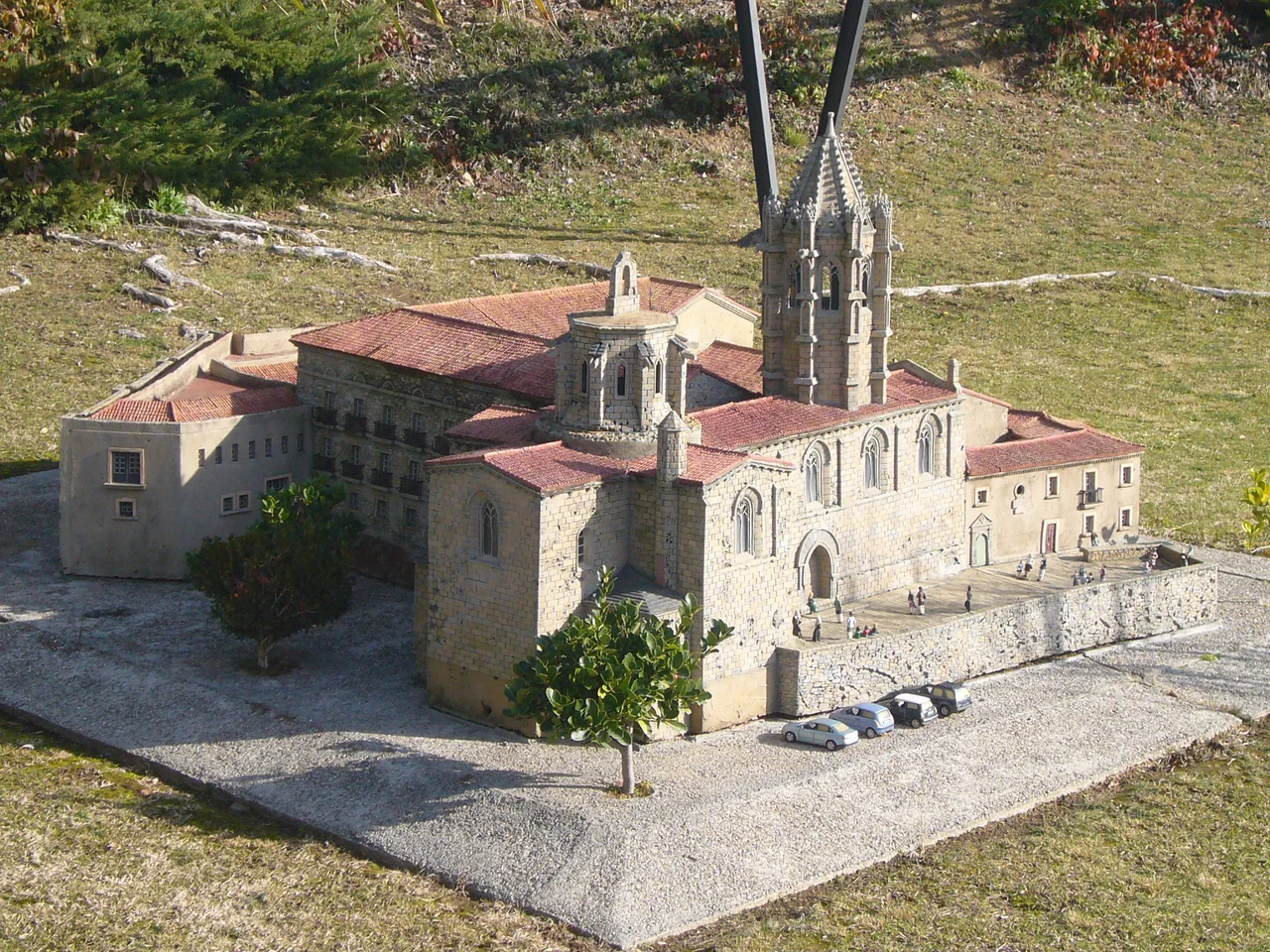

Vallbona Abbey
Walk once around the cloister at Vallbona and you walk through four hundred years. Each of its four sides was built in a different era and a different style, and because the builders never coordinated across the centuries, the wings do not even match in length. The south range is sober early Romanesque; the east, a little younger, opens in triple windows whose small rose openings carry decoration in an Arabic manner; the north is Gothic, its tracery pointed; the west, the last to rise, is proto-Renaissance. Stand in the middle of this quadrangle and you are standing at the center of a slow conversation between generations of stonemasons, held in a village so defined by this place that it is called Vallbona de les Monges, Vallbona of the Nuns.
From Hermits to Nuns
The community began as something looser than an abbey. In its earliest form, documented from 1157, it was a settlement of hermits of both sexes gathered around a founder named Ramon de Vallbona, living by the Rule of Saint Benedict in the hills of Urgell. It might easily have faded. By 1175 only a small group of nuns remained, and they made a decisive choice: to affiliate themselves with the Cistercian Order and continue as a female house. The following year their first abbess, Oria Ramirez, arrived from Tulebras Abbey in distant Navarre to lead them. A gift of land in 1163 from Ramon Berenguer IV, count of Barcelona, had already given the fragile community roots. What survived was a monastery run by women, and it would endure for centuries.
Kings, Popes, and Protection
A small nunnery in the hills needed powerful friends, and Vallbona found them. King Alfonso II of Aragon and his queen, Sancha of Castile, granted it privileges, and noble families across the region poured in gifts that let it grow. From Rome came something even more valuable than money: Pope Innocent III extended papal immunity and protection around 1200, and a bull of 1201 regulated the enclosure and guaranteed the abbey's independence from the local bishop, letting the women govern their own affairs. For a house of women in the Middle Ages, this pairing of self-rule with powerful patronage was a rare and durable foundation. King James I of Aragon stayed here repeatedly and personally sponsored the construction. This layering of royal and papal favor is written into the buildings, including a church whose architecture marks the very transition from Romanesque to Gothic. In 1931 it was declared a national monument.
Names in the Floor
Vallbona keeps its dead close, and many of them are women. In the southern aisle lies the tomb of Ferrer Alamany de Toralla, who died in 1360, and his wife Beatriz de Guimera; he is carved on the lid as a gentleman bearing his heraldry, while she appears on one side in the Cistercian habit she wore in life, and beneath them two angels lift a soul toward heaven. The northern wall holds five sarcophagi; on two the names can still be read, Sibil-la de Guimera and Miquela Sasala, the latter dated 1244. The chapter hall, entered through a Gothic gate built under the abbess Anglesola in the 14th century, is paved with the tomb slabs of abbesses, and the western cloister carries the heraldry of the Caldes family, who supplied the monastery's leaders in that age. Here, unusually for a medieval institution, it is women whose names and faces are set permanently into the stone.
A Route of Three Abbeys
Vallbona does not stand alone. Together with the great monasteries of Poblet and Santes Creus, it forms the Cistercian Route across this corner of Catalonia, three houses that shaped the region's faith, land, and art. Its treasures reward a close eye. In the chapel of Corpus Christi stands an image of the Virgin Mary in polychrome stone by Guillem Seguer, and from that same altar two 14th-century antependia now hang in the National Art Museum of Catalonia. In the chapter hall, an alabaster Virgin of Mercy is attributed to the sculptor Pere Johan. The main portal, facing the abbey square, gathers five archivolts around a tympanum of the Virgin and Child ringed by angels, a doorway that has welcomed pilgrims for the better part of a thousand years.
From the Air
The abbey lies at 41.525 N, 1.088 E, in the village of Vallbona de les Monges among the low hills of the Urgell, in inland Lleida province. From 3,000-5,000 feet AGL, look for the small village clustered tightly around the pale stone bulk of the monastery church and its tower, set amid dry farmland, almond groves, and vineyards, with the Montsec range on the far northern horizon. Nearest airport is Lleida-Alguaire (LEDA) to the northwest; Reus (LERS) lies to the south and Barcelona-El Prat (LEBL) to the east. Clear, dry air over the interior gives strong visibility most of the year.
Nearby Stories
- Battles of El Bruch 2.1 km away
- Món Casteller Human Tower Museum of Catalonia 3.1 km away
- L'Aplec del Caragol 7.5 km away
- Autódromo de Sitges-Terramar 8 km away
- National Day of Catalonia 26 km away
- Patum de Berga 31 km away
- Miravet 31 km away
- Battle of Graus 49 km away