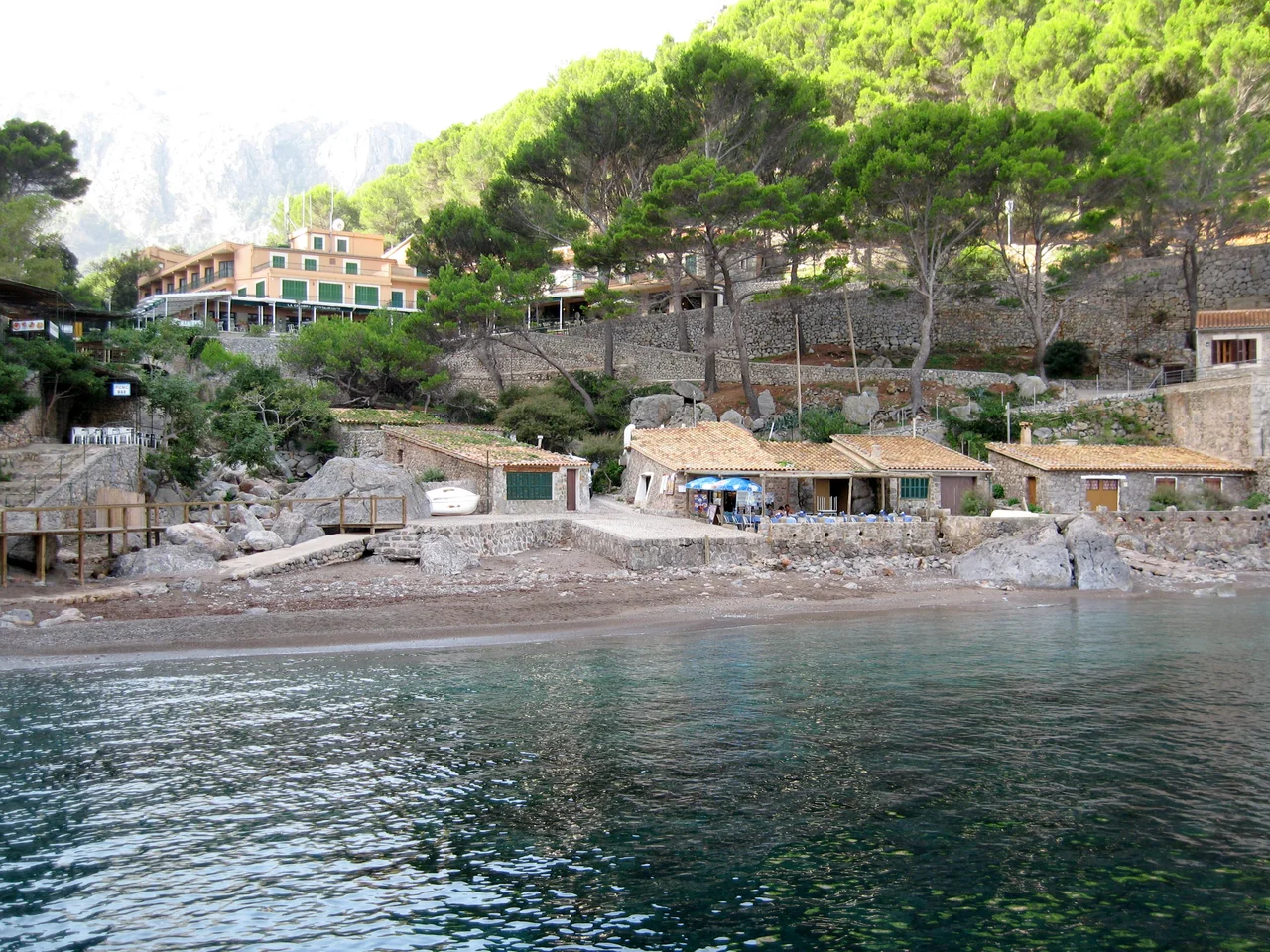

Sa Calobra
Antonio Parietti built a road that ties itself into a knot. To reach the tiny coastal village of Sa Calobra, on Mallorca's rugged northwest shore, you must descend a single ribbon of asphalt that folds back on itself so completely that at one point, a 270-degree loop called the Nus de sa Corbata, the tie knot, the road passes underneath itself, the upper lane visible through an arch from the lower. Parietti opened it in 1933, and he did something almost unheard of for the era: he engineered it not for commerce or convenience, but for the sheer pleasure of the drive.
An Engineer Who Followed Donkeys
Parietti, an Italian-Spanish engineer, faced a genuine problem. Sa Calobra sat at the foot of near-vertical cliffs with no practical way in. Rather than blast a tunnel, he chose to write the road across the mountainside in a series of tightly stacked switchbacks, close to thirty hairpin bends dropping some 800 meters over about twelve kilometers. To find the gentlest line down the cliffs, he is said to have followed the paths of donkeys, trusting the animals' instinct for grade and footing. The road descends from the Coll dels Reis, a pass at 682 meters, all the way to the sea. Parietti went on to design other celebrated Mallorcan roads, including the serpentine route out to the Cap de Formentor at the island's northern tip.
The Tie Knot
The road's signature moment is the Nus de sa Corbata. Needing to shed elevation in a space too tight for ordinary switchbacks, Parietti curled the road through a full 270 degrees and ran it beneath its own carriageway, so that a driver briefly passes under the very stretch just traveled. Seen from above, it looks exactly like its name: a length of ribbon knotted around the mountain. It is the kind of flourish that makes engineers smile and passengers reach for cameras, and it helped earn the road a reputation as being about as close to a perfect course for motorsport as a public highway gets. Cyclists treat the long climb back up as a rite of passage; coaches inch down it in low gear, mirrors folded.
Where the Mountains Meet the Sea
The reward at the bottom is a place the road could never have improved on. Sa Calobra is a small port village pinned between towering limestone walls and the Mediterranean, and just beside it opens the mouth of the Torrent de Pareis, one of the most dramatic gorges in the Balearic Islands. There the cliffs press to within a few meters of each other before releasing a pebble beach to the sea, the rock rising sheer and pale on either side. Walkers pick their way down the dry riverbed of the gorge; day-trippers arrive by boat around the headland; and the whole scene has the hidden, sculpted quality of a place the land kept to itself until a road finally arrived.
A Road for Its Own Sake
What makes Sa Calobra unusual is the honesty of its purpose. Most great mountain roads are compromises, the least-bad way to move goods or troops or ore. Parietti's was, unusually, built with visitors in mind, a road meant to be experienced rather than merely used. Nearly a century later that intention has been fully vindicated. The village at the bottom is small, but the journey to it has become the destination: a pilgrimage for road cyclists chasing the climb, for drivers testing the curves, and for coach passengers who came for the beach and remember the descent. Few short stretches of asphalt anywhere have been so loved simply for being beautiful to travel.
Coaches, Cameras, and Cyclists
On a summer morning the road can feel like a parade. Coaches grind down from the mountain passes, cyclists in bright kit crest the final hairpins with legs burning, and tour boats round the headland from Port de Sóller to unload day-trippers onto the small beach. The village itself stays tiny, almost incidental to the traffic it draws. Come early or late, though, and the crowds thin, the light softens on the pale cliffs, and the mouth of the Torrent de Pareis empties into a quiet you can almost hear. That contrast, a remote cove reached by one of Europe's most theatrical roads, is the whole strange magic of Sa Calobra.
From the Air
Sa Calobra lies at 39.85°N, 2.80°E on Mallorca's northwest coast, where the Serra de Tramuntana falls straight into the sea. The standout visual landmark is the coastline itself: the pale gorge mouth of the Torrent de Pareis and the snaking, switchbacked road stitched across the cliffs above the cove, with the 270-degree tie-knot loop visible from the right angle. A viewing altitude of 2,000 to 3,500 ft AGL best reveals the hairpins against the terrain. The nearest major field is Palma de Mallorca (LEPA), roughly 35 km to the south-southeast, with Son Bonet (LESB) on Palma's northern outskirts. Coastal winds and sea breezes interact with the cliffs here, so expect turbulence and downdrafts close to the terrain.
Nearby Stories
- Palace of Marivent 2 km away
- Fundacion Yannick y Ben Jakober 3.4 km away
- Coves dels Hams 13 km away
- Cala de Sant Vicent 69 km away
- Portinatx 93 km away
- Battle of Ebro River 127 km away
- Llobregat Delta 143 km away
- Cosquer Cave 396 km away