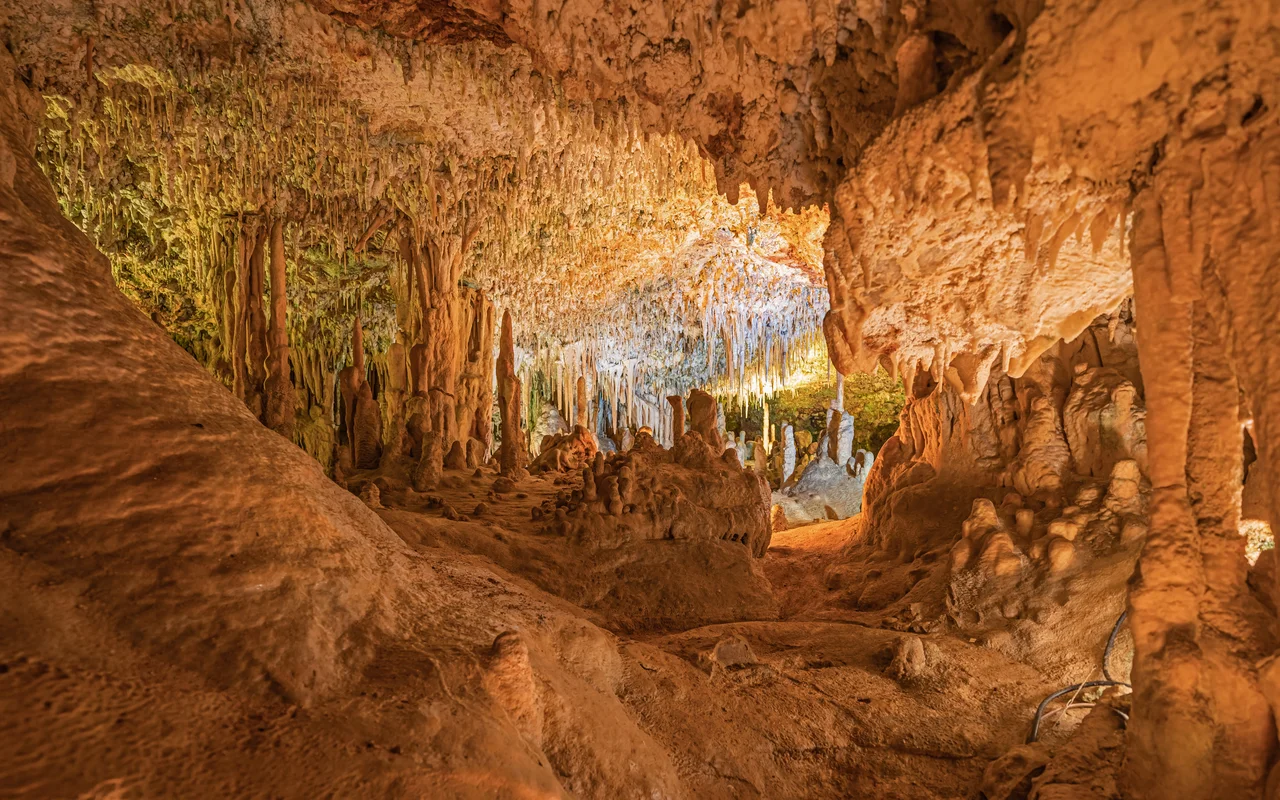

Coves dels Hams
Somewhere in the galleries beneath the fields of Manacor, the stone seems to forget which way is down. Stalactites that ought to hang straight as icicles instead curl and hook sideways, bending back on themselves as though reaching for something in the dark. The man who first explored this underworld on 2 March 1905, Pedro Caldentey, knew at once what they resembled: hams — the Mallorquí word for the fishhooks and harpoons of the island's fishermen. More than a century later, scientists still cannot fully explain why these formations grow the way they do.
The Stone That Bends
The Coves dels Hams are old almost beyond reckoning — more than ten million years in the making, carved when rainwater seeped through the limestone of eastern Mallorca and dissolved the rock grain by grain. In most caves the result is predictable: water falls, minerals settle, and stalactites grow downward in slender points. Here, in at least one gallery, something went strangely awry. The formations twist and curve into the shapes that gave the caves their name, hooking outward in apparent defiance of gravity's plain instruction. The reason remains an open question, one of those small mysteries that geology has not yet closed. Whatever the cause, the effect is unmistakable: a thicket of pale stone hooks, frozen mid-reach, suspended in the still and lightless air.
The Sea of Venice
Deep inside lies water so still it doubles the ceiling above it — an underground lake the caves' keepers named the Sea of Venice. On summer evenings it becomes a stage. Musicians push off in a small rowboat, its railings lined with candle flames, and glide across the black mirror while the music of Mozart rises through the chambers and a light show plays over the formations overhead. The 'Magical Mozart' concert has become the signature of a visit here: sound, flame, and reflected light moving together in a space that spent ten million years in perfect silence and total darkness. For a few minutes, the cave is neither silent nor dark, and then the boat glides back and it is both again.
A Family's Underworld
The caves owe their modern life to a single family. Pedro Caldentey opened them to the light in the spring of 1905; his son Lorenzo, a certified diver, later strung the chambers with electric lighting and shaped them into a place fit for performances and visitors. Today multilingual guides lead groups on a walk of roughly five hundred meters through twelve distinct chambers, each with its own character, before the boats appear on the Sea of Venice. In the crowded summer months the tour groups come steadily, threading the same passages that Caldentey once crawled through by lamplight — seeing at the flick of a switch what he had to piece together in the dark, chamber by chamber, with no promise of what lay ahead.
Cave Country
The Hams do not stand alone. This corner of eastern Mallorca, wrapped around the coastal town of Porto Cristo and the inland town of Manacor, is riddled with hollow limestone, and close by lies the larger and more famous Coves del Drach — the Cavern of the Dragon, with its own vast underground lake. Together they draw crowds inland from the beaches, offering a cool, echoing counterpoint to the Mediterranean glare above. It is an old rhythm on this coast: the bright, dry world of vineyards and resorts on the surface, and beneath it a slower, darker one, where water has been patiently sculpting stone since long before anyone thought to carry a light down into it.
A Word from the Sea
There is something fitting in the name. The people of Mallorca speak Mallorquí, a dialect of Catalan shaped by centuries of life between the mountains and the water, and hams is a working word — the fishhooks and harpoons of men who made their living from the sea. That a cave full of curling stone should borrow its name from a fisherman's tackle says much about how the islanders saw their world: the strange made familiar, the underground christened for the surface. The formations themselves remain a scientific puzzle, but the name that suits them was never in any doubt.
From the Air
The cave lies at roughly 39.5458°N, 3.3200°E, on the road between Manacor and the harbor town of Porto Cristo on Mallorca's east coast. The site itself is underground and invisible from the air, so navigate by the surface landmarks: the marina and narrow inlet of Porto Cristo about a kilometer to the east, and the larger inland town of Manacor to the west. A viewing altitude of 2,000–4,000 feet gives a clear read of the karstic coastline and its coves. Nearest airports are Palma de Mallorca (LEPA), roughly 60 km to the west, and Menorca (LEMH) across the water to the northeast. Coastal visibility is excellent through the summer, though midday heat haze can soften the horizon.
Nearby Stories
- Fornalutx 8.7 km away
- Palma de Mallorca 18 km away
- Fundacion Yannick y Ben Jakober 19 km away
- Capture of Minorca (1708) 23 km away
- Binibeca Vell 51 km away
- Illa de Tagomago 102 km away
- Cala de Sant Vicent 151 km away
- Shipwreck of Dellys 254 km away