_arp.jpg)
Fornalutx
In most Mediterranean villages, a house stripped down to bare stone signals neglect. In Fornalutx, it signals pride. Over recent decades the residents of this mountain village on Mallorca have gone to their own façades and peeled away the smooth render their grandparents applied, exposing the rough golden stone beneath. The effect is a place that looks older and more rustic than it once did, a village that decided, deliberately, to look like the postcard of itself. Tucked into a fold of the Serra de Tramuntana between the Alfabia Mountains and the crags of Els Cornadors, Fornalutx is home to fewer than 800 people, and it has won national prizes simply for being beautiful.
A Village Built on Steps
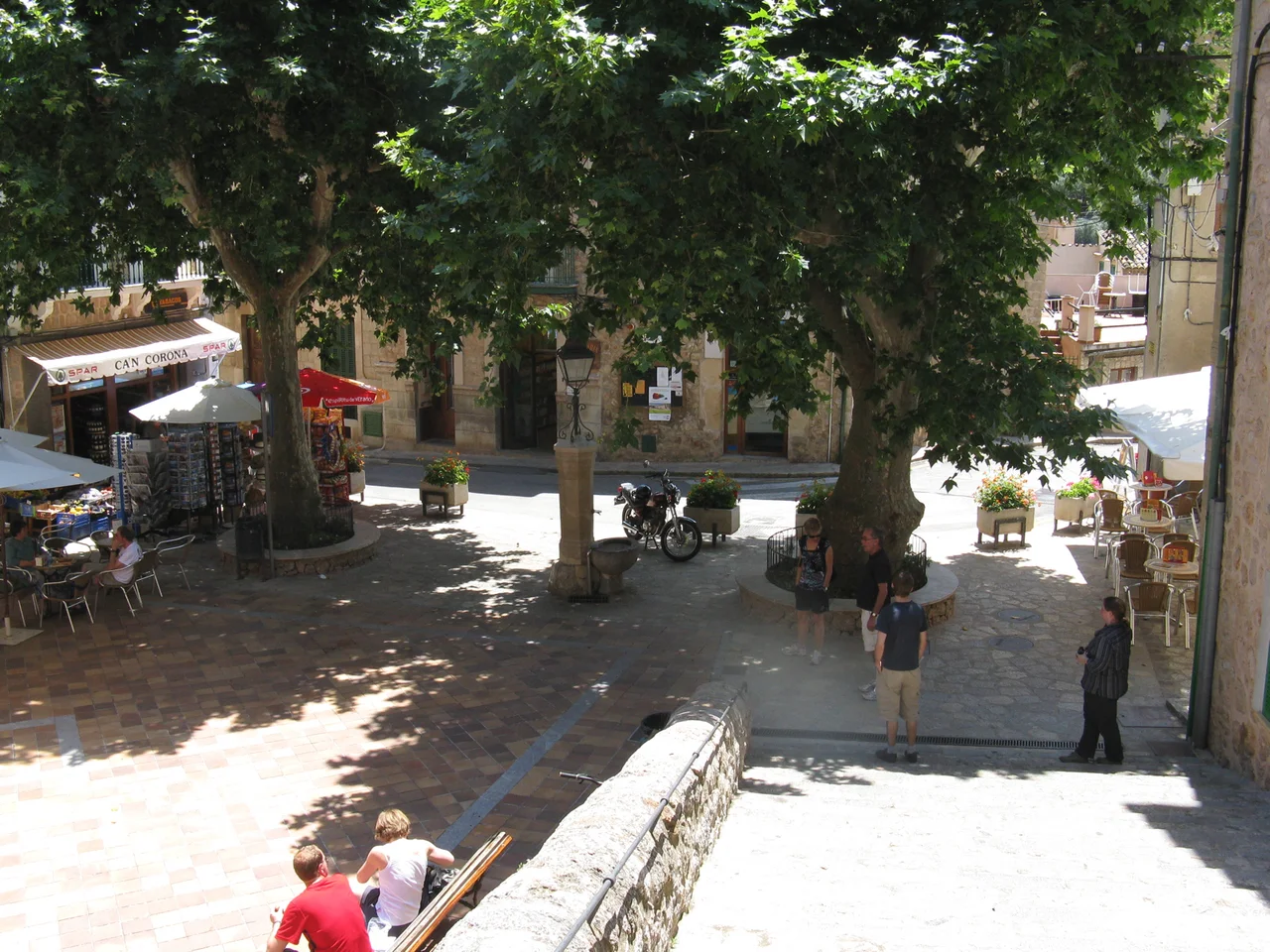
Fornalutx does not sit on flat ground; it climbs. Built across different levels of the hillside, its higher streets are cobbled and closed to cars, and grassy paths lead off them into orchards and farms to the north. At the heart of it all is the Plaça d'Espanya, ringed by cafés and a general store. Steps rise from the square to the church, whose façade carries a large clock that keeps time over the rooftops. A short walk down the street stands the Panadería de Fornalutx, the village bakery, and the road out of town gathers a handful of restaurants. On the eastern edge stands an old defensive tower, now pressed into gentler service as the ajuntament, the town hall. Everywhere the same materials repeat: honey-colored stone, red roof tiles, and window shutters painted a particular shade of green.
Where the Mountain Water Runs
Just a few doors from the old tower stands one of the village's quiet marvels: the public washing house. Water gathered high in the mountains is channeled down to it through open stone culverts that run alongside the roads, arriving at a long stone bath sheltered by an open loggia. Above the water hangs a rail, where for generations locals have left their laundry or washed themselves. It is easy to walk past such a thing and miss it, but it explains something essential about Fornalutx. This is a village organized around the movement of mountain water, its terraces and orchards fed by the same gravity that fills the wash house. Long before piped supply reached these hills, the culverts decided where people gathered and how the day was shaped.
Orchards Older Than the Church
The land around Fornalutx is worked and green. Orange and lemon trees dominate the terraces, their fruit bright against the stone walls, and cacti cluster along the margins. Sheep graze in the surrounding orchards, and thousands of house sparrows flit through the lanes in noisy clouds. Climb higher and the citrus gives way to olive groves, where some of the gnarled, silver-leaved trees have stood for more than a thousand years, older than nearly everything else in sight, older than the church, older than the tower. These are not decorative plantings but a living agricultural inheritance, the terraced groves that once fed the village and still shape its slopes. In spring the scent of orange blossom drifts up through the cobbled streets and settles over the square, a fragrance the village has lived with for centuries and that no prize could ever quite capture.
A Prize for Staying Beautiful
Fornalutx has been rewarded for looking after itself. In 1983 the Mallorcan Tourism Board gave it a Silver Plaque for defending and maintaining the village, and the same year Spain's tourism authorities named it runner-up in a national competition for the country's best-kept towns. In 1985 came the Premi Alzina from a Balearic conservation and ornithology group. The village guards its character in practical ways too: a weight limit and a deliberately narrow bottleneck near the square turn away lorries and coaches, which are sent to a turning place on the northern edge instead. The nearest town, Sóller, lies a short distance away, reachable on foot along old footpaths that thread through the hamlet of Binibassi. Most residents speak Mallorquí, the island's Catalan, as easily as Castilian Spanish, one more thing here that has been quietly kept.
From the Air
Fornalutx sits at 39.78°N, 2.74°E, tucked into a fold of the Serra de Tramuntana just northeast of Sóller. A viewing altitude of 3,000 to 4,000 ft AGL frames the village against its surrounding peaks, the Alfabia Mountains and Els Cornadors, with the citrus terraces of the Sóller valley spread below and the bulk of Puig Major (1,445 m) rising to the northeast, crowned by its white radar dome. The nearest major field is Palma de Mallorca (LEPA), roughly 30 km south; the small general-aviation aerodrome of Son Bonet (LESB) lies a little closer on Palma's northern outskirts. Mountain weather changes fast here and the terrain funnels wind through the valleys, so clear, calm mornings offer the best light and the safest approach.
Nearby Stories
- Palace of Marivent 2 km away
- Fundacion Yannick y Ben Jakober 3.4 km away
- Coves dels Hams 13 km away
- Cala de Sant Vicent 69 km away
- Portinatx 93 km away
- Battle of Ebro River 127 km away
- Llobregat Delta 143 km away
- Cosquer Cave 396 km away