.jpg)
Binibeca Vell
Its name means Binibeca the Old, and that is the first thing about it that isn't true. The tangle of blinding-white houses on Menorca's southern coast looks like a fishing village that has weathered five hundred summers of salt and sun. It has weathered barely sixty. Binibeca Vell was drawn on a plan and built more or less all at once, an entire hamlet conjured in the image of an older one. Tourists arrive expecting antiquity and find an argument instead: about what makes a place authentic, and whether a beautiful imitation counts.
A Village That Was Never Old
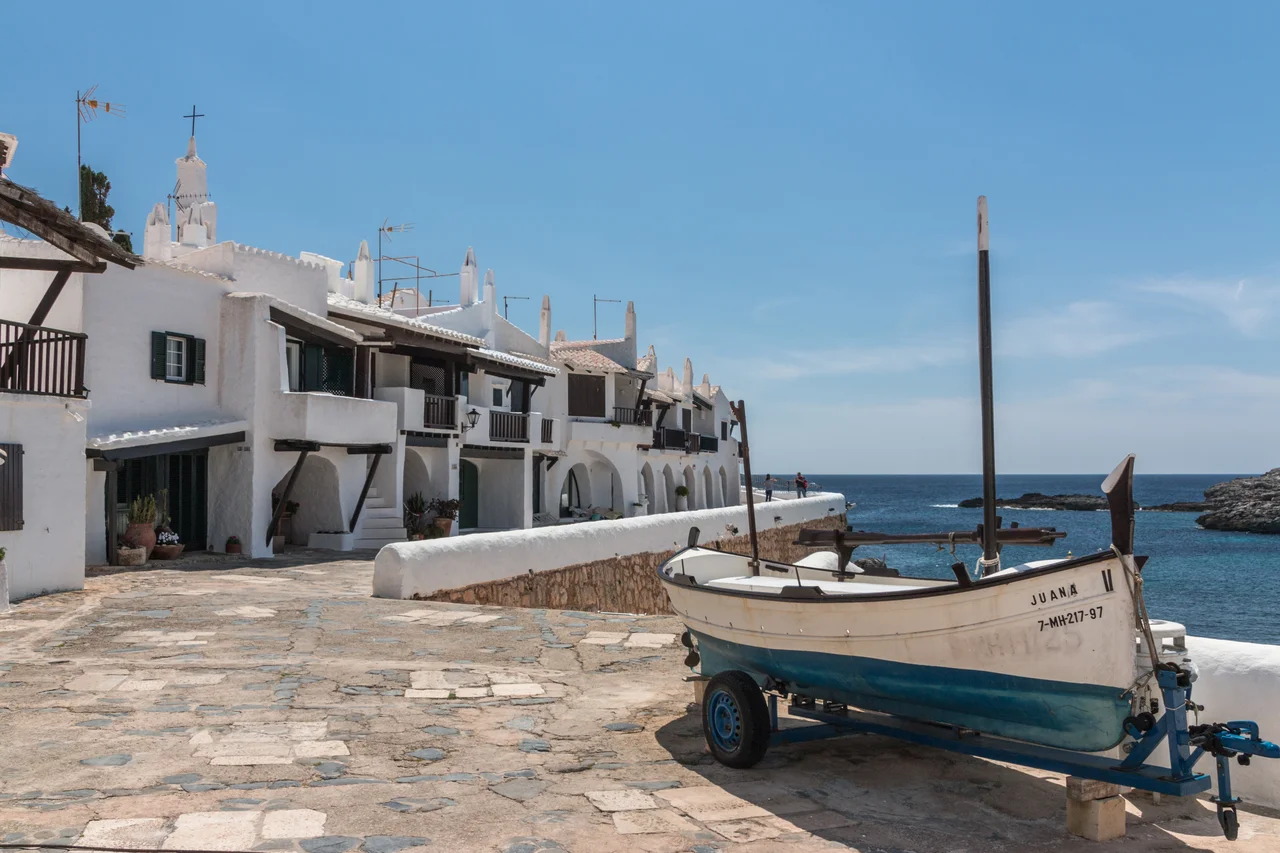
Binibeca Vell belongs to the municipality of Sant Lluis, sitting about five kilometres from the town centre and eight from the island capital at Port Mahon. It was conceived around the 1960s by the Barcelona architect F. J. Barba Corsini, whose brief was less to build a resort than to reproduce one, to echo the prototypical whitewashed coastal villages that dot the Mediterranean. The result is a warren of cube-shaped houses stacked and folded together, brilliant white against the blue, deliberately made to look as though generations of fishermen had added a room here and a staircase there. Nothing about it is accidental. Every charming irregularity was designed to seem unplanned.
The Argument Over Authenticity
That sleight of hand has always divided people. To many visitors, Binibeca is simply lovely, a place to lose an hour among cool shadowed lanes. To its critics, it is a handsome fake, unfaithful to the very tradition it borrows from, a stage set dressed as heritage. The debate is oddly Menorcan. This is an island layered with the genuinely ancient, prehistoric taulas and Bronze Age towers that have stood for three thousand years, and here, a short drive away, is a village pretending to a past it never had. Whether that pretence is homage or forgery is a question the whitewashed walls politely decline to answer.
White Walls and Narrow Lanes
Argue as you like; the place works on the senses regardless. The streets are narrow enough that the heat drops the moment you step into them, the light bouncing off lime-washed plaster until the shade feels almost blue. The village sits between Cap d'en Font to the west and Binibeca beach to the east, so the smell of the sea is never far, and the small commercial heart offers the expected constellation of restaurants, bars and souvenir shops. Around the original core, a looser sprawl of single-family houses and holiday apartments has spread, a resort that grew up hungry beside the fantasy village at its centre.
The Wider Shore
Binibeca does not stand alone. It anchors a stretch of the southeastern coast within the municipality of Sant Lluis, roughly five kilometres from the municipal town and eight from the island capital at Port Mahon, and it works as a base for the coves and beaches running along this shore. For a long time the village stayed light on commercial development, a quiet knot of white lanes with a small centre of restaurants, bars and souvenir shops. That is changing fast, and the change reaches beyond the original core. Visitors drawn by the manufactured village spill outward onto the genuine coastline around it, so the two Menorcas, the designed one and the natural one, end up sharing the same narrow roads, the same beaches and the same relentless summer sun.
Loved to the Point of Closing
Beauty at this scale carries a cost. Binibeca became a magnet for summer tourism and then, as photographs circulated, for the kind of crowds a village of a few hundred homes was never built to absorb. In May 2024 residents, worn down by noise and rubbish and the sheer press of visitors filing past their front doors, went public with a threat to close the village to tourists altogether. These are people who actually live behind the postcard walls, and their frustration is the newest chapter in Binibeca's odd story: a place built to be looked at, now wondering whether it can survive being seen.
From the Air
Located at 39.82 N, 4.24 E on the south coast of Menorca, within the municipality of Sant Lluis, roughly 8 km southwest of Port Mahon and about 6 nm southeast of Menorca Airport (LEMH). From the air the settlement reads as a dense, brilliant-white cluster hugging a small rocky cove, set between Cap d'en Font to the west and Binibeca beach to the east. A viewing altitude of 1,500-2,500 ft shows the tight geometry of the white houses against the turquoise shallows. Summer visibility is excellent; expect sea breezes off the southern shore.
Nearby Stories
- Ciutadella 21 km away
- Cuevas del Drach 46 km away
- Coves dels Hams 92 km away
- Llobregat Delta 200 km away
- Somorrostro 235 km away
- Porto Flavia 300 km away
- Nuraghe Seruci 307 km away
- Cosquer Cave 350 km away