
Cuevas del Drach
Deep beneath the eastern coast of Mallorca, in a chamber that has never seen daylight, a string quartet tunes up in the dark. Then the lights fall, and music drifts across the black surface of an underground lake as illuminated boats glide out from a hidden shore. This is how a visit to the Caves of Drach ends — with a concert on Lake Martel, one of the largest underground lakes in the world. The caves take their name from the Catalan word drac, meaning dragon, and they have drawn legends the way deep places always do. What they actually hold is stranger, and more beautiful, than any dragon. Before the concert, visitors wind down through galleries of glistening rock toward the water, the air cooling with every step below ground.
Sixteen Years to Chart
The caves gave up their secrets slowly. In 1880 a German explorer, M. F. Will, mapped the first two chambers — the White Cave and the Black Cave — and for a while it was assumed that was all there was. Then, in 1896, the owners invited Édouard-Alfred Martel, a French scientist regarded as the founding father of speleology, to push deeper. Martel found two more great caves the earlier survey had missed and, at the bottom of the system, the vast still lake that now carries his name. All told, the four caves reach some 2.4 kilometres in length and descend to a depth of about 25 metres below the surface, a labyrinth of galleries hung with stone. Martel's visit sealed the caves' fame, and the lake at their floor became the crown of the whole system.
The Lake in the Dark
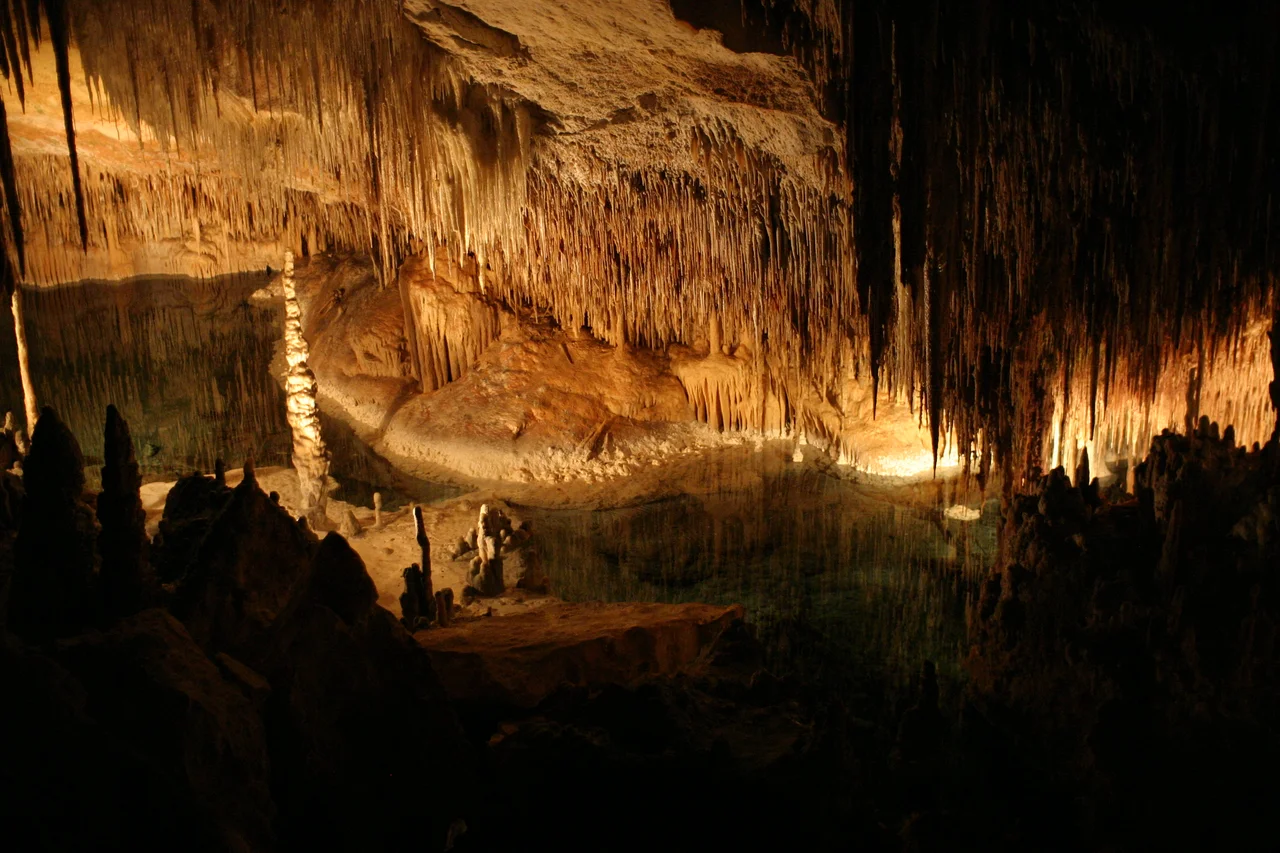
Lake Martel is the heart of the place. Roughly 115 metres long and 30 wide, and ranging from about four metres to a dozen metres, its water lies so motionless and so clear that the boundary between stone and reflection dissolves. Stalactites hang down toward their own mirror images until you can no longer tell which way is up. The air holds cool and steady the year round, and every footstep and whisper carries far in the enclosed silence. Coloured light picks out mineral draperies overhead, formations built up drop by patient drop across spans of time the human mind struggles to hold. To stand at the water's edge here is to feel the weight of the whole island pressing down above you, and yet the space feels serene rather than crushing.
A Concert on the Water
Since 1935, the caves have staged what may be the most atmospheric performance on the island. In an auditorium carved beside the lake, with room for more than a thousand visitors, the lights go down and a small ensemble — cello, harpsichord, and two violins — plays from rowing boats that slip across the water, each lit from within. The programme runs to gentle classical pieces, works by Chopin and Offenbach among them, and lasts only about ten minutes. In that setting, ten minutes is enough. The ritual has scarcely changed in spirit since the first musicians rowed out onto the lake, a tradition now older than most visitors' grandparents. When the last note fades, boats ferry visitors across the lake themselves, gliding out over the black water toward the daylight waiting at the exit.
The Cave the Island Cannot Close
The Caves of Drach sit just inland of Porto Cristo, a former fishermen's harbour in the municipality of Manacor, and they rank among the most visited attractions in all of Mallorca. That popularity is not merely a point of local pride. So many livelihoods along this stretch of the Llevant coast depend on the crowds the caves draw that any closure, however brief, lands like an omen; residents read a shuttered Drach as a warning sign for the whole local economy. For Porto Cristo and the wider municipality of Manacor, the caves are not a curiosity but a cornerstone. A cavern that took explorers sixteen years to fully chart has become, more than a century later, something the island quietly cannot do without.
From the Air
The caves lie at 39.54°N, 3.33°E, just inland of Porto Cristo on Mallorca's southeastern coast. The entrance is underground and invisible from the air, so navigate by the surface: Porto Cristo's narrow harbour inlet and marina cut an unmistakable notch into the low limestone coastline, with the caves immediately south of the town. An approach at 1,500–3,000 feet gives the clearest read of the karst shoreline and its pale cliffs. Palma's LEPA lies about 50 kilometres west across the island; Menorca's LEMH sits offshore to the northeast. Coastal haze is common on summer afternoons, but the turquoise water over the shallow rock shelf stays vivid.
Nearby Stories
- Fornalutx 8.7 km away
- Palma de Mallorca 18 km away
- Fundacion Yannick y Ben Jakober 19 km away
- Capture of Minorca (1708) 23 km away
- Binibeca Vell 51 km away
- Illa de Tagomago 102 km away
- Cala de Sant Vicent 151 km away
- Shipwreck of Dellys 254 km away