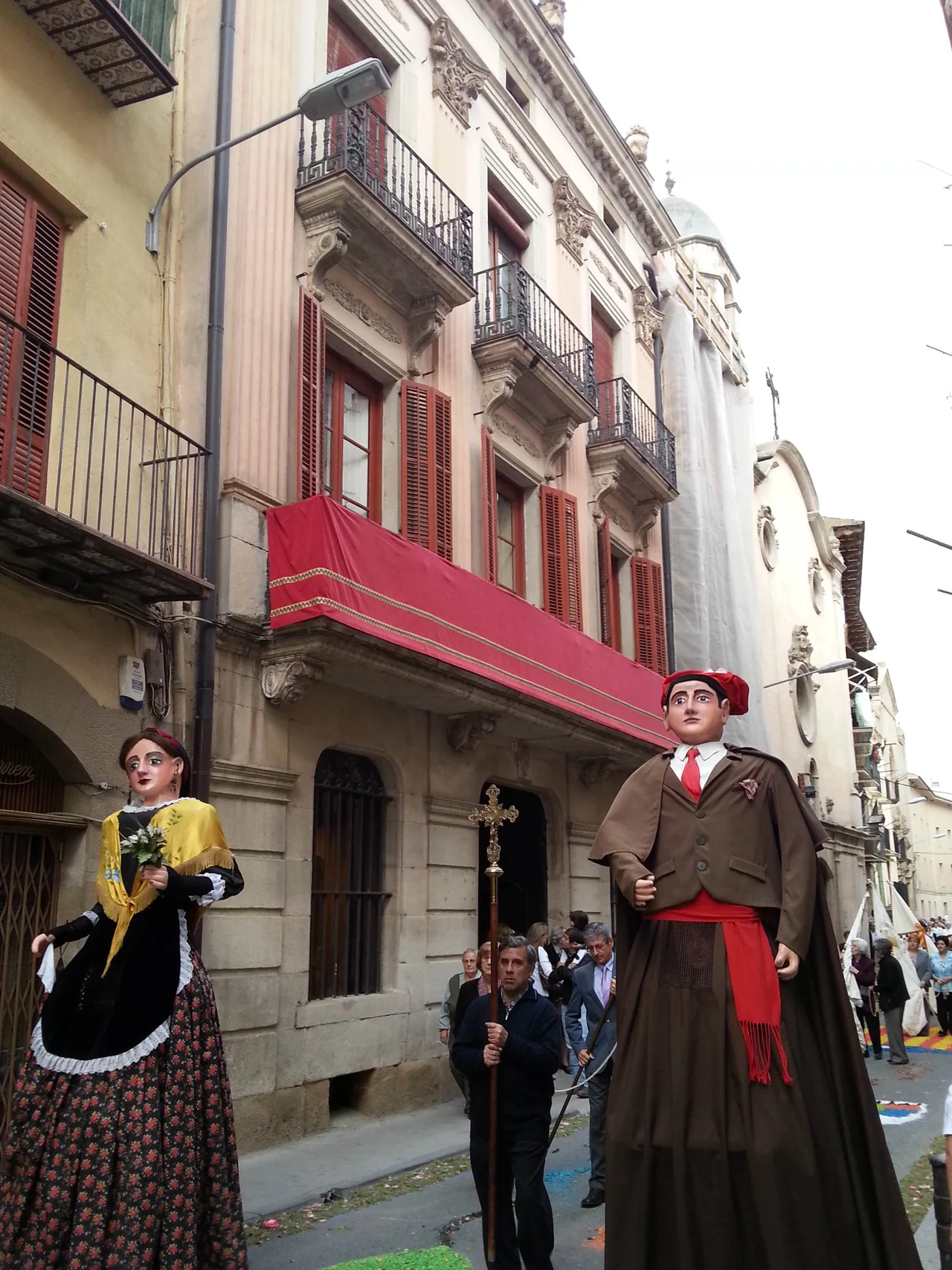

Palauet de la muralla de Balaguer
During the Spanish Civil War, someone in Balaguer saved a thousand books by hiding a doorway. In this old manor house, the library held more than a thousand volumes, many bound in parchment, carried here from the Franciscan convent of Sant Domenec. As anti-clerical fires threatened, an unknown hand simply bricked up the entrance, sealing the room out of sight until the danger passed. That small act of concealment is one layer among many in the Palauet de la Muralla, a house whose very walls tell the town's history: its back is the medieval city wall, its cellar is older than the mansion above it, and its story begins with an expulsion.
A House on the Medieval Wall
The Palauet stands in the historic heart of Balaguer, in the old Jewish quarter, its main facade on Miracle Street near the Placa Mercadal. That square has hosted a market every Saturday for more than 800 years, and it still does. The back of the house is no ordinary rear wall; it is a stretch of the town's original fortifications, dropping toward the Segre river. Through the courtyard, hemmed in by thick stone, a passage leads to a lookout the locals call lo Portalet, a small opening over the water. From the upper terraces the view runs along the Segre as it passes through the city and out to the Montsec mountains standing blue in the distance. The house is also known as Can Tarragona, and it shares the old wall passage with its neighbors, so the fortification runs on unbroken behind several houses at once.
Down in the Jewish Cellar
The oldest part of the house is underground. The basement is of Jewish origin, still legible in its water pipes, and it holds what the family calls the celler, with two wells or reservoirs once used to keep oil and other goods, alongside the old stable. In one of the basement rooms sits a massive stone table cut from a single piece. Most evocative of all is a passage, now walled shut, that once connected the house directly to the neighboring Church of Sant Joseph, which had itself been a synagogue in earlier centuries. To descend here is to move through the buried architecture of a community that lived, worked, and worshipped along this wall long before the mansion above took its present shape.
Salvaged Splendor
Over the last half-century the house has been restored piece by piece, much of it furnished with objects rescued from churches of the region that were falling into ruin, saving them from disappearing altogether. Through the main entrance, a hall floored in stone slabs and lined with monastic stalls gives way to stairs, a game room, and the principal suites above. Master craftsmen brought the interiors back: the carpenter Ton Camarasa and the painter Angel Soldevila recovered the original ceiling paintings, moldings, and coffered woodwork, while mosaics and old wooden floors were preserved beneath. The grandest room holds a mirror from Murano; the dining room keeps a fireplace of solid wood; the bedrooms are dressed in imperial and Venetian style. Above the main suites, the second floor holds six bedrooms, several opening onto terraces that hang directly over the Segre. Higher still lies the attic the region calls lo Perche, its original wooden beams and worn old floor tiles left exposed, a cool and quiet space tucked beneath the roof where the house feels most like the past it came from.
Origins in an Expulsion
The manor's deeper history reaches back to 1333, when the Jews were expelled from the older part of Balaguer and the settlement shifted toward what would become the Placa Mercadal. The building grew and changed across the centuries, acquiring its Renaissance facade in the 1700s, which gave the interior much of its current structure. In 1930 the Carmelite Sisters of Charity took over the property and ran it as a girls' school and convent until the late 1950s. The library that survived the Civil War, with its lives of saints and old sermons, came from the Franciscan convent of Sant Domenec, and today the house lives on as a hotel, its guests sleeping above a cellar that predates them by many hundreds of years.
From the Air
The Palauet sits in Balaguer at 41.789 N, 0.806 E, on the right bank of the Segre where the river leaves the Pre-Pyrenean foothills for the plains of Lleida. From 3,000-5,000 feet AGL, look for the compact walled old town on the riverbank, the broad Placa Mercadal, and the Segre threading through the city, with the long ridge of the Montsec range on the northern horizon. Nearest airport is Lleida-Alguaire (LEDA) just to the southwest; Reus (LERS) and Barcelona-El Prat (LEBL) lie further out to the south and east. Visibility over the inland plain is generally excellent.
Nearby Stories
- Montsec Range 10 km away
- Mequinenza 13 km away
- National Day of Catalonia 15 km away
- Roca dels Moros 15 km away
- Barbastro 19 km away
- Castellers de Vilafranca 29 km away
- Patum de Berga 38 km away
- Battle of Graus 48 km away