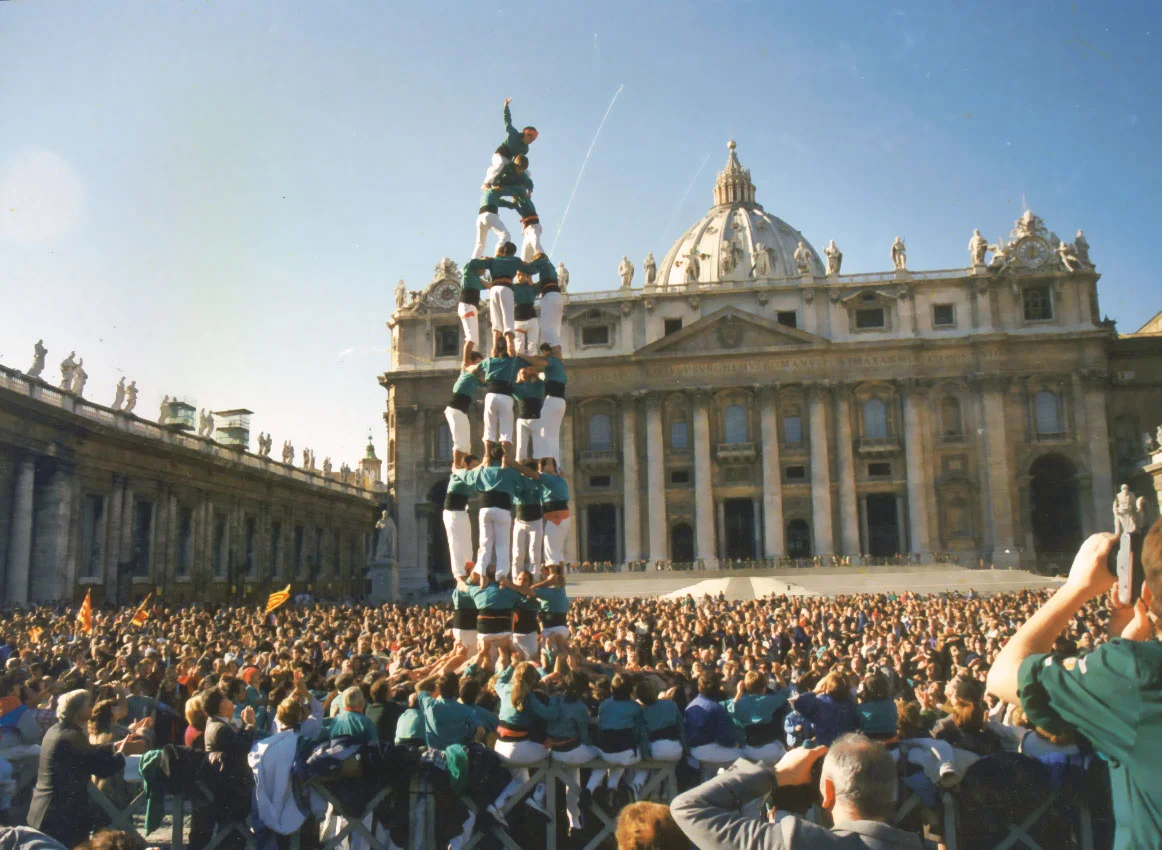

Castellers de Vilafranca
A child no older than six clambers up a wall of human backs, past shoulders and thighs and gripping hands, until there is nothing above her but sky. At the top she flattens her small body across the highest pair of climbers, raises one arm, and for a single held breath a tower of bodies eight or nine levels tall stands finished. Then it comes apart, deliberately, level by level, and the crowd packed into a square in Vilafranca del Penedès lets out a roar. This is a castell, a human tower, and the people in green who build the tallest and most difficult of them are the Castellers de Vilafranca.
From a Valencian Dance
The tradition has deep and slightly improbable roots. It grew out of the eighteenth-century Ball de Valencians, a dance carried north from Valencia whose final flourish stacked a few performers into a small tower. Over generations the flourish outgrew the dance. In September 1948, responding to a swell of local enthusiasm for tower-building, Oriol Rossell founded the Castellers de Vilafranca. The early group wore rose-coloured shirts, then red, and for a decade could raise no more than seven levels. Internal quarrels nearly finished them off in 1956. When they regrouped the following year, they chose green shirts, and green they have worn ever since.
The Anatomy of a Tower
A castell is engineering worked in flesh. At the base, hundreds of people press together into the pinya, a dense human foundation that spreads the load and cushions anyone who falls. On the tallest towers, second and third rings of bodies, the folre and the manilles, brace the lower levels from outside. Above them the trunk narrows, level by level, until the lightest upper rungs are carried by children and the final cap belongs to the enxaneta, the small climber who scrambles up the whole structure and lifts a hand. A tower only counts as complete, descarregat, when it is dismantled as cleanly as it was raised. Castellers sum up the work in four words: força, equilibri, valor i seny, strength, balance, courage and good sense.
Green Shirts, Green House
The group's home is Cal Figarot, a neo-Gothic mansion designed by the architect August Font i Carreras at the end of the nineteenth century. The castellers acquired it in 1983, bought the warehouse beside it in 1998, and turned the courtyard into a training ground. From that base they became the dominant force in their sport. At the Concurs de Castells in Tarragona, the discipline's great competition, held every two years inside a bullring, Vilafranca first won in 1972, then took title after title through the 1990s and 2000s: 1996, 1998, 2002, 2004, 2006, 2008, 2010 and 2012. By 2010, roughly four hundred active members were building under the green banner.
Pushing the Limit
Each decade the group reached higher. In 1989 they became the first to fully dismantle a tres de nou amb folre, a nine-level tower. In 2005 came the torre de nou amb folre, a construction so slender and precarious that it is still regarded as the hardest any group has ever completed. These are not stunts. A collapse, called llenya, firewood, in casteller slang, sends bodies tumbling down onto the crowd below, and the injuries are real. The pinya exists for exactly that reason: when a tower falls, it should fall onto people who have braced themselves to catch it.
The World Below the Tower
Human towers are Catalan to the core, yet the Castellers de Vilafranca have carried them far, performing in France, Italy, Chile, India and New York, and on some of the grandest stages there are. They rose at the opening ceremony of the 1992 Barcelona Olympics. In 2010 they traveled to Brussels to back the campaign that, that November, saw castells inscribed on UNESCO's list of the Intangible Cultural Heritage of Humanity. Whatever the tower and whatever the crowd, the oldest lesson of the castell always holds. No one reaches the top alone, and no one climbs at all without the mass of people, unseen at the bottom, holding everything up.
From the Air
The Castellers' home city of Vilafranca del Penedès sits at 41.3458 N, 1.6966 E, on the broad Penedès wine plain about 45 km southwest of Barcelona. Best appreciated from 3,000-4,500 ft AGL, with the Gothic bell tower of the Basilica of Santa Maria marking the old town and the serrated ridgeline of Montserrat rising to the north as an unmistakable landmark. Sabadell (LELL) lies to the northeast; Barcelona-El Prat (LEBL) is the main gateway to the southeast, with Girona (LEGE) farther up the coast. Vineyards and low hills give clear visibility on typical dry Mediterranean days.
Nearby Stories
- Monastery of Pedralbes 0.3 km away
- Siurana (Tarragona) 19 km away
- National Day of Catalonia 20 km away
- Torre dels Escipions 22 km away
- Palauet de la muralla de Balaguer 25 km away
- Vandellòs I nuclear incident 26 km away
- Montseny Massif 29 km away
- Sa Calobra 154 km away