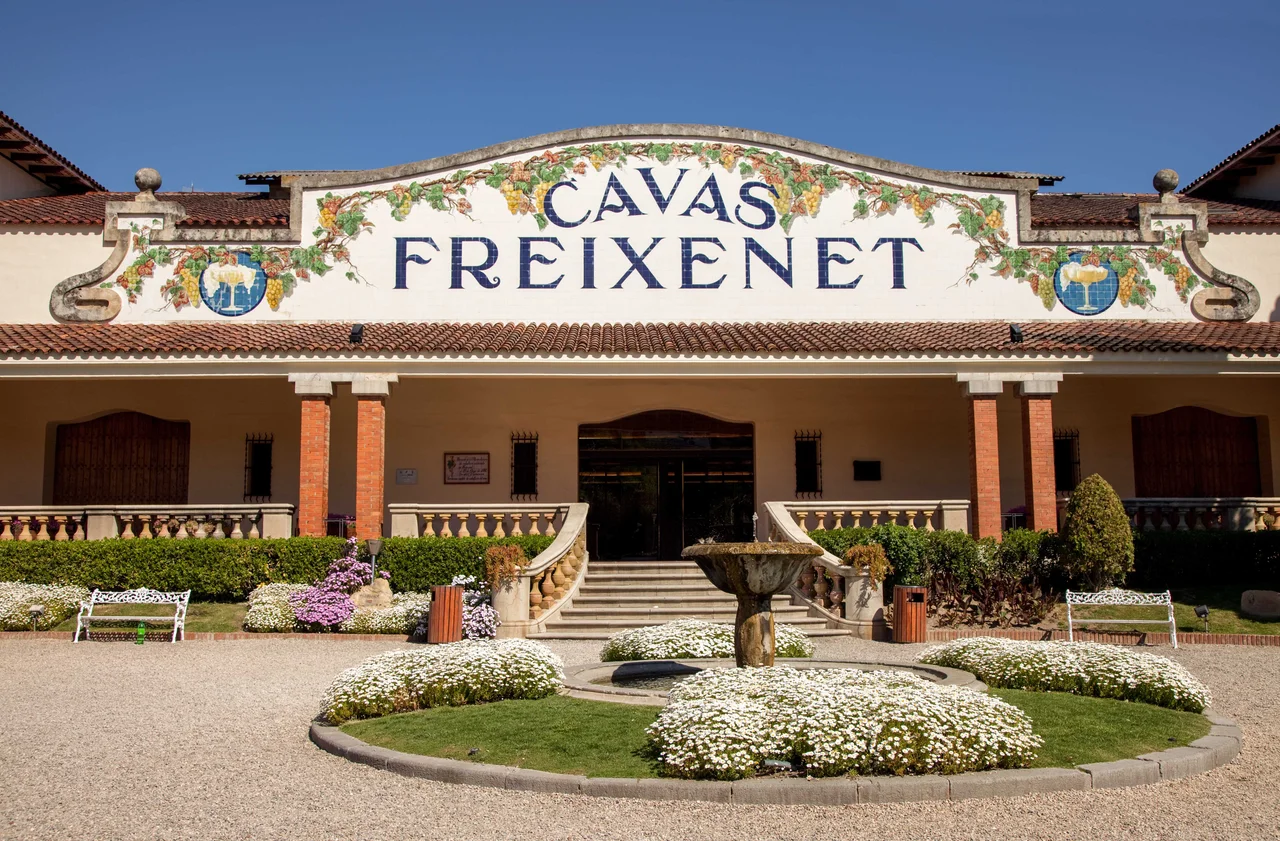

Freixenet
For a generation of Spaniards, Christmas did not truly begin on a date in the calendar. It began when the Freixenet advert aired. Each year the cava house unveiled a lavish holiday commercial fronted by a world-famous face, and the parade of stars, Liza Minnelli, Paul Newman, Antonio Banderas, Penelope Cruz, Shakira, became a national ritual as reliable as the December lights. Behind the glamour sits something older and more grounded: a cellar in the small Catalan town of Sant Sadurni d'Anoia that grew into the largest producer of traditional-method sparkling wine on Earth.
Two Families, One Bottle
Freixenet was born of a marriage. On one side stood the Ferrer family, owners of a country estate called La Freixeneda, an ash grove, whose roots in the land reached back to the twelfth century. On the other stood the Sala family, founders of Casa Sala in 1861. When Pedro Ferrer Bosch married Dolores Sala Vive, two wine dynasties became one. As Spanish still-wine production faltered at the end of the nineteenth century, producers across the region turned to bottling sparkling wine instead, and from 1914 the couple began selling theirs under the Freixenet name, taken from the old family estate.
Cava from the Traditional Method
What Freixenet makes is cava, sparkling wine produced by the same painstaking traditional method used in Champagne. Pressed traditionally from Catalan white grapes such as Macabeo, Xarel-lo and Parellada, the wine undergoes a second fermentation inside the very bottle it will be sold in, then rests for months or years on its lees in cool, dark cellars before the sediment is removed. Sant Sadurni d'Anoia, riddled with kilometres of such cool underground cellars, is the acknowledged capital of the craft, and its cellars hold millions of bottles quietly aging in the dark at any given moment. Freixenet's own landmarks followed one after another: the best-selling Carta Nevada arrived in 1941, and in 1974 came Cordon Negro, its frosted black bottle destined to become one of the most recognizable in the sparkling-wine world.
War, Recovery, and a Woman's Resolve
The company's rise was nearly cut short. During the Spanish Civil War the family lost control of the business altogether. That it survived at all owed much to the determination of Dolores Sala and her daughter, who rebuilt it in the war's aftermath. From that recovery the house climbed steadily. Under Jose Ferrer the commercial fortunes improved through the late 1950s, exports pushed into international markets from the 1970s, and by 1985 Freixenet had become the world leader in the cava trade, a small-town Catalan cellar selling its bubbles across the globe.
The Face of Christmas
The celebrity commercials were no passing gimmick but a decades-long institution. Liza Minnelli fronted the campaign as early as 1977; Raquel Welch followed in 1985, Paul Newman in 1989, Antonio Banderas and Sharon Stone in 1992, Kim Basinger in 1993, and later Pierce Brosnan, Demi Moore and Shakira. To grow up in Spain in those years was to measure the approach of the holidays by which star was pouring the cava this time. In 2018 the company retired the formula, shifting to a strategy meant to loosen cava from its Christmas-only associations and sell it as an everyday emblem of the Mediterranean good life. The brand's reach extends into sport as well: Freixenet has backed the roller hockey club of Sant Sadurni, which races under the name CE Noia Freixenet, and pops its corks on the MotoGP podium.
A Global Fizz
The modern chapter is bigger and more complicated. In 2018 the German group Henkell acquired a 50.67 percent majority stake, and the following year the Spanish-German alliance was rechristened Henkell Freixenet, the leading sparkling-wine group in the world. In 2026 Henkell bought out the rest, acquiring the remaining shares from the Ferrer and Bonet families and leaving the founding Catalan clans as honorary presidents rather than owners. The house even owns a California winery, Gloria Ferrer, carrying the family name across the Atlantic. Yet the vine remains at the mercy of the sky. In April 2024, after three dry vintages had sharply reduced the base wine available for cava, the company announced temporary layoffs affecting more than six hundred employees, a reminder that behind the celebrity gloss, this is still farming, still bound to rain that may or may not come.
From the Air
Freixenet's home town of Sant Sadurni d'Anoia sits at 41.4203 N, 1.7922 E, in the vineyard hills of the Penedes about 40 km west of Barcelona and just north of Vilafranca del Penedes. From 3,000-4,500 ft AGL the town reads as a cluster amid a patchwork of vineyards, with the cava cellars near the rail line and the ridge of Montserrat rising unmistakably to the north. Sabadell (LELL) is the nearest small field, to the northeast; Barcelona-El Prat (LEBL) lies southeast toward the coast, and Girona (LEGE) up the coast beyond. The open wine plain gives clear visibility on dry days.
Nearby Stories
- Santes Creus 6.6 km away
- Torre dels Escipions 7.3 km away
- Cave of Saint Ignatius 11 km away
- Cervera 11 km away
- El Celler de Can Roca 47 km away
- Tarragona Amphitheatre 57 km away
- Fageda d'en Jordà 84 km away
- Cap de Formentor 145 km away