.jpg)
Vilafranca del Penedès
Order a glass of the deep-red local wine in Vilafranca del Penedès and you are, in a sense, drinking the town's biography. This is the capital of the Penedès, a broad inland plain of vineyards southwest of Barcelona that has grown grapes since Roman times and now carries its own protected denomination of origin. The vine paid for the Gothic churches, the manor houses and the modernist mansions that crowd the old centre. It also feeds a town that, come autumn, forgets the harvest just long enough to build the tallest human towers in Catalonia. Wine and stone and daring: Vilafranca runs on all three.
Capital of the Vine
The Penedès is wine country in the fullest sense, and Vilafranca is its market town and capital. The surrounding plain, hemmed by low hills, produces still reds and whites under the Penedès denomination, while the cava cellars of the same region turn out sparkling wine a short drive away. The local table follows the vine. The signature dish is xató, a robust winter salad of escarole, salt cod, tuna, anchovies and black olives, bound by a pounded sauce of chillies, toasted almonds and garlic, and washed down with the region's black wine. For dessert there are catànies, almonds smothered in chocolate, and coca garlanda, a ring-shaped sweet bread. Little of the local identity strays far from the grape.
The First Gothic Nave
At the heart of the old town, near the Plaça de Jaume I, stands the Basilica of Santa Maria. Begun at the close of the thirteenth century on the footprint of an older Romanesque chapel, it holds a quiet distinction: it was the first parish church in Catalonia built in the Gothic style. Its architects followed the pattern that would come to define Catalan Gothic, a single wide nave of five bays, roofed with ribbed vaults and flanked by chapels tucked between unusually thick buttresses. The main facade, started in the fifteenth century, has been reworked more than once, most recently at the start of the twentieth. Today visitors can climb the bell tower, and the church times some ascents to catch the sunset spreading over the vineyards below.
Manor Houses and the Old Quarter
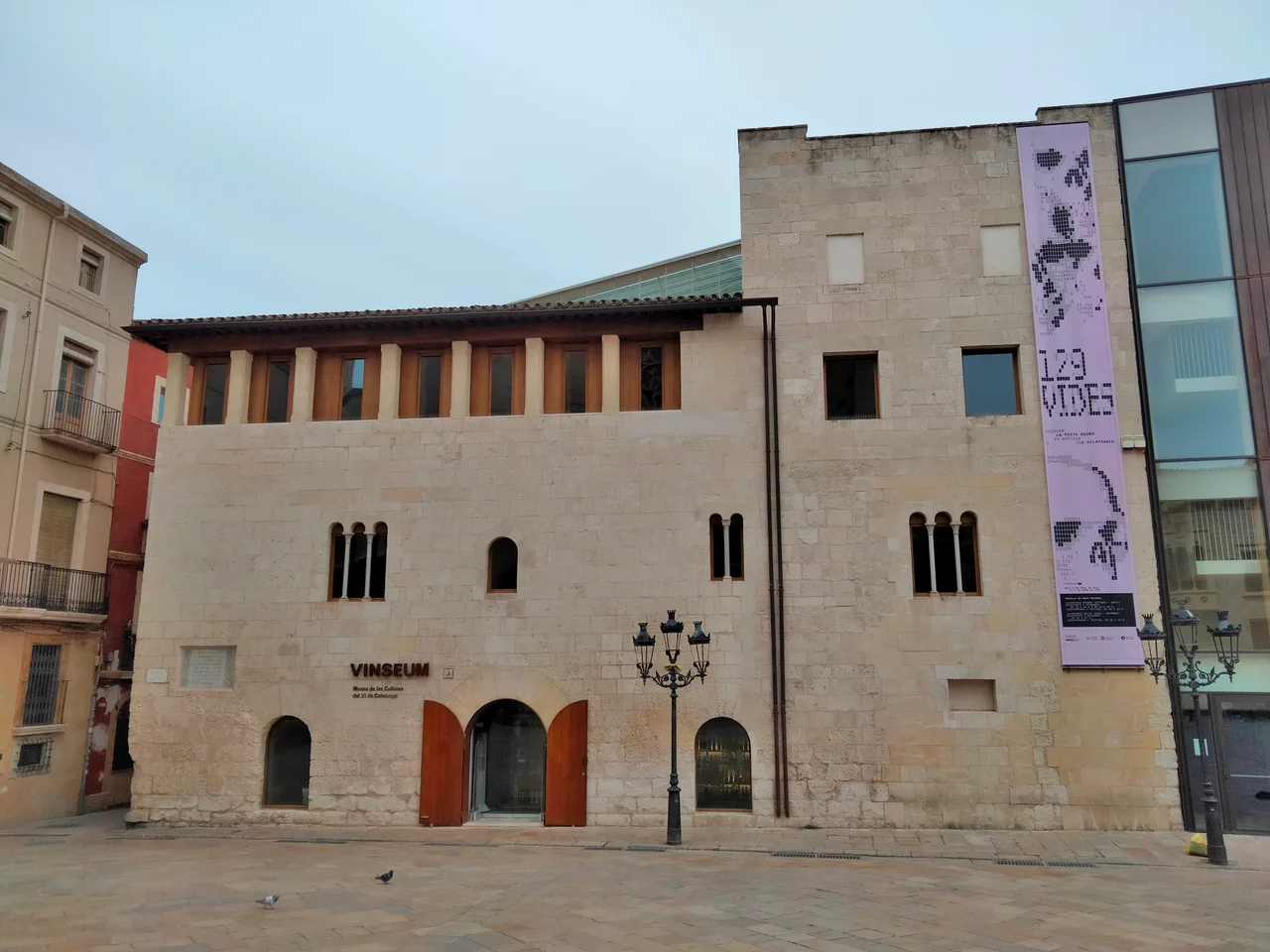
Vilafranca kept its medieval bones. Within the line of the old walls, Gothic manor houses still front the narrow streets, each with the same essential plan: a central courtyard as the hub of the house, a covered staircase, and a gallery of pointed arches above. Palau Baltà, first built in 1308 and restored in 1889 by the local architect August Font, is a fine example. Cal Gomà, from the fifteenth or sixteenth century, was the manor house of Bishop Josep Torras i Bages and stands close to where the town's Jewish quarter once lay; it now shelters a municipal library that bears his name. Nearby, only the sober cloister survives of the Franciscan convent of Sant Francesc, a late-thirteenth-century building that became a burial place for the nobility of the Penedès. Almost as old is the Chapel of Sant Joan, raised in the early fourteenth century by the military order of the Hospitallers of Saint John of Jerusalem, its robust Gothic walls softened by lingering Romanesque touches. Later centuries left their own marks too, among them the Church of the Trinity of 1578, a rare local example of the moment when Gothic gave way to the Renaissance.
Modernism, and a Cemetery Worth the Detour
Wine wealth also bought the town a coat of modernist finery. The Casa de la Vila, the town hall, is medieval at its core, but its facade was remade in 1912 with asymmetrical floral ornament, wrought-iron balconies and a clock framed in garlands of carved fruit. The taste for the ornate followed residents into the afterlife. Vilafranca's cemetery, opened in 1839 on the grounds of a former Capuchin convent, is filled with neo-Gothic and modernist family pantheons designed by architects such as Santiago Güell and August Font. Among those buried here are the writer and philosopher Eugeni d'Ors and the scholar Manuel Milà i Fontanals. The cemetery is a member of the European Association of Significant Cemeteries, and guided tours lead visitors through its funerary architecture.
From the Air
Vilafranca del Penedès lies at 41.3447 N, 1.6994 E, on the vineyard plain of the Penedès roughly 45 km southwest of Barcelona, ringed by low hills and threaded by the AP-7 motorway. View it from 3,000-4,500 ft AGL, using the Gothic bell tower of Santa Maria over the compact old town as the visual anchor and the sawtooth silhouette of Montserrat to the north for orientation. Sabadell (LELL) is the nearest small-aircraft field to the northeast; Barcelona-El Prat (LEBL) sits to the southeast toward the coast, with Girona (LEGE) up the coast beyond. The open agricultural landscape offers good visibility in typical dry conditions.
Nearby Stories
- Monastery of Pedralbes 0.3 km away
- Siurana (Tarragona) 19 km away
- National Day of Catalonia 20 km away
- Torre dels Escipions 22 km away
- Palauet de la muralla de Balaguer 25 km away
- Vandellòs I nuclear incident 26 km away
- Montseny Massif 29 km away
- Sa Calobra 154 km away