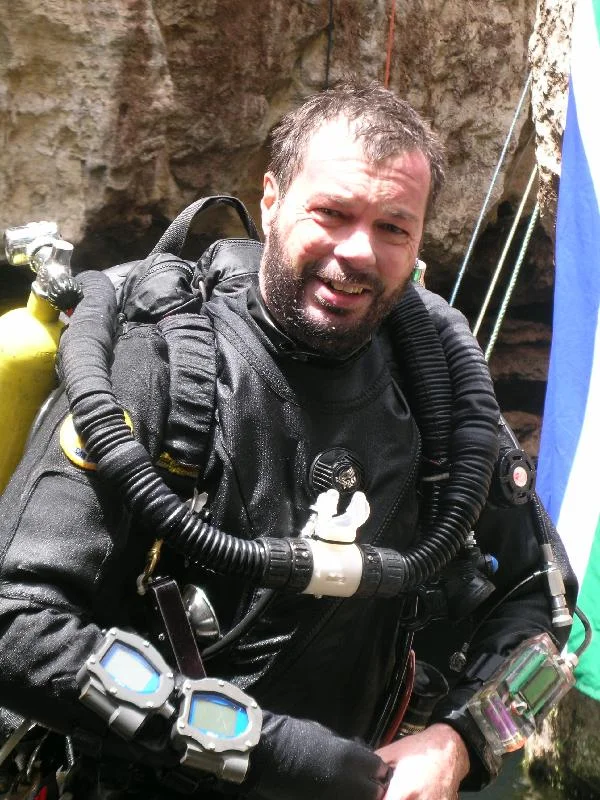

Boesmansgat
From the surface, Boesmansgat looks almost ordinary - a still pool of water in a sinkhole on a quiet South African farm. It betrays nothing of what lies below. The water drops away into darkness for more than 280 meters, making this one of the deepest freshwater caves on Earth, and the depth is only half the danger. Because the sinkhole sits more than 1,500 meters above sea level, the thin air at the surface plays cruel tricks on a diver's body: descending to the bottom here is, in decompression terms, the same as diving to 339 meters in the open ocean. "Bushman's Hole," the English name, sounds gentle. It is not. This is one of the most demanding and dangerous dives in the world, and the people who have gone deepest into it have come back changed - or not at all.
The Long Way Down
In August 1996, the South African diver Nuno Gomes descended to 282.6 meters at Boesmansgat and set a world record for the deepest dive in a freshwater cave that would stand for over two decades. The dive took twelve hours - a few minutes falling through the dark, then hours hanging in the water on the way up, off-gassing nitrogen one careful stage at a time so the pressure would not tear his body apart. At the very bottom, in near-zero visibility, Gomes became stuck in soft mud for two agonizing minutes before he could free himself and begin the ascent. Records have edged deeper since. Women divers have written their own chapters: Verna van Schaik reached 221 meters in 2004, and in October 2022 Karen van den Oever descended to 246.56 meters on open-circuit equipment, claiming the women's world record for the deepest cave dive.
The Diver in the Dark
In 1994, a twenty-year-old named Deon Dreyer was helping a diving team at Boesmansgat when something went wrong on his ascent. He lost consciousness at around 50 meters and never resurfaced. His body could not be recovered - it had come to rest far below, at the bottom of the hole - and for a decade his family lived without the certainty of laying him to rest. Then, in 2004, a cave diver named Dave Shaw, pushing toward a record of his own near 270 meters, found Dreyer where he had lain for ten years. Shaw made a quiet promise to the family: he would go back and bring their son home.
Dave Not Coming Back
On 8 January 2005, Dave Shaw descended into Boesmansgat to recover Deon Dreyer's body. At that crushing depth, the smallest problem becomes deadly. Shaw became entangled in his own guideline as he worked, and he could not free himself in time. He died on the bottom of the cave he had hoped to leave for the last time. His close friend and support diver, Don Shirley, nearly died as well during the desperate response and was left with permanent injury to his balance. The story is told in the 2020 documentary Dave Not Coming Back, and it has echoed beyond the diving world - the Australian band We Lost the Sea wrote "The Last Dive of David Shaw" in his memory. What lingers is not the records but the human cost: a young man lost too soon, and a diver who died trying to give that man's family some peace.
Still Pushing the Limit
Even now, Boesmansgat draws the small, fierce community of technical divers who measure themselves against the deepest, most unforgiving water in the world. In May 2024, Richard Harris - the Australian anaesthetist who helped rescue the Thai youth soccer team from a flooded cave in 2018 - explored the bottom at 284 meters, breathing an exotic hydrogen mix in a twin rebreather system to survive the depth. On a second dive there with his longtime friend Craig Challen, Harris suffered spinal decompression sickness and needed treatment in a Johannesburg hospital. The hole gives up its records grudgingly. For everyone who descends, the same truth holds at the bottom: getting down is the easy part. The water does not care about your reputation, and the only way home is the slow, patient climb back toward the light.
From the Air
Boesmansgat is a flooded sinkhole on a farm in South Africa's Northern Cape at 27.92°S, 23.64°E, on the dry southern margin of the Kalahari at an elevation above 1,500 meters. From the air it is nearly invisible - a small dark pool in flat, sun-bleached savanna grazing land, with no dramatic surface relief to mark one of the planet's deepest freshwater caves. The nearest large airport is Kimberley (FAKM), roughly 200 km to the southeast; Upington (FAUP) lies to the west. The high-altitude desert air delivers clear skies and long visibility for most of the year over a tawny, sparsely vegetated landscape.
Nearby Stories
- Kalahari Meerkat Project 33 km away
- Canteen Kopje 54 km away
- Witsand Nature Reserve 84 km away
- Tswalu Kalahari Reserve 88 km away
- Nooitgedacht Glacial Pavements 89 km away
- 1995 Rugby World Cup 101 km away
- Battle of Rooiwal 132 km away
- Boegoeberg Dam 164 km away