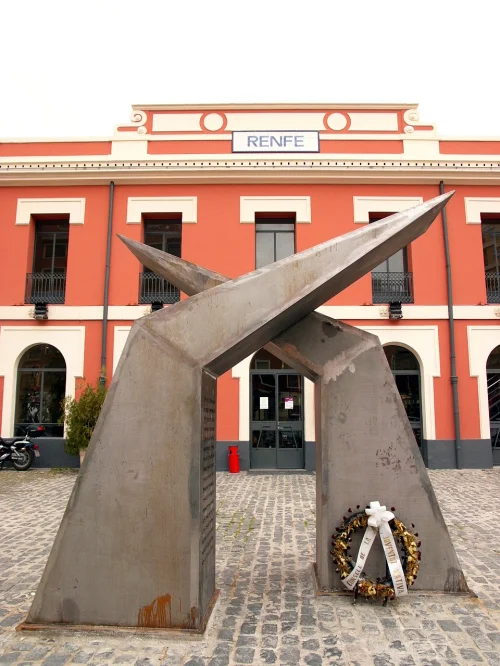

Bombing of Xàtiva
The train reached Xàtiva station on the morning of 12 February 1939, and the platform was already crowded with people waiting for it. Word had spread that soldiers were aboard, and families had come to the station hoping to catch sight of a son, a husband, a brother among them, or simply to press a parcel into a familiar hand before the train moved on. It was an ordinary human scene in the last, exhausted weeks of the Spanish Civil War. It lasted only until half past ten, when the sound of aircraft engines came in high from the sea.
The Platform at Half Past Ten
The train carried military personnel of the Spanish Republican Army, men of the 49th Mixed Brigade being transferred to another posting. As it stood in the station, it was ringed by civilians, the ordinary throng of a market town whose railway was its lifeline to the rest of the shrinking Republican zone. Xàtiva itself was old and unremarkable to the war, a place of the Valencian interior with a castle on its hill and no front line anywhere near. There was nothing about that morning to suggest the station was a target worth twenty bombs, and yet it was about to become one.
Five Aircraft from Mallorca
The attack was carried out at the behest of Francisco Franco's Nationalist government by the Aviazione Legionaria, the expeditionary air force sent by Fascist Italy to fight on his side. Five Savoia-Marchetti SM.79 bombers had taken off from Palma de Mallorca, out across the Mediterranean. At around 10:30 they arrived over Xàtiva and, from a height of 4,200 meters, released twenty bombs of 250 kilograms each onto the railway station below. From that altitude the crews would have seen almost nothing of who was on the platform. The bombs fell on the standing train and the crowd pressed around it.
The Toll
One hundred and twenty-nine people were killed, one hundred and nine of them instantly, and more than two hundred were wounded. Most of the dead were soldiers of the 49th Mixed Brigade, but the crowd meant the killing did not stop at uniforms. Among the victims were fourteen women and three children, people who had come to the station only to greet the men on the train. The brigade was so shattered by its losses that the Republican command gave up trying to rebuild it, scattering the survivors among other units instead. A fighting formation, and a good part of the crowd that had come to welcome it, were erased in a few minutes.
A War All but Over
What makes the morning harder to bear is how little was left to decide. By February 1939 the Republic was collapsing. Barcelona had already fallen in January, and the central-southern zone that still held Xàtiva would surrender within weeks; Franco declared final victory on 1 April 1939. The soldiers of the 49th Mixed Brigade were not defending a threatened front but being shuffled through the wreckage of a losing war. The bombs that killed them and the families around them fell on a town whose fate, and whose country's fate, was already effectively sealed.
Remembering Xàtiva
For decades the dead of the station were part of a history Spain was slow to speak about aloud. The bombing joined the grim roll of Republican towns struck from the air by Italian and German aircraft during the war, from Guernica to Barcelona, raids that helped make the deliberate bombing of civilians a signature of the conflict. What happened at Xàtiva was, in the end, an ordinary example of an extraordinary cruelty: a rail junction in the Republican rear, a transferring brigade, a crowd of well-wishers, and a formation of bombers willing to release its load on all of them together from four kilometers up. Xàtiva has kept the memory, in local accounts and images that preserve what happened on its platform, and in the quiet arithmetic of 129 names. The station still stands and still runs trains, but for the town, the morning of 12 February 1939 remains a wound that no timetable ever quite covers over.
From the Air
The site is Xàtiva railway station at 38.992 N, 0.524 W, on the plain of the Valencian interior about 55 km south of Valencia city. From the air the town is marked unmistakably by the long, twin-castle silhouette of the Castell de Xàtiva stretching along the ridge above the rooftops, with the rail line and station on the flat ground below. Recommended reflective viewing altitude 3,000 to 5,000 ft AGL. Valencia (LEVC) lies to the north; Alicante-Elche (LEAL) is farther south. The Italian bombers approached from the Mediterranean to the east at 4,200 m; today the surrounding huerta is generally clear, though summer heat haze can soften the view of the castle ridge by afternoon.
Nearby Stories
- Font Roja Natural Park 1.9 km away
- Calpe 5 km away
- Battle of Almansa 7.6 km away
- Hēmeroskopeion 14 km away
- Battle of Alcalá (1129) 19 km away
- Jumilla 32 km away
- Requena 32 km away
- Festival Internacional de Benicàssim 95 km away