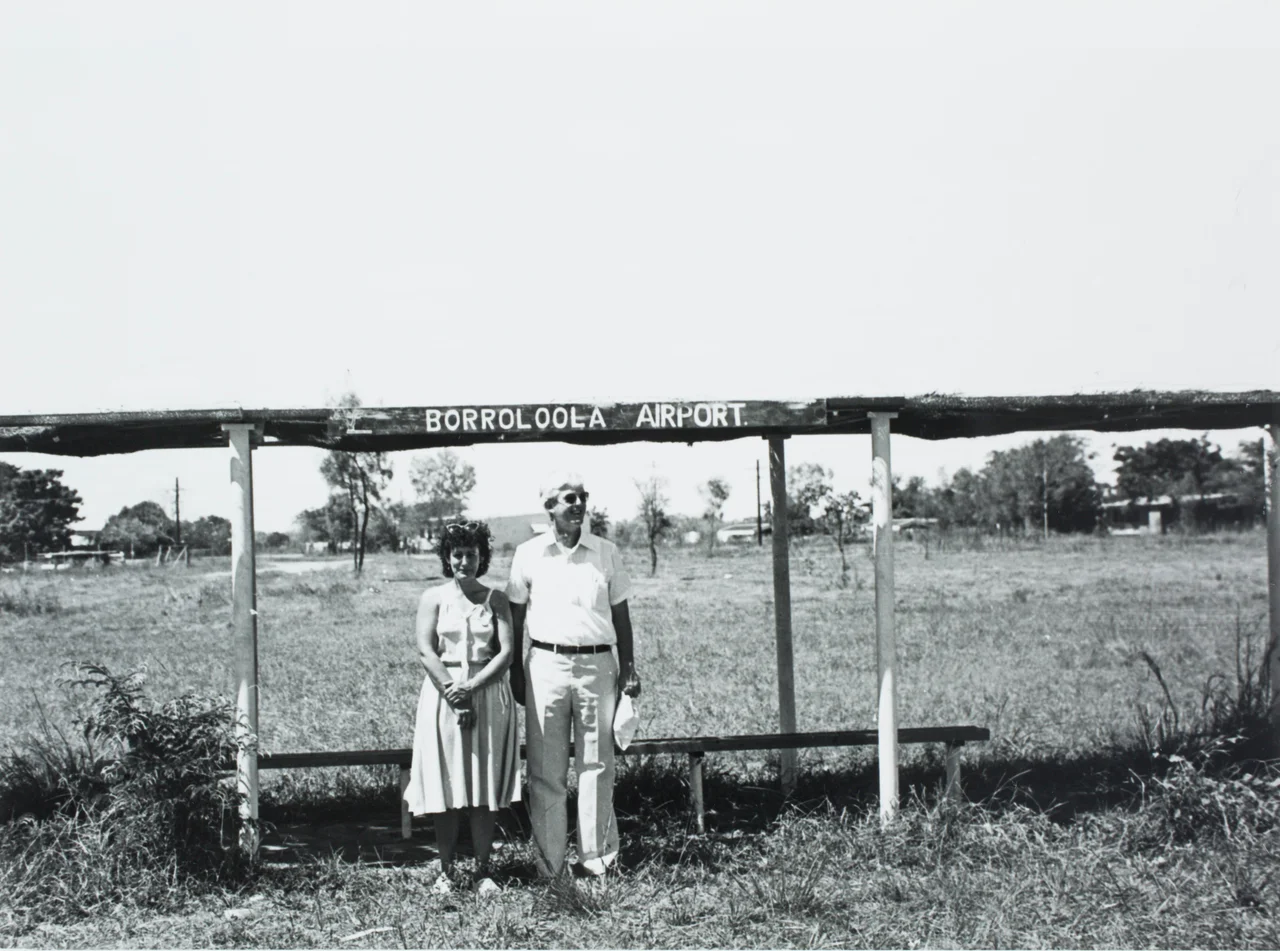

Borroloola
Some 3,000 books once arrived in a town that had no library to put them in. The volumes came to Borroloola early in the twentieth century after a police corporal wrote to the Carnegie Trust asking for something to read, and the courthouse became their only shelter. Plutarch ended up in the hotel lavatory; a fine edition of Shakespeare was torn up to light campfires. That a town this remote — a cluster of buildings on the McArthur River, a day's hard travel from anywhere — became briefly famous for a flood of literature it could not keep tells you something about Borroloola. It is a place where the unexpected washes in, and where the deeper story belongs to people who have read this country far longer than any book.
Burrulula, Where the Kangaroo Danced
In Yanyuwa, Garrwa, Mara and Gudanji, the town is Burrulula, and the name belongs to a small lagoon just east of the present caravan park. The story says the Hill Kangaroo Ancestor, Nangurrbuwala, danced his ceremonies here. The white-barked gums scattered through the area are remembered as his body decorations, flung from him as he moved. Nearby places carry the rest of him: Wurrarawala, the hill that is his backbone; Mabunji, rocks at the river crossing that hold the imprint of his tail and feet. This is not folklore tacked onto a map. It is the map. For the four nations whose country meets here, the land is read as ancestral bodies and their deeds, and Borroloola sits in the middle of that reading, on the country of the Rrumburriya clan.
A Decade That Changed Everything
The town was declared in 1885, but the change had already begun. Cattle drovers pushed herds from north-west Queensland to stock new stations, following — without ceremony or permission — paths Aboriginal people had walked for generations. The historian Tony Roberts records what came next: in a single decade after 1870, the peoples of this Gulf country went from near-total isolation to a scattered, defeated remnant. Whole groups, among them the Wilangarra, were massacred — women, children and babies killed alongside the men, by police, by quasi-police parties, by station hands moving the cattle. These were not statistics. They were families with names, ceremonies and country, and the violence done to them is part of how Borroloola came to be a town on a map drawn by others.
The Man Taken at Four
John Kundereri Moriarty was born here around 1938, a full member of the Yanyuwa, his Dreamings the Rainbow Serpent and the Kangaroo. At four years old he was taken from his mother under the policies that created the Stolen Generations, and he did not see her again for a decade. He found his way back. In 1960 he became the first Aboriginal man selected for the Socceroos, Australia's national team, though he never took the field — Australia was suspended by FIFA before he could play. He went on to found the Balarinji design studio, whose Aboriginal artwork wrapped entire Qantas jets, and to receive the Order of Australia and a UNESCO award. With his wife Ros he built the Moriarty Foundation to strengthen Aboriginal families. His life runs the length of the wound and the return.
The Longest Wait for Home
In 1977, the Yanyuwa became the first people in the country to lodge a claim under the new Aboriginal Land Rights (Northern Territory) Act 1976, over Borroloola and their Pellew Islands sea country. What followed was not swift justice. Centre Island came back in 2006. A surveying error left four small islands out of that grant, and they were not returned until 2015 — thirty-eight years after the claim began, by which time many of the elders who fought for it were gone. Today the town's life turns on three things: tourism, the controversial McArthur River zinc mine 70 kilometres away, and art. At Waralungku Arts, an Aboriginal-owned centre opened in 2003, that long story of country gets painted, and sold, on the artists' own terms.
Saltwater People, Freshwater Town
Borroloola sits upriver, but its heart reaches to the sea. The Yanyuwa call themselves li-Anthawirriyarra — people whose spiritual origin is the sea — and their hunters once ranged the seagrass beds out to the islands after dugong and turtle. The McArthur estuary below town runs near-pristine, mangrove-lined, thick with barramundi that draw anglers every dry season, and with saltwater crocodiles that ask for a healthy respect. When the wet season floods the unsealed road east to Queensland, the town turns inward and waits. Then April comes, the waters drop, the grey nomads roll in for the Easter fishing classic, and Borroloola opens again to the river that made it.
From the Air
Borroloola lies at 16.07°S, 136.31°E on the McArthur River, roughly 60 km upstream from the Gulf of Carpentaria. The town's airport (ICAO YBRL, IATA BOX) has a single sealed runway just south of the settlement, solar-lit at night; the nearest alternate is McArthur River Mine Airport (YMHU) about 47 km away. From the air the silver thread of the McArthur estuary winding through dark mangroves toward the Sir Edward Pellew Islands is the clearest landmark. Best viewing is in the dry season (May–September), when clear skies and low haze open up the coastal plain; wet-season storms and flooding can make the region impassable on the ground and bumpy above it.
Nearby Stories
- Sir Edward Pellew Group of Islands 18 km away
- McArthur River zinc mine 19 km away
- Vanderlin Island 49 km away
- Limmen National Park 106 km away
- Maria Island, Gulf of Carpentaria 118 km away
- Limmen Bight 147 km away
- Wollogorang Station 159 km away
- Murranji Track 350 km away