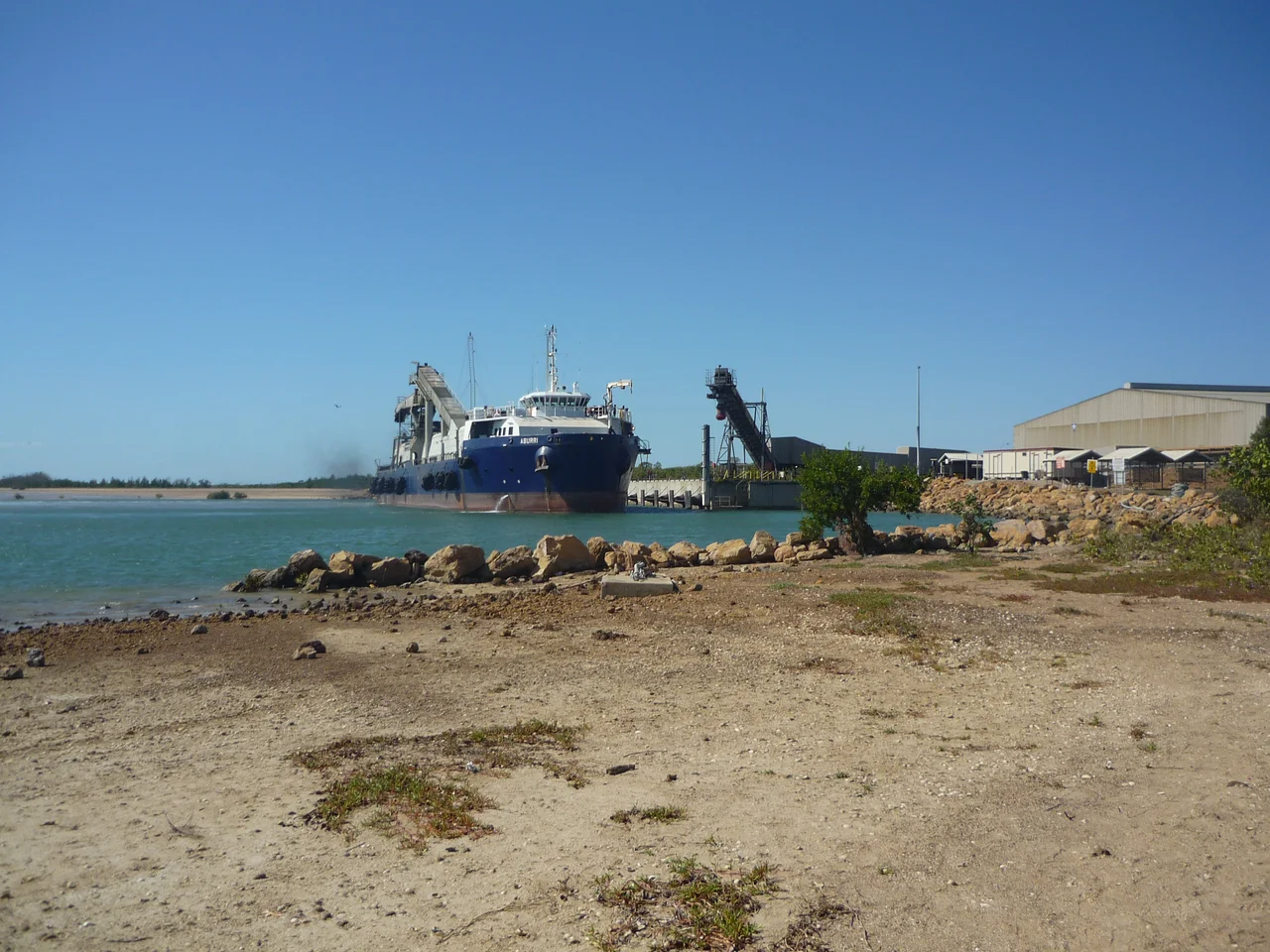

McArthur River zinc mine
To open the pit, they moved the river. In the country southwest of Borroloola, near the Gulf of Carpentaria, the McArthur River once ran its ancient course until the mine that bears its name diverted it through a five-and-a-half-kilometre artificial channel and dug an open-cut pit into the old riverbed. The ground beneath holds one of the largest zinc, lead, and silver deposits on Earth. It is also, for the Gudanji, Garrwa, Marra, and Yanyuwa peoples, the resting place of the Rainbow Serpent - and that collision, between a world-class orebody and a living sacred landscape, is the whole story of this place.
Here's Your Chance
The deposit's official name was born of an offhand joke. A station manager had noted valuable metals in the area as far back as 1887, but it took a Mount Isa Mines survey party to prove the find in 1955. As the geologists tallied prospects, chief geologist Syd Carter asked his colleague Ron Beresford what to call the zinc body. Beresford, who had been naming everything in sight, shot back: "Here's your chance, Syd." Carter replied, "That'll do." And so one of the planet's great mineral deposits became, officially, HYC - "Here's Your Chance." The casual christening belied a hard reality: the ore was so fine-grained and so tangled with lead that no existing technology could economically separate it. The deposit would sit, known but untouched, for decades.
The Problem of the Ore
What finally unlocked McArthur River was an engineering breakthrough. The HYC orebody is a dust-fine dissemination of valuable minerals laced through worthless rock, and its high lead content made the lead and zinc nearly inseparable before smelting - with few smelters anywhere able to handle concentrate so rich in lead. The mine could not exist until Mount Isa Mines perfected the IsaMill, a fine-grinding technology, and later developed a new leaching method called the Albion process. Only then, in 1995, did the mine open at last - first underground, then, after a contentious 2009 conversion, as a vast open cut. Bulk concentrate now travels 120 kilometres by road to the coast, where a purpose-built barge ferries it out to bulk carriers waiting offshore in the Gulf.
A River and a Dreaming Disturbed
Borroloola is home to the Gudanji, Garrwa, Marra, and Yanyuwa peoples, and the mine sits in the heart of country woven through with their law and stories. The orebody lies at what they understand as the resting place of the Rainbow Serpent; nearby run the Barramundi Dreaming and the Jabiru Dreaming. When the river was diverted and the pit opened, traditional owners said it tore at this sacred fabric, and the growing mountains of waste rock came to block the view of Damangani, the Barramundi Dreaming. They fought the expansion through every avenue available - the Northern Land Council, the Environmental Defenders Office, the Supreme Court, the Federal Court. They won cases only to see the wins overturned or declared invalid; approvals were revoked and reinstated within days. In 2026 the Federal Court awarded traditional owners more than 54 million dollars in compensation for cultural loss — in a landmark ruling known as the Davey decision, delivered after years of on-country hearings — a recognition of harm that money cannot truly undo.
The Ground Itself Turns
The mine's troubles have not been only legal. In 2013, a waste dump caught fire from within: pyrite stacked in the heap overheated and ignited, after the rock was wrongly classified in the mine's own environmental statement - only 12 percent labelled as acid-forming when far more was. Smoke kept reappearing for years. Seepage of sulfate, zinc, and possibly lead and cadmium has been detected in nearby creeks. Testing found small fish in the McArthur River contaminated with lead above safe limits, yet in 2015 it emerged that a health officer's recommendation to warn local people not to eat the fish had gone unheeded. For people whose diet and culture are tied to that river and to dugongs grazing the coastal seagrass, the contamination is not an abstraction. It strikes at food, health, and a way of life.
A Reckoning Still Unfinished
Rehabilitating the site may cost up to a billion dollars. The mine, now owned by the Swiss commodities giant Glencore, has been approved to operate until 2038, and it pours billions into the Northern Territory and national economies. But Indigenous people and environmental groups continue to call for its closure and cleanup. When Tropical Cyclone Megan dumped 274 millimetres of rain in a single day in March 2024, traditional owners raised alarm over erosion of the acidic waste piles, even as Glencore insisted the dumps held firm. In recent years the company and a Gudanji, Yanyuwa, Garrwa, and Marra Aboriginal corporation have signed cooperation and cultural-heritage agreements - a tentative step toward repair. Whether that can heal a diverted river and a wounded Dreaming is a question the Gulf country is still living through.
From the Air
The McArthur River mine lies at roughly 16.43 degrees S, 136.08 degrees E, about 70 km southwest of Borroloola in the Gulf country of the Northern Territory, inland from the Gulf of Carpentaria. From the air the open-cut pit, the diverted river channel, and the pale waste-rock dumps make the site unmistakable against the surrounding scrub. The mine has its own airfield, McArthur River Mine Airport (ICAO YMHU); Borroloola (YBRL) lies to the northeast. The Bing Bong loading facility, where concentrate is barged out, sits on the coast to the north. This is remote, sparsely serviced country with few navigation aids and long distances between fields. Visibility is excellent in the dry season (May to October); the wet season brings monsoonal storms, flooding, and tropical cyclones - one of which forced the mine's temporary closure in 2024.
Nearby Stories
- Borroloola 14 km away
- Merlin diamond mine 20 km away
- Sir Edward Pellew Group of Islands 56 km away
- Vanderlin Island 83 km away
- Wollogorang Station 139 km away
- Limmen National Park 140 km away
- Limmen Bight 185 km away
- Murranji Track 347 km away