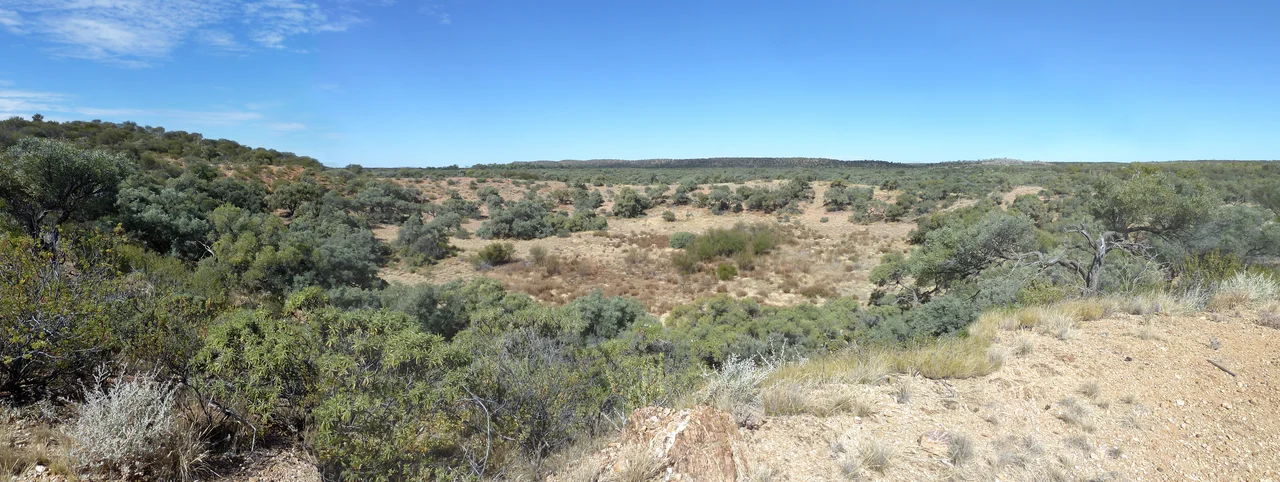

Boxhole Crater
Somewhere between five thousand and thirty thousand years ago - geologists still disagree - a chunk of iron travelling at enormous speed slammed into the central Australian desert and punched a near-perfect bowl into the earth. That bowl is still there, a hundred and seventy metres across, its rim sharp and its floor open to the sky - barely weathered by the standards of geology. Boxhole crater is one of the youngest impact sites on the continent, and it sits in country that Aboriginal people have walked for far longer than the crater has existed. A scar this fresh raises an irresistible question: who was here to see the sky catch fire?
A Bowl in the Desert
Boxhole is what scientists call a simple crater - no central peak, no terraced walls, just a clean circular depression where the ground recoiled from a sudden, violent blow. At a hundred and seventy metres wide it would swallow a few football fields, and it lies fully exposed at the surface, which is rare and lucky. The dating is fiercely debated: one method using cosmogenic carbon-14 puts the impact at roughly 5,400 years ago, give or take fifteen centuries; another using different isotopes suggests closer to thirty thousand years. Both place it firmly in the Holocene, our own geological epoch. In planetary terms the crater is practically newborn. The desert simply has not had enough time, or enough rain, to soften its edges or fill it in.
The Shearer and the Geologist
The crater entered the scientific record almost by accident. In 1937, a shearer named Joe Webb, who worked at the Boxhole sheep station, led the geologist Cecil Madigan out to see the strange circular feature in the scrub. Madigan knew at once it was something extraordinary. Poking through the ground he found nickel-bearing metallic fragments and rounded iron shale-balls, the unmistakable shrapnel of a meteorite, identical to material from the Henbury craters south of Alice Springs that he had studied before. Boxhole became only the second impact crater ever described in Australia, after Henbury. Later searches turned up more of the fallen iron, including a single mass weighing eighty-two kilograms - heavy as a grown man - which now resides in the Natural History Museum in London.
Witnesses to the Fall
Here the science runs into something deeper. The crater is young enough that humans were unquestionably living in central Australia when it formed - this is country of the Arrernte and their neighbours, occupied for tens of thousands of years. Elsewhere in Australia, Aboriginal traditions preserve startlingly accurate memories of cosmic impacts; the nearby Henbury craters, known in the local language as Tatyeye Kepmwere, carry their own stories of fire falling from the sky. Boxhole itself has no widely recorded oral tradition in the published literature, and any knowledge that does exist belongs to its Aboriginal custodians, not to outsiders. But the possibility hangs over the place. Somewhere on this land, fifty centuries ago, people may have looked up and seen a streak of fire and felt the ground shudder beneath their feet.
Reading the Sky's Handwriting
Boxhole belongs to a small and exclusive club. Only a handful of impact craters on Earth are well preserved, openly exposed, and young enough to have formed within the span of human memory, and Australia's stable, ancient, slow-eroding interior holds more than its share. Each one is a fragment of solar-system violence frozen in stone, a reminder that the planet is not sealed off from what lies beyond it. Standing on the rim, you are looking at the precise spot where the sky once reached down and touched the ground. The iron that made this hole came from the broken core of an asteroid, drifting for billions of years before its path happened to intersect with one quiet patch of desert. The crater is the receipt for that collision, written in the only handwriting the sky has - and central Australia keeps the record beautifully.
From the Air
Boxhole crater lies at approximately 22.61 degrees south, 135.20 degrees east, about 180 kilometres north-east of Alice Springs in the Northern Territory, on Dneiper Station in the Central Desert Region. From altitude the crater reads as a small but distinct circular depression about 170 metres across, set in flat to gently undulating desert scrub - easiest to pick out when low sun casts a shadow along its raised rim. The nearest major airport is Alice Springs Airport (YBAS) to the southwest, the gateway to all of Central Australia. The Dulcie Range lies to the east and the Harts Range to the south. The arid climate gives excellent year-round visibility; for crater-spotting, the raking light of early morning or late afternoon makes the rim and bowl far easier to distinguish from the surrounding plain.
Nearby Stories
- Hart, Northern Territory 22 km away
- Barrow Creek, Northern Territory 118 km away
- Alice Springs Telegraph Station 120 km away
- Stuart Highway 134 km away
- Marqua Station 164 km away
- Wycliffe Well 196 km away
- Simpson, Northern Territory 253 km away
- Moonah Creek Hanging Tree 344 km away