.jpg)
Moonah Creek Hanging Tree
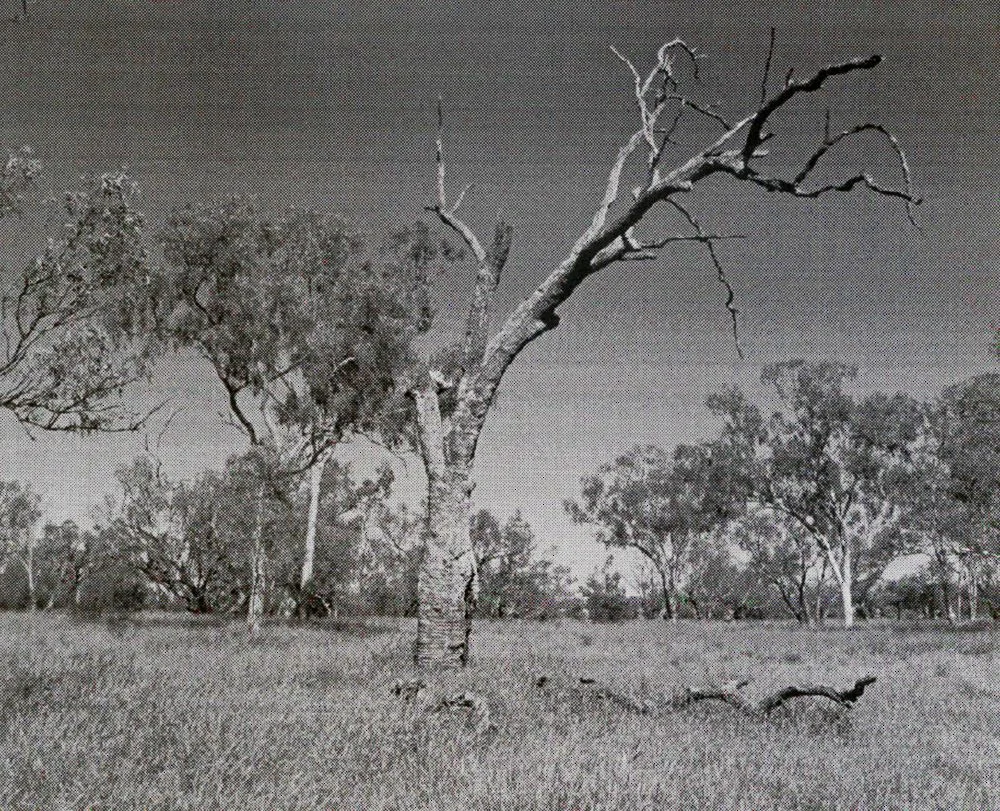
It is a beautiful tree, or was. A ghost gum, pale-barked and luminous against the red earth of far western Queensland, standing about ten metres back from the bank of Moonah Creek. To the people who pass it on the road between Urandangi and the Diamantina, it has another name, and another meaning. The Waluwarra remember it as the place where their ancestors were hanged. Around the turn of the twentieth century, oral history holds, local police used this gum as a gallows and put to death fifteen Aboriginal people, a punishment for cattle spearing carried out, in the colonists' phrase, as an example. The tree is now on the Queensland Heritage Register, listed not for its beauty but for what was done beneath it.
Whose Country This Is
This is Waluwarra country, and has been for far longer than there have been fences across it. Their lands run through the dry, open tablelands of the far west, along the Georgina River and Pituri Creek, around Urandangi and the parish of Moonah where the tree stands. They are a people of this specific, demanding landscape of gidgee and coolibah and spinifex, who knew its waters and its seasons across countless generations. When pastoralists pushed cattle onto the Barkly Tableland from the 1870s, they did not arrive at empty land. They arrived in the middle of a nation, and the conflict that followed was not a clash of strangers but an invasion of a homeland whose people had every reason, and every right, to resist.
What the Old People Say
The Waluwarra account, carried in the oral history of the Waluwarra Aboriginal Corporation, is specific. Two policemen stationed at Urandangi, helped by Aboriginal trackers, rounded up a group of Waluwarra people said to have speared cattle. The men were competing with Aboriginal families for the same country and the same scarce water, and stock losses were met not with arrest and trial but with reprisal. The police built a timber gallows in the fork of the gum and hanged the prisoners, fifteen of them by the count that survives, as a warning to everyone watching. No record was kept of their names. They were somebody's parents, somebody's children, somebody's brothers and sisters, and the colonial state that killed them did not think their identities worth writing down. That silence in the archive is its own kind of violence, and the remembering that fills it is the work of the descendants who refuse to let the dead go nameless and forgotten.
The Frontier in the Record
What the police wrote down, and what actually happened, are not the same history. No documentary evidence of the Moonah Creek hangings has ever been found, and historians note that in the long, bloody operation of Queensland's Native Police, the killings were almost always by gun rather than rope. Some have suggested the beam grown into the gum might instead have been a butchering frame for cattle, of a kind found on many stations. But the absence of a paper trail proves nothing about the absence of a crime, least of all on a frontier where massacres went deliberately unrecorded and where the men who carried them out had every reason to keep no ledger. The Waluwarra do not doubt what happened here. The Queensland Heritage Register, in listing the place in 2005, recognised it for exactly what they have always said it is: a conflict site, a true witness to the violence that ran through the frontier.
A Witness Still Standing
The tree itself is dying, or already dead. A report in 2003 found it reduced to about eight metres, two of its four great limbs gone, the very limb that had held the gallows beam fallen and broken on the ground, the beam itself missing, the trunk cracked and eaten through by termites. Nature is slowly taking back the wood. But the place does not lose its meaning when the timber rots. For the Waluwarra and for the wider community of the region, Moonah Creek remains a site of mourning and of memory, somewhere the past is not abstract but rooted in a particular patch of red ground beside a particular creek. Australia is dotted with such trees, quiet markers of a war that the nation took a long time to name. This one is remembered out loud, which is the least the dead are owed.
From the Air
The Moonah Creek Hanging Tree stands at 21.50 degrees south, 138.92 degrees east, deep in the far west of Queensland on the Barkly Tableland, on Oban country near the small settlement of Urandangi and close to the Northern Territory border. This is remote inland country, not the coast: flat, semi-arid rangeland of grass, gidgee and ghost gums, threaded by the usually dry channel of Moonah Creek near the Urandangi to Mount Isa road. The site is unmarked from the air and easily lost in the vast tableland; the creek line and the Urandangi township are the main references. Mount Isa Airport (ICAO YBMA) lies roughly 150 km to the northeast and is the nearest significant aerodrome; Urandangi has only a basic airstrip. Recommended viewing altitude is 3,000 to 5,000 feet over open country with excellent visibility for most of the year, though summer heat haze and dust can reduce it. This is a place to approach with quiet respect, not spectacle.
Nearby Stories
- Mary Kathleen, Queensland 69 km away
- Casa Grande, Mount Isa 74 km away
- Mount Elliott Mining Complex 97 km away
- Burke River 122 km away
- Glenormiston Station 127 km away
- Camooweal Caves National Park 143 km away
- Pilungah Reserve 154 km away
- Community Hall, Camooweal 184 km away