.jpg)
Mount Elliott Mining Complex
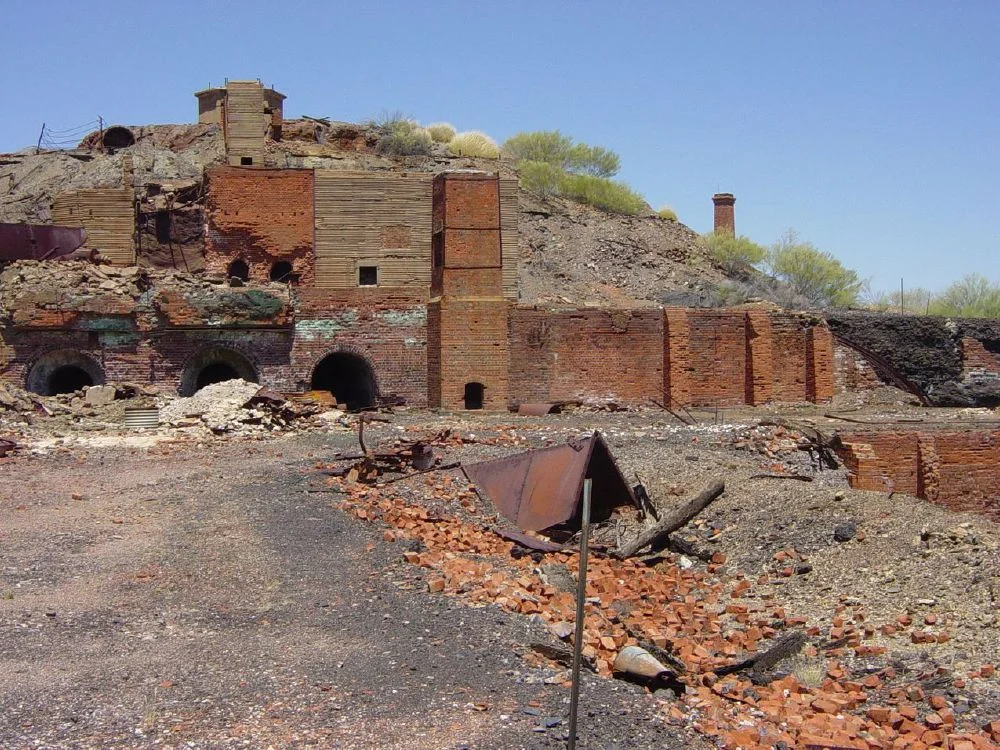
For a few feverish years, this stretch of dry, broken country fed copper to the world. The town of Selwyn grew from nothing to 1,500 people; the smelter beside it ran the largest furnace in Australia. Then the price of copper collapsed, the works fell silent, and the desert began taking everything back. Today the chimneys, slag heaps, and rusting machine beds of the Mount Elliott Mining Complex stand among the saltbush like the bones of a beast that lived hard and died young. It is one of the most complete records of Queensland's frantic copper age - a place where ambition, engineering, and bad timing are written into the ground itself.
A Field That Waited Forty Years
The Cloncurry copper field had stagnated for four decades before Mount Elliott woke it. The problem was a trap with no obvious way out: without capital, no one could prove the ore bodies were rich; without proof of wealth, no one would build a railway; and without a railway, no one dared sink capital into the unknown. Something had to break the deadlock. In 1906, with copper fetching its highest London price in thirty years, it finally did. A prospecting shaft went down at Mount Elliott, a Cornish boiler and winding plant arrived in August, and Melbourne investors floated the venture on the stock exchange. The bet was enormous, the country merciless. But the metal was there, and the rush was on.
Corbould's Empire
The man who turned the gamble into an industry was William Henry Corbould, a metallurgist with a grand vision for the whole Cloncurry district. Arriving as manager, he scrapped the directors' first plant and designed his own. He commissioned a 200-ton water-jacket furnace from Walkers Limited of Maryborough, built a powerhouse, and pushed production to its peak: 6,690 long tons of blister copper in 1912, the company's best year. He bought rival mines, including the Hampden Consols at nearby Kuridala, stitching the scattered fields into one enterprise. Many of the surviving ruins date from this confident moment. Corbould was no gentle boss - he clashed with inspectors and unions alike - but his name is on almost everything that still stands here.
War, Strikes, and the Reckoning
The First World War sent copper prices soaring as the metal went into shells and wire, and Selwyn boomed. Corbould rebuilt the smelter around an enormous new furnace - so large it was later cut down from 6.5 to 5.5 metres. In 1918 it swallowed 77,482 long tons of ore and produced 3,580 tons of blister copper, shipped to Bowen and on to Britain. But the new plant did the work of the old with far fewer men, and the bitterness over lost jobs erupted into strike after strike. Then the war ended. In 1919 the copper price plunged within months, the company's hopes for low-grade ore collapsed, and the smelter closed after two months. Most of the workforce was simply let go.
What the Desert Kept
The end came slowly. Mount Isa Mines bought the plant and machinery in 1943 for just £2,300, hauling away what it needed to keep copper flowing during the Second World War; the parent company was wound up a decade later. What remains is a landscape, not a monument. On the northern flank of Mount Elliott lie the ruins of furnaces and an assay office; to the south-west, a square brick stack, the bed of the primary ore crusher, and a winder engine's footings. A nearby basin holds the powerhouse beds, an ore tunnel, and railway embankments. Scattered across it all are the foundations of Selwyn itself, and its cemetery - the quietest evidence of the people who lived, worked, and were buried in this hard, beautiful place.
From the Air
Located at 21.53°S, 140.50°E, roughly 90 km south of Cloncurry near the active Starra mine. From the air the site reads as pale slag heaps, a square brick chimney, and the gridded scars of vanished streets against red-brown ranges. Best viewed in the clear, dry winter months (May–September) when haze is minimal; summer brings heat shimmer and storm dust. The nearest major airfield is Cloncurry Airport (YCCY/CNJ) to the north; Mount Isa Airport (YBMA/ISA) lies further west. Terrain is rugged and remote with few landmarks - the Selwyn Range and the rail formation toward Kuridala are the clearest navigation cues.
Nearby Stories
- Eloise Copper Mine 35 km away
- Cannington Mine 48 km away
- Mount Elliott Company Metallurgical Plant and Mill 61 km away
- Underground Hospital, Mount Isa 75 km away
- Casa Grande, Mount Isa 100 km away
- Combo Waterhole 113 km away
- Boulia Camel Races 124 km away
- Diamantina National Park 174 km away