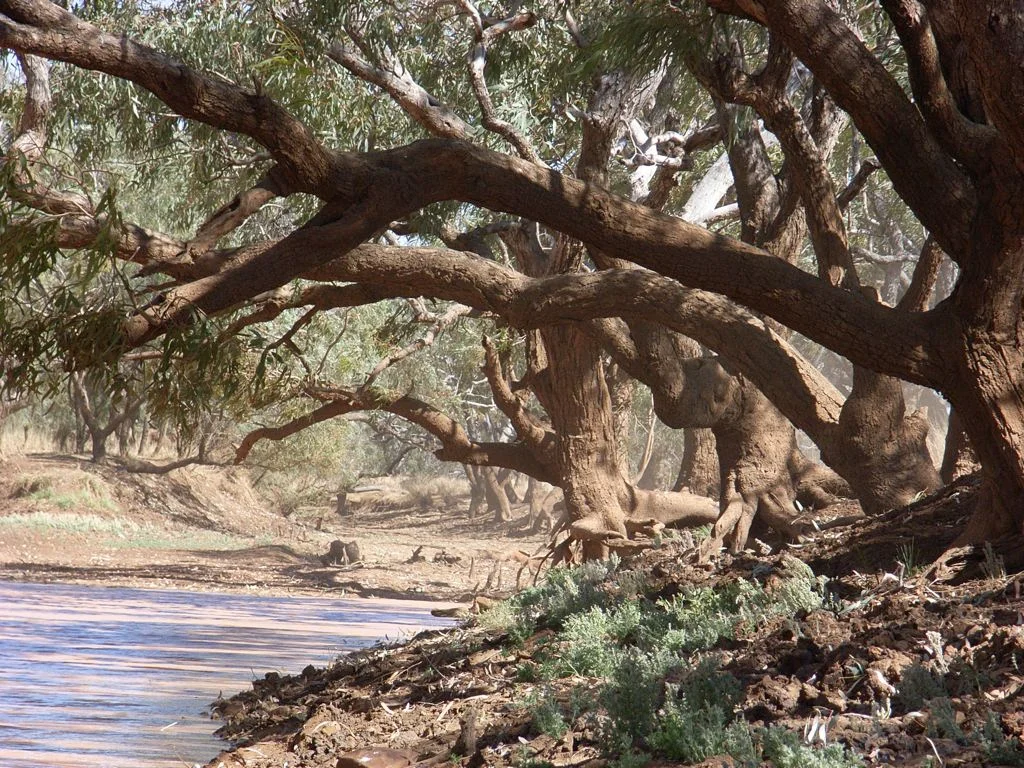

Combo Waterhole
Almost every Australian can sing it, and most of the world has heard it: a swagman by a billabong, a stolen sheep, troopers closing in, and a man who chooses the water over capture. "Waltzing Matilda" is Australia's unofficial anthem, and the billabong that most likely inspired it is a long, still stretch of water on the Diamantina River called Combo Waterhole. There is no monument here, no grand sign, just coolibah trees, Mitchell grass running to the horizon, and the slow brown water that has held its secret for more than a century.
The Real Swagman
The song is gentler than the history. In September 1894, the great shearers' strike was tearing through outback Queensland. At Dagworth station, north of Winton, striking shearers fired their rifles and torched the woolshed, killing more than a hundred sheep. The station owner and three policemen pursued one of the strikers, a man named Samuel Hoffmeister, known as "Frenchy." Cornered near Combo Waterhole, Hoffmeister shot himself rather than be taken. A real man, real desperation, a real death by this water. The defiant swagman of the song who cries "You'll never catch me alive" carries the ghost of a striking worker who meant it.
How the Song Was Born
In 1895, the poet Andrew Barton "Banjo" Paterson visited the Macpherson family at Dagworth. The story goes that at a picnic by Combo Waterhole, Bob Macpherson told Paterson about the drowned striker and his belief that the billabong was haunted. Christina Macpherson played a tune she half-remembered, and Paterson set words to it. From a labour tragedy and a borrowed melody came a ballad about a wandering swagman and a stolen jumbuck. Paterson softened the politics into folklore, and in doing so wrote a song that would outlive every name involved. Whether the ghost was Hoffmeister's or the country's own, it has never left the water.
Stone in the Riverbed
The waterhole holds an older labour story too. Stretched across the Diamantina's braided channels are stone-pitched overshot weirs, low causeways of fitted stone built in 1883 by Chinese labourers to manage the river's floods. Thousands of Chinese workers came to the Australian colonies in the nineteenth century and often did the hardest, least-credited work on stations and goldfields, frequently in the face of hostility. Their weirs still lie in the riverbed near Combo, quietly outlasting the men who laid them, much as the carved waterhole has outlasted the swagman. And older still: this is Koa country. The Koa people have followed the Diamantina's braided channels for generations, and in 2021 the Federal Court recognised their native title over more than 31,000 square kilometres of this country, including this waterhole. The country here remembers its people, even when the history books forget their names.
A Scar From the Sky
Look at the wider land and a stranger story emerges. Combo Waterhole sits at the northern rim of a roughly circular zone about 130 kilometres across that Geoscience Australia has flagged as a crustal anomaly, a faint scar buried in the rock. Its cause is unproven, but one leading idea is that an asteroid struck here around 300 million years ago, long before the Diamantina, the coolibahs, or the swagman. If so, the gentlest folk song in Australia was born on the floor of an ancient impact crater. The waterhole keeps that secret too, layered beneath the billabong like everything else this country chooses not to say out loud.
Standing at the Water
Today Combo Waterhole sits inside a small conservation park, roughly 130 kilometres north-west of Winton off the Landsborough Highway. A walking track leads through Mitchell grass downs and red-soil plains to the water's edge, past the old stone weirs. In the dry season the billabong shrinks to a series of pools fringed with coolibah; after rain the Diamantina spreads across its channels and the whole landscape greens. It is an easy place to stand quietly and feel the weight of it: a labour death, a haunting, an anthem, and an asteroid, all gathered at one bend in an outback river that most travellers would otherwise drive straight past.
From the Air
Combo Waterhole lies at 21.60°S, 142.07°E on the Diamantina River near Kynuna in north-west Queensland, about 130 km north-west of Winton. From the air the billabong shows as a sinuous ribbon of water threading through pale Mitchell grass downs and red-soil plains, with the Diamantina's braided channels fanning out around it. The Landsborough Highway is the obvious linear landmark running northwest toward Cloncurry. Best viewing altitude is 2,500–5,000 ft; in the dry season the water contracts to scattered pools, while after wet-season rain the river spreads dramatically across its floodplain. The nearest serviced airfields are Winton Airport (YWTN) to the southeast and Cloncurry Airport (YCCY) to the northwest; Julia Creek (YJLC) lies north. Expect excellent visibility in the dry season but watch for heat haze, dust, and isolated thunderstorms in the November-to-March wet.
Nearby Stories
- Great Northern Railway (Mt Isa line) 62 km away
- Cannington Mine 80 km away
- Eloise Copper Mine 81 km away
- Bladensburg National Park 101 km away
- Mount Elliott Mining Complex 122 km away
- Lark Quarry Dinosaur Trackways 138 km away
- Millungera Station 171 km away
- Darr River Downs 199 km away