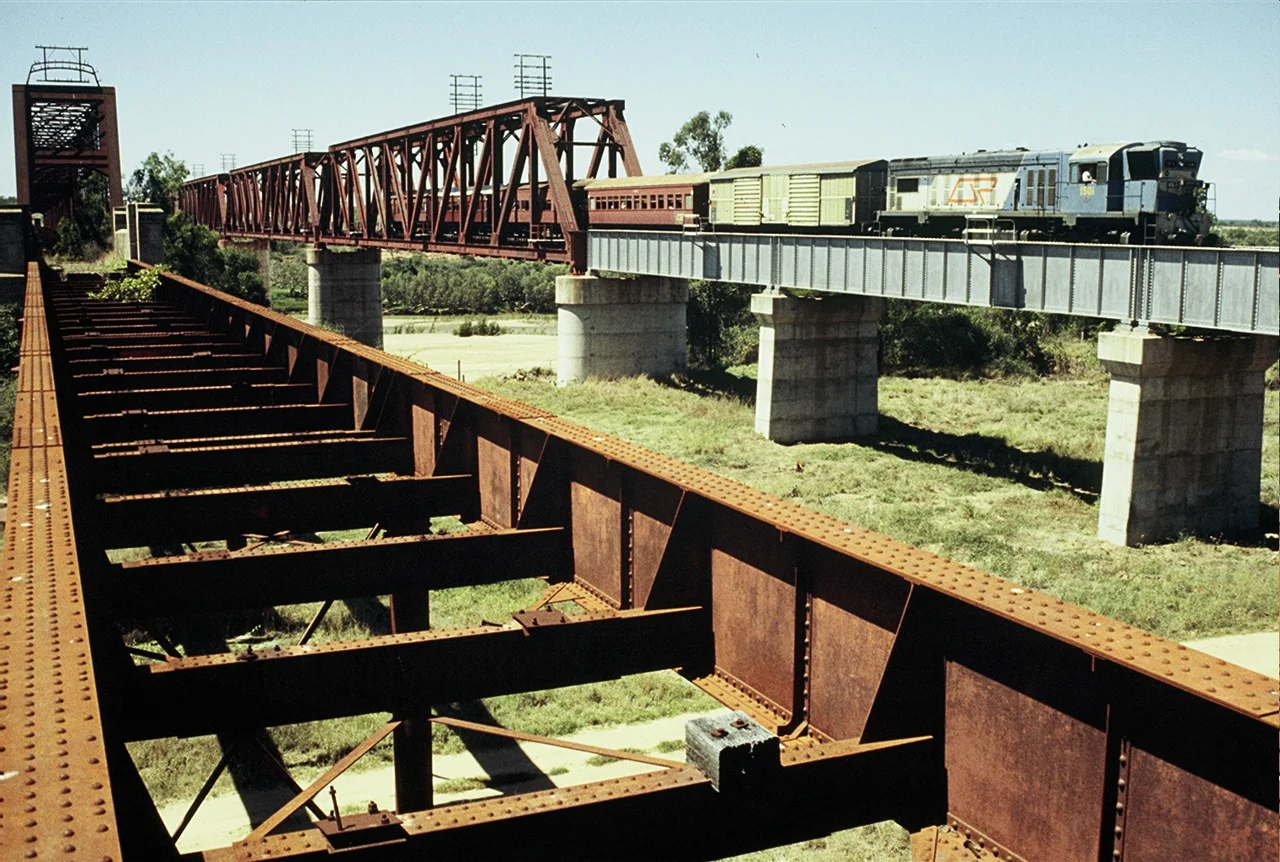

Great Northern Railway (Mt Isa line)
Follow the rails west out of Townsville and you are tracing a fifty-year argument between geology and ambition. The Great Northern Railway runs nearly 977 kilometres from the port wharves on the Coral Sea, up over the Great Dividing Range, and out across the parched western downs to Mount Isa, one of the richest mineral deposits ever found in Australia. It was never planned as a single grand line. It was dragged westward in fits and starts, each new section lunging toward whatever gold, wool, copper, or lead had just been discovered beyond the last railhead. The result is a working monument to nineteenth-century hunger for the inland, and to this day it remains the lifeline that carries Mount Isa's ore to the sea.
Chasing the Gold
The line's first impulse came from gold. Strikes at Ravenswood in 1868 and the fabulously rich Charters Towers field in 1872 gave Townsville a reason to push inland, and the first rails opened on 20 December 1880. To save money, engineers flung the track straight up the Haughton Range on brutal 1-in-25 grades and tight curves, a punishing climb that trains crawled at a few kilometres an hour. The line reached Charters Towers in December 1882, with trains taking more than five hours to cover roughly 140 kilometres. The climb proved so costly to operate that the whole section was re-graded in 1887; the old, abandoned alignment now carries the Flinders Highway. Even the rivers fought back. The Burdekin demanded a major bridge in 1899, designed by chief railway engineer Henry Charles Stanley, and that second crossing still stands today on the Queensland Heritage Register.
West for Wool, West for Copper
Once gold gave way to grazing, the line crept on across the downs toward wool and cattle country, reaching Hughenden in 1887 after a daily mixed train of roughly thirteen hours. Then came copper. The mines around Cloncurry, far out west, pulled the rails onward in a slow relay of approvals and construction. Crews learned to lay track across dry riverbeds first and build the bridges later, since the arid channels stayed empty most of the year. In a small act of frugality that captures the whole enterprise, 85 kilometres of rail originally shipped to Normanton, then stored unused at Croydon, was railed back to Normanton, shipped all the way around Cape York to Townsville, and finally laid in the new track creeping toward Cloncurry. The first train reached Cloncurry in December 1907; the weekly mail train from Townsville took nearly twenty-four hours.
The Mountain of Silver
The last and most consequential push came from a single discovery. In 1923, vast silver and lead deposits were found at Mount Isa. There was an urgent need for rail, but the government doubted the mine would last and balked at the cost. Only when the mining company guaranteed to cover any losses did construction begin in 1926, and the line finally reached Mount Isa on 27 May 1929. That stretch brought the entire half-century enterprise to a close and tied Mount Isa to the eastern seaboard. The government's caution proved spectacularly misjudged: the mine became one of the most successful in the world and is working still. Almost from the start the railway ran a beautifully efficient loop, hauling coal west to feed the smelters and metal ingots east for export, so that few wagons ever ran empty.
Comfort and Catastrophe
For the people who rode it, the line slowly grew more bearable. A Travelling Post Office sorted mail on the move from 1899, and one of Queensland's first buffet cars appeared in 1912, hitched on at Mingela to spare it the haul up the Haughton Range. The real revolution came in February 1953 with the Inlander, the first air-conditioned train in Queensland and the first with air-conditioned sleeping cars in Australia, a small miracle of cool, clean air crossing a hot and dusty land; it still runs the route in around 21 hours. But the country never stopped testing the rails. In February 2019, catastrophic floods tore up 307 kilometres of track between Cloncurry and Hughenden, damaged sixteen bridges, and derailed a freight train of 81 wagons at Nelia. Repairs demanded 100,000 cubic metres of ballast and 10,000 new sleepers. The line endures, as it always has, by being rebuilt.
From the Air
The Mount Isa line runs east-west across north Queensland; this point sits near Hughenden at roughly 20.73°S, 142.88°E. From altitude the railway reads as a remarkably straight ruled line across the tan-and-olive downs, often shadowing the Flinders Highway, with the Flinders River winding nearby. To the east it climbs over the Great Dividing Range toward Townsville and the Coral Sea; to the west it runs through Richmond, Julia Creek, and Cloncurry on its way to Mount Isa. Useful waypoints along the corridor include Hughenden (YHUG), Richmond (YRMD), Julia Creek (YJLC), Cloncurry (YCCY), and Mount Isa (YBMA) at the western end, with Townsville (YBTL) anchoring the coastal terminus. The terrain is mostly flat, treeless downs ideal for low-level following of the line. Dry-season visibility (May to October) is excellent; the summer wet brings flooding that has historically severed the track, so expect storms, reduced visibility, and standing water across the plains after rain.
Nearby Stories
- Combo Waterhole 83 km away
- Millungera Station 105 km away
- Porcupine Gorge 107 km away
- Eloise Copper Mine 150 km away
- Bladensburg National Park 194 km away
- Mount Cornish Homestead 219 km away
- The Etheridge Line: The Town That Took a Train Hostage 230 km away
- Georgetown: The Piece of North America in the Outback 242 km away