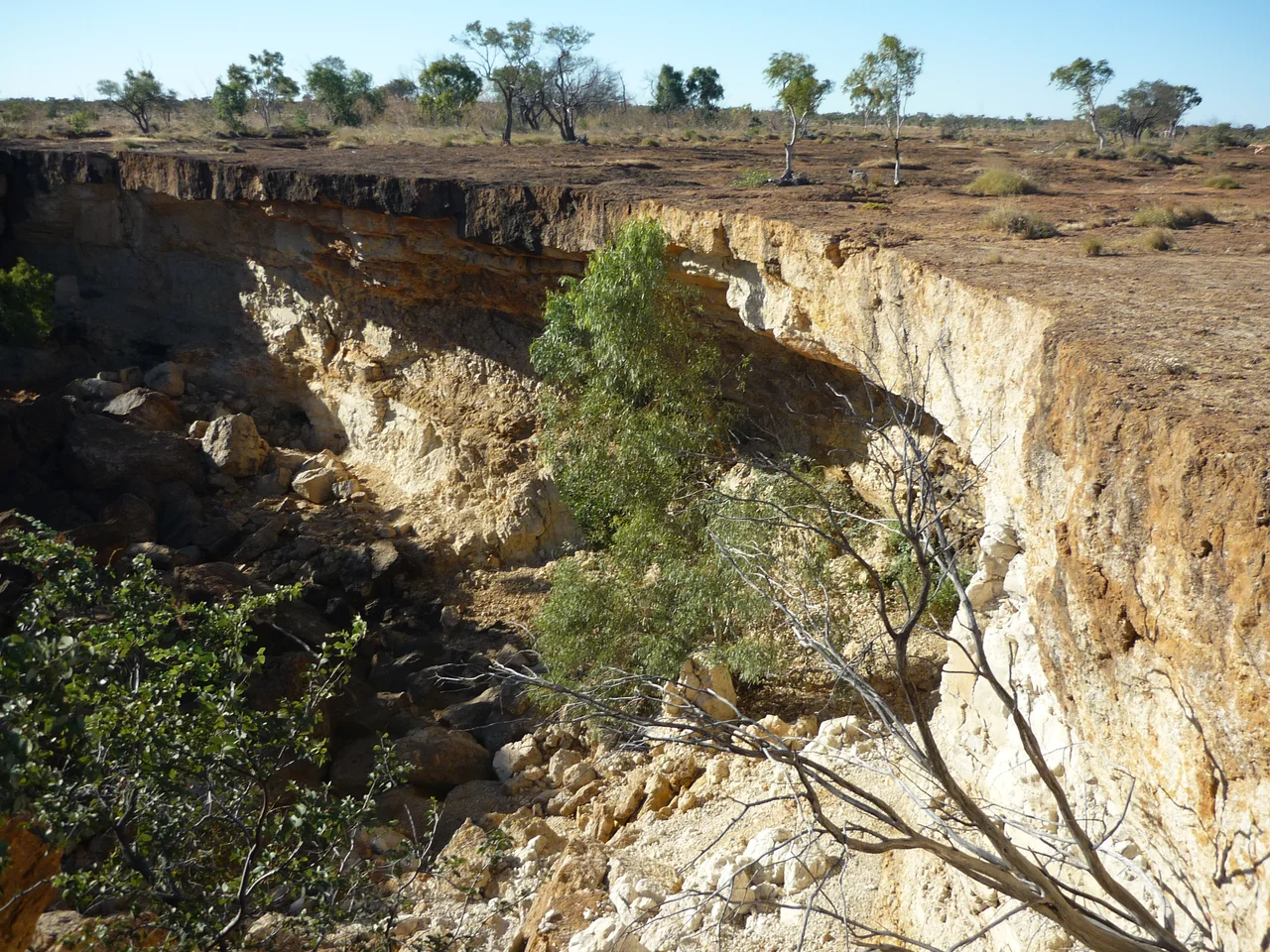

Bladensburg National Park
Surprise Creek is dry most of the year, a pale ribbon of sand winding between the jump-ups south of Winton. Follow it far enough into Bladensburg National Park and you reach a quiet, shaded waterhole that the country knows by a harder name: Skull Hole. In the 1870s, somewhere in this landscape, settlers and Native Police killed a large number of Aboriginal people, and for generations afterward bones lay among the rocks. The place is preserved now, not as a tourist curiosity but as a site of remembrance, a reminder that the wide outback calm of this park was won at a cost that the Koa people have never forgotten.
Koa Country
This is the homeland of the Koa people, who lived across the Winton district long before any sheep arrived. In 2021 the Federal Court of Australia formally recognised the Koa as native title holders over some 31,400 square kilometres of country taking in Winton and its surrounds, an acknowledgement in law of a connection that was never actually broken. The land is also significant to the neighbouring Maiawali and Karuwali peoples. To read Bladensburg only as a former sheep station is to miss most of its history; the deeper story is one of belonging that predates the colonial map by tens of thousands of years.
The Weight of Skull Hole
The massacre at Skull Hole sits at the centre of that history, and it must be told plainly. Sometime in the 1870s, in one of the frontier killings that swept pastoral Queensland, a group of Aboriginal people camped near this waterhole were attacked and killed; a contemporary report claimed nearly the whole group died. The exact year is uncertain and accounts differ, but the loss is not in doubt. These were people, families, with their own country and kin, not a footnote to a grazing lease. Preserving the site within the park keeps that truth visible rather than letting the grass quietly grow over it, and lets visitors stand where something terrible happened and reckon with it honestly.
A Working Station's Bones
European pastoralists took up this country to run sheep, and the marks of that enterprise remain. The original Bladensburg homestead, thought to have been moved to its present spot around the 1910s, still stands and now serves as the park's visitor information centre, its timber walls holding the memory of shearers, drovers, and the long isolation of outback station life. Out across the property the old infrastructure of wool, yards, tanks, and tracks, lingers in the dry air. Declared a national park in 1984, Bladensburg trades the relentless work of grazing for conservation, but it wears its station past openly, a layered place where industry and country overlap.
Plains, Jump-Ups and Mesas
The land itself is classic central-western Queensland: open Mitchell-grass downs rolling to the horizon, broken by river flats and by the sandstone ranges and flat-topped mesas, the jump-ups, that rise abruptly from the plain. The park straddles two bioregions, mostly the Goneaway Tablelands of the Channel Country, with a touch of the Mitchell Grass Downs, and shelters real biodiversity in a region that can look deceptively bare. Reached by 16 kilometres of road from Winton, with camping allowed along Surprise Creek and no reliable water, it rewards those who come prepared. At dawn the jump-ups catch the light first, glowing rust-red above grass still silver with night, a view that has changed little across the long sweep of time.
From the Air
Bladensburg National Park lies at about 22.65 degrees south, 143.06 degrees east, immediately south of Winton in central-western Queensland. From altitude, navigate by Winton and its airstrip just to the north; the park is identifiable by the contrast between open Mitchell-grass plains and the abrupt sandstone jump-ups and flat-topped mesas, with the thin dry line of Surprise Creek threading through. The nearest aerodrome is Winton Airport (YWTN), a short hop north; Longreach Airport (YLRE) to the south-east provides the main regional connections. Terrain is arid tableland and downs with sparse cover and minimal night lighting. Dry-season visibility is excellent; after rain the unsealed access road and creek crossings can become impassable, and the plains may green dramatically.
Nearby Stories
- Lark Quarry Dinosaur Trackways 56 km away
- Darr River Downs 56 km away
- Combo Waterhole 87 km away
- Bexley Station 113 km away
- Diamantina National Park 139 km away
- Cannington Mine 172 km away
- Great Northern Railway (Mt Isa line) 177 km away
- Porcupine Gorge 236 km away