
Diamantina National Park
In 2013, on a remote Queensland cattle station, a naturalist named John Young photographed a living night parrot — a small green bird that had been a phantom for more than a century, known mostly from dead specimens and unverified glimpses, written off by many as effectively extinct. The genuine rediscovery electrified ornithologists worldwide. Three years later, Young claimed to have found a population of night parrots in Diamantina National Park, but those records were subsequently retracted after an independent investigation found his evidence could not be verified. The night parrot's true story is still being written — and Diamantina remains the kind of landscape where almost anything could be hiding in the spinifex.
Where the Rivers Braid
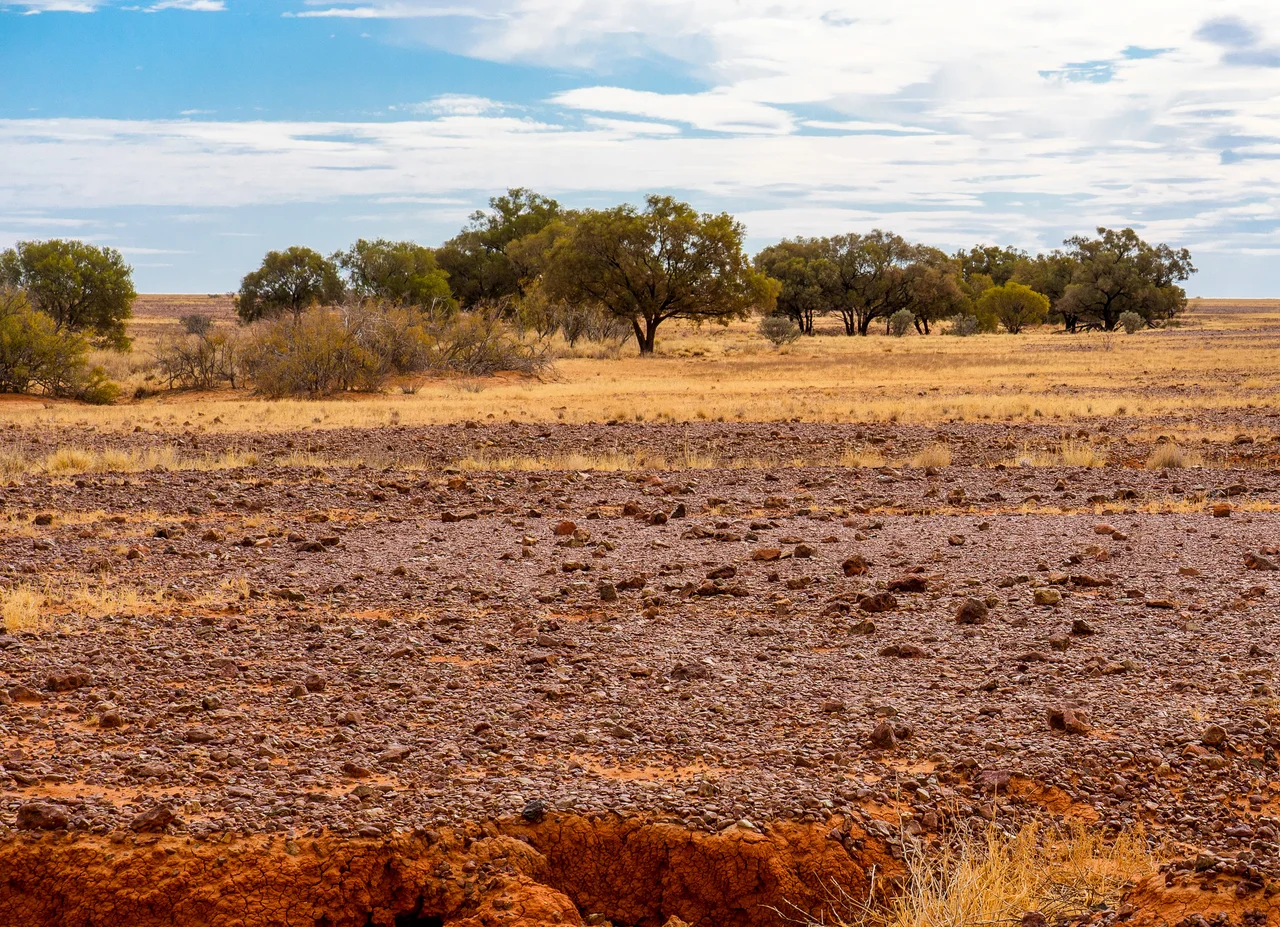
Diamantina sits in the Channel Country of South West Queensland, more than 1,200 kilometres west of Brisbane, where rivers stop behaving like rivers. Instead of a single channel, the Diamantina River fans out across the floodplain in a maze of braided threads, anastomosing watercourses that fill and empty with the rhythm of distant rain. After a wet season far to the north, water arrives in slow brown sheets, and the gibber plains and red sandhills erupt with green and birdlife. In drought, the same country bakes to bone and dust. The park protects more than 507,000 hectares of this feast-and-famine landscape, named, like the river itself, for Lady Diamantina Bowen, wife of Queensland's first colonial governor.
Maiawali and Karuwali Country
Long before any of it carried a governor's wife's name, this was the homeland of the Maiawali and Karuwali peoples, who read this country with a fluency that the boom-and-bust hydrology demands. They moved with the seasons, following water and food across the sandhills and gibber in the wet and drawing back to permanent waterholes in the dry. The land still holds the evidence of that life: rock art, hearths, scarred trees, fish traps, stone arrangements, and burial sites woven through the ranges and plains. These are not relics of a vanished people but the deep signature of a culture that understood this place across thousands of years, longer than any pastoral lease or park boundary has existed.
A Refuge for the Vanishing
Diamantina has become one of the last strongholds for animals slipping toward extinction elsewhere. The greater bilby, a rabbit-eared marsupial that once ranged across much of the continent, still digs its spiralling burrows here in the wild, in one of the few Queensland places it survives outside fences. The kowari, a fierce little carnivorous marsupial of the gibber, hunts across the stony plains. Overhead and underfoot move the plains-wanderer and the night parrot, two of the most elusive birds on Earth. When the Queensland Government bought the old Diamantina Lakes Station in 1992 and gazetted it as a park the following year, then removed the livestock by 1998, it gave these species something rare in the modern outback: room to simply be.
An Ark Worth the Detour
The recognition has followed. In 2007 the World Wildlife Fund named Diamantina among its top ten reserves of the decade, citing its work protecting the bilby. Together with neighbouring Astrebla Downs, the park anchors a 7,627-square-kilometre Important Bird Area that BirdLife International singled out largely because of the night parrot, alongside globally significant numbers of Australian bustard, straw-necked ibis, and a roll-call of arid-zone specialists. To stand here at dusk, watching the light go molten across the channels while something rare stirs unseen in the spinifex, is to grasp why a place that looks like emptiness is in fact one of the fullest landscapes in Australia.
From the Air
Diamantina National Park lies at roughly 23.36 degrees south, 141.14 degrees east, in the remote Channel Country of South West Queensland. From altitude the standout feature is the river itself: the braided, anastomosing channels of the Diamantina fanning across the floodplain, a silver web after rain and a pale tracery of dry beds in drought, set against red sandhills and stony gibber plains. There are no nearby major airports; the closest aerodromes are at Bedourie (YBIE) to the south-west and Boulia (YBOU) to the west, both small outback strips. Birdsville (YBDV) lies further south. Expect vast horizons, minimal cultural lighting at night, and excellent visibility in the dry season; in the wet, dust and heat haze can reduce clarity, and the floodplain can be partly inundated.
Nearby Stories
- Elizabeth Springs 7 km away
- Diamantina Lakes Station 23 km away
- Coorabulka 38 km away
- Burke River 67 km away
- Lark Quarry Dinosaur Trackways 74 km away
- Boulia Stone House 128 km away
- Warbreccan 145 km away
- Bladensburg National Park 158 km away