
Lark Quarry Dinosaur Trackways
More than three thousand footprints crowd a single slab of rock the size of a small house, a chaos of three-toed impressions left when these were not stone but soft grey mud on the edge of a Cretaceous waterway. For decades the standard reading was thrillingly cinematic: a hungry predator stalks toward a flock of small dinosaurs at the water's edge, they panic, and a hundred and fifty of them bolt in a single terrified surge, stamping their flight into the ground forever. It was called the world's only recorded dinosaur stampede. The trouble is, the more closely scientists have looked, the less sure anyone has become about what actually happened here.
A Moment in the Mud
The tracks belong to the Winton Formation, sandstone laid down roughly 95 million years ago, when central-western Queensland was not desert but a low, green floodplain laced with rivers, swamps, and forest. Two distinct sizes of small footprint dominate the slab, made by chicken-sized and emu-sized two-legged dinosaurs. Cutting across them runs a set of much larger three-toed prints, around 50 centimetres long, left by something the size of a modern car. Whatever made those big tracks, and whatever the small animals were doing, the encounter was sealed almost at once: the water rose, sandy sediment slid over the prints before the mud could crack, and successive floods buried the whole surface deep enough to turn it to rock.
The Stampede on Trial
The original interpretation, built in the 1970s, cast the big trackmaker as a predatory theropod that triggered the panic. Later research complicated nearly every part of that story. In the 1990s, reanalysis suggested the large prints might belong not to a meat-eater but to a big plant-eating dinosaur, something more like Muttaburrasaurus. More recently, Dr Anthony Romilio of the University of Queensland and colleagues argued from the sediments that the surface formed in a seasonal watercourse over perhaps several days, not a single frantic minute, with animals simply crossing the channel. Other studies, using a reconstructed foot of the carnivore Australovenator, concluded the large tracks could still be theropod after all. The honest answer today is that the stampede is contested, and the case is not closed.
Sixty Tonnes of Rock
However it formed, getting to it was its own epic. A station manager named Glen Seymour first noticed dinosaur footprints in the area in the 1960s. In 1976 and 1977, palaeontologists from the Queensland Museum and the University of Queensland, among them Mary Wade and Tony Thulborn, excavated the main site, shifting more than 60 tonnes of overburden by hand to expose the track layer. The quarry took its name from Malcolm Lark, a volunteer who cleared much of that rock. They uncovered roughly 200 square metres of prints; a 2025 digital re-survey by Romilio put the figure at least 3,436 footprints across 210 square metres, a density of more than 16 prints per square metre, an extraordinary concentration even if not Australia's densest.
A House Built Over Deep Time
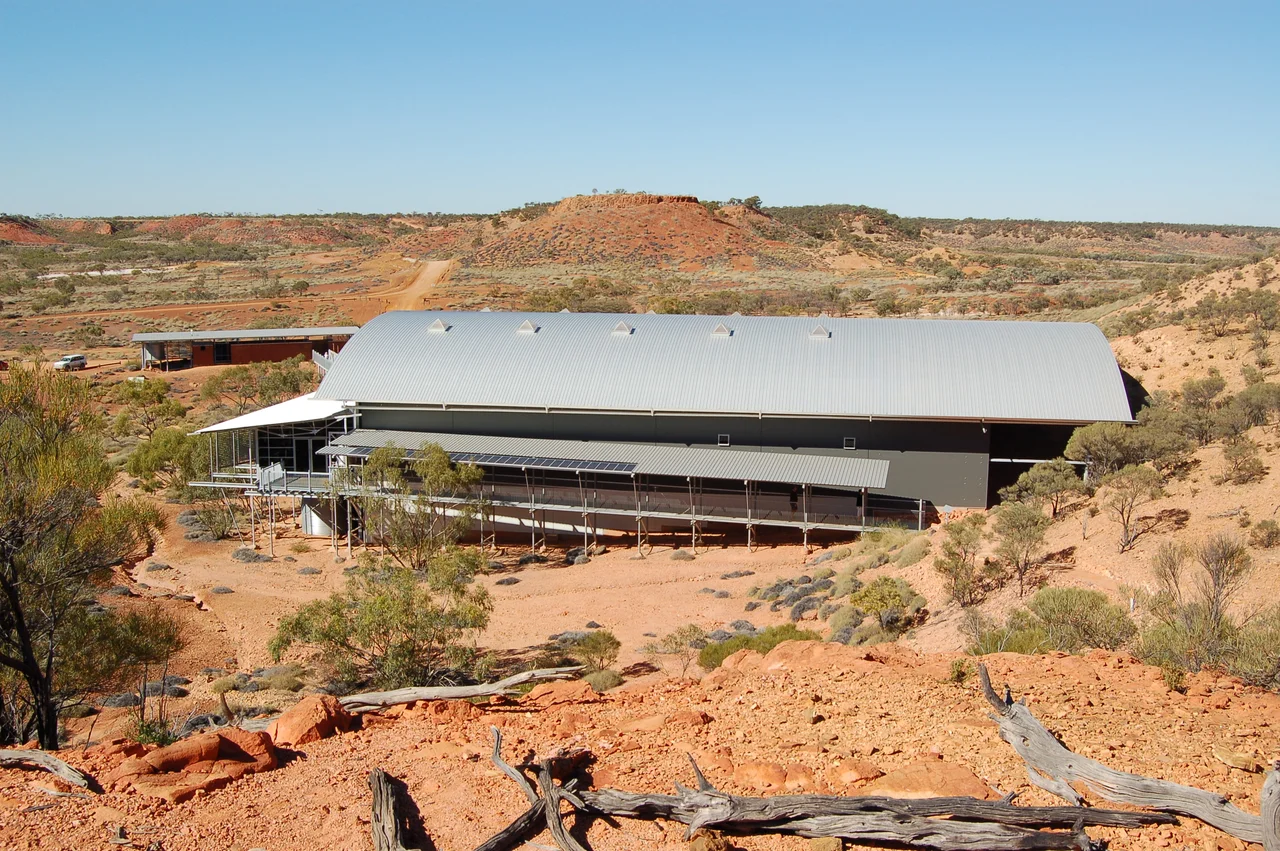
Footprints that survived 95 million years underground proved alarmingly fragile once exposed to Queensland weather. An early shelter slowed the damage but did not stop it, so in 2002 a purpose-built Conservation Building was raised over the trackways, stabilising temperature and humidity and keeping rain, people, and wildlife off the rock. The site joined the Australian National Heritage List in 2004 for its rarity and research value, and guided tours, now run with the Australian Age of Dinosaurs museum, draw visitors more than a hundred kilometres south-west of Winton each year. A popular claim links the tracks to the Gallimimus stampede in Jurassic Park, though a consultant on the film has denied any connection, one more legend layered over a place that keeps refusing to settle into a single tidy story.
From the Air
Lark Quarry lies at approximately 23.02 degrees south, 142.40 degrees east, about 110 kilometres south-west of Winton in central-western Queensland. The site itself is a single building set in low jump-up and mesa country, hard to pick out from altitude, so navigate by the town of Winton and its airstrip to the north-east. The nearest aerodrome is Winton Airport (YWTN); Longreach Airport (YLRE) lies further south-east and offers the main regional services. The terrain below is arid Winton Formation tableland: flat-topped rises, eroded gullies, and sparse vegetation. Expect very clear, dry-season visibility, intense daytime heat, and almost no night lighting; the access road is unsealed for long stretches, visible as a pale thread across the downs.
Nearby Stories
- Bladensburg National Park 51 km away
- Darr River Downs 92 km away
- Diamantina National Park 93 km away
- Arrilalah 95 km away
- Warbreccan 127 km away
- Diamantina Lakes Station 129 km away
- Cannington Mine 147 km away
- Mount Cornish Homestead 157 km away