.jpg)
Darr River Downs
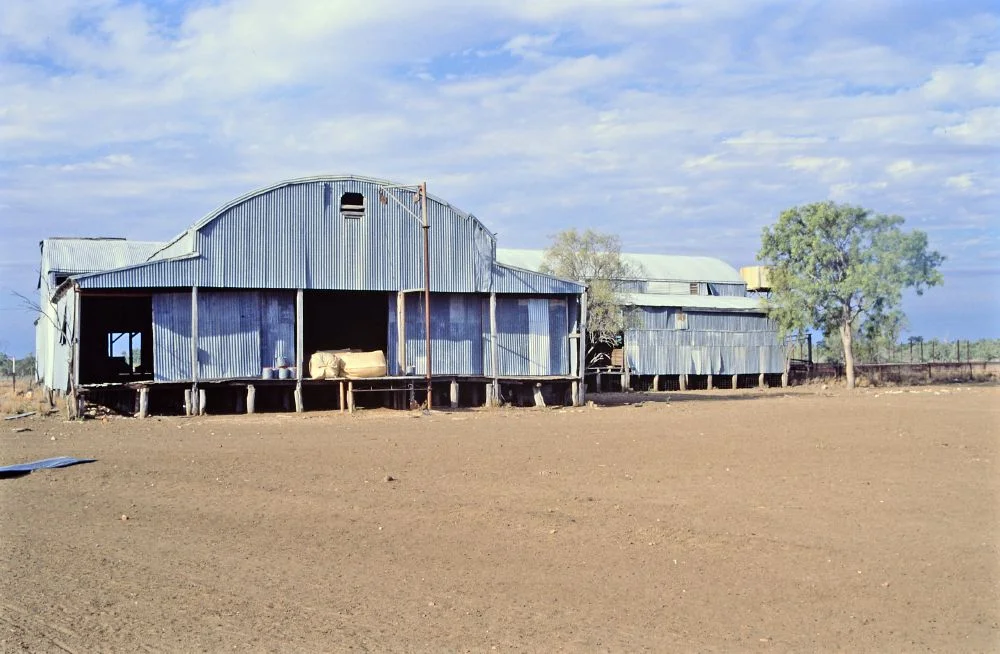
The woolshed at Darr River Downs may once have stood in Melbourne, full of crowds at an international exhibition. According to local memory it was a temporary pavilion from the great fair of 1880, dismantled, shipped to Rockhampton, hauled inland, and raised again on the plains near Morella to shelter shearers instead of exhibits. Whether the timber-and-iron shed is truly that pavilion or a close relation, the story fits this place perfectly: a station assembled out of whatever the wide country could be made to yield, including stone quarried straight from the bed of its own river.
Stone from the River
The runs that became Darr River Downs were taken up in the early 1870s and consolidated through the 1880s into one of three great properties in the district, alongside Corona and Evesham. The earliest homestead was a stone storehouse pressed into service as a dwelling before a proper stone homestead was built. The builders did not import their walls. They quarried the stone from the bed of the nearby Darr River and laid it up with clay mortar, and several of those rough field-stone buildings still stand: an office and saddle room, a store, their verandahs propped on posts made from whole tree trunks, their floors bare earth and paving. They are plain, durable, and unmistakably of this ground.
Chasing the Cleanest Wool
Like its neighbours, Darr River Downs lived and died by the price its wool fetched half a world away. To present London buyers with the cleanest possible clip, the owners built a woolscour, reputedly the first in this part of Queensland, around the mid-1880s. By 1886 the station was scouring its own wool for the first time. The numbers from those years are staggering for such remote country: roughly 135,550 sheep on the property in 1890, and 1,725 bales of wool recorded in 1893. Washing the grease and dirt from a fleece before it travelled meant lighter freight and a better sale, and a station that could scour its own wool controlled a little more of its own fate.
The Strike and the Soldiers
The wool that made fortunes was cut by men whose labour built one of Australia's defining conflicts. During the bitter shearers' strike of 1891, a group of strikers tried and failed to burn down the Darr River Downs woolshed, and six unionists were arrested for sheep stealing on the property that April. The strike was a turning point in the country's industrial and political history, the labour movement forged in sheds exactly like this one. A different kind of memory attaches to a later owner. Edward Watt, who held the station from the First World War, was remembered as a generous employer: after the war he carved 60,000 acres from Darr River Downs and gave the land to four of his workers who had served and come home.
What Still Stands
The station passed through many hands, from Melbourne syndicates to a New Zealand partnership to the Lowry family, and was acquired by its present owners in 1989. Time has thinned the place. The homestead has been so altered that the heritage listing does not count it significant, and the great cruciform woolshed has been partly dismantled, its sections re-erected on other properties, though what remains is still worked. Yet the river-stone outbuildings endure, the arched metal trusses of the surviving shed speak of real engineering ambition, and the woolscour ruins lie north of the homestead. To the south, behind a timber post-and-rail fence, a small cemetery holds two headstoned graves, the quiet last record of lives spent on this stretch of the Darr.
From the Air
Darr River Downs lies at 22.90°S, 143.98°E, west of the Darr River and northeast of the small township of Morella, off the Landsborough Highway in outback central western Queensland. The nearest scheduled airfield is Longreach Airport (ICAO: YLRE, IATA: LRE), roughly 50 km to the south; Winton Airport (ICAO: YWTN) lies to the northwest. The station sits on open Mitchell-grass plains threaded by the timbered line of the Darr River, which is the most reliable visual landmark from the air, along with the highway and railway running through Morella. The homestead complex, woolshed, and scour ruins form a scattered group of corrugated-iron and stone structures west of the river; they are low against the plain and best located by following the river and the Morella rail siding. Visibility is excellent in the dry season; expect heat haze on summer afternoons and the chance of flooding across these creeks after monsoonal rain.
Nearby Stories
- Beaconsfield Station Sheep Wash 15 km away
- Mount Cornish Homestead 18 km away
- Longreach Powerhouse 39 km away
- Bladensburg National Park 39 km away
- Langenbaker House 61 km away
- Lark Quarry Dinosaur Trackways 107 km away
- Lochern National Park 116 km away
- Edgbaston Reserve 141 km away