_(1998).jpg)
Longreach Powerhouse
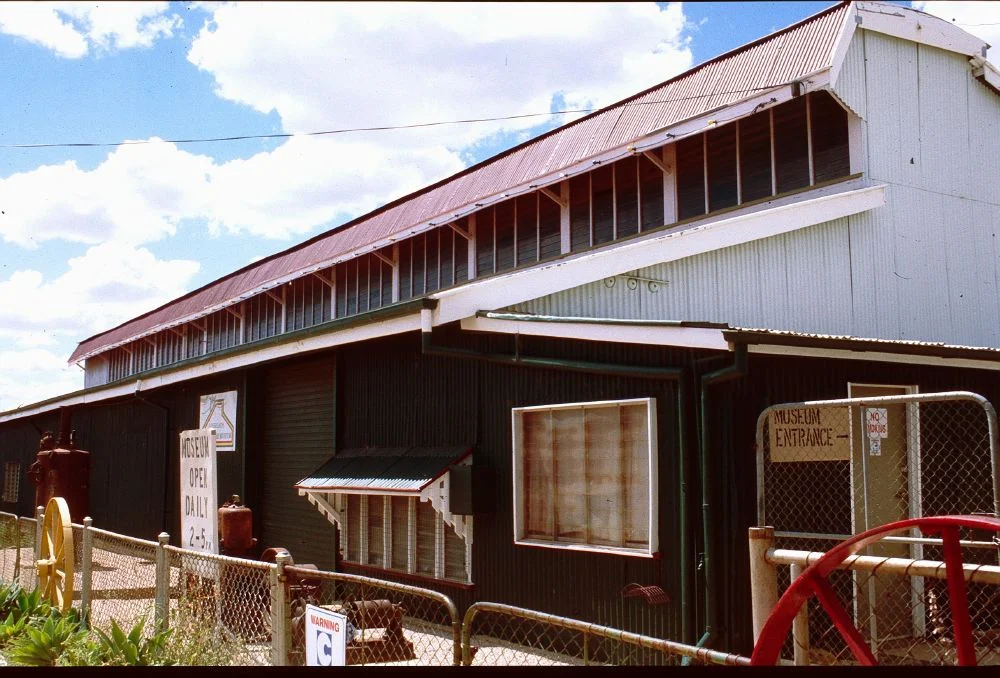
For sixty-four years, the heartbeat of Longreach was mechanical. It came from a row of galvanised-iron sheds on Swan Street, where massive engines hammered through the outback nights to keep the lights of an isolated wool town burning. When the power finally went off here in September 1985 and the district plugged into the state-wide grid, it ended an era that had started before most homes in Australia took electricity for granted. The engines did not leave. They sit where they stopped, the largest collection of preserved rural generating machinery in the country, and the silence inside that engine hall is its own kind of loud.
Switching On the Outback
Power first surged from this site in 1921, the same boom year that gave Longreach its ambulance station and saw the town's railway terminus rebuilt. The plant was raised by Edward and Martin, the same local building firm working all over town, under the supervision of consulting engineer Norman White, and finished by September. The Longreach Shire Council owned and ran it. Think about what that meant in a settlement nearly 700 kilometres from the coast: refrigeration in a place where summer afternoons push past 40 degrees Celsius, electric light in shops and homes, the machinery of modern life arriving in a town that had been founded barely thirty years earlier on the strength of a waterhole and a railhead. The powerhouse did not just supply electricity. It announced that Longreach intended to be a real town, not a frontier camp.
The Engine Hall
The generating complex is a run of interconnected galvanised-iron sheds, and inside them stand ten enormous engines installed between 1948 and 1971 as the town's hunger for power kept growing. What makes the machinery nationally significant is hidden in its plumbing. The plant pioneered a coal-fired gas producer system, the first application of its kind in the Australian electricity industry, a method later taken up elsewhere across the country. To walk the floor is to read the history of how a remote community kept itself powered without the easy crutch of a grid connection. Every flywheel and cylinder was a deliberate choice made by people who could not simply call for help when the power dropped. Engineers Australia has marked the site with an engineering heritage marker, formal recognition of what these machines achieved in the middle of nowhere.
Cooling Off in the Heat
Power was not the only thing this corner of town gave Longreach. Beside the powerhouse stand the 1921 Swimming Baths, among the earliest public pools in Queensland, built the very same year the generators started. In a climate this punishing, a pool was not a luxury but close to a public health measure, and it survives today as part of the wider site. The pairing is telling. The same townsfolk who wanted the certainty of electric light also wanted somewhere to escape the heat that made the outback so hard to live in. Both projects came from the same impulse: to make a brutal landscape liveable, and then to make it comfortable.
A Museum That Still Hums in Memory
When operations passed from the Shire Council in 1966, control moved to the Central West Regional Electricity Board and later the Capricornia Regional Electricity Board, until the connection to the state grid in 1985 made local generation unnecessary. Rather than scrap the plant, the community preserved it, and the Queensland Heritage Register listed it in 1999. As the Longreach Powerhouse and Historical Museum, the site now lets visitors trace exactly how electricity was made, distributed and maintained across a vast and thinly settled region. It is industrial archaeology you can stand inside, the bones of the machine that powered a town, kept intact by the descendants of the people it served.
From the Air
Longreach Powerhouse stands at 23.44°S, 144.25°E, at 12 Swan Street on the flat plains of central-west Queensland, only a short block from the heritage railway station and the Ambulance Centre. From the air the long galvanised-iron sheds and the adjacent swimming baths sit within the compact town grid, with the wide Thomson River bending past to the west. Recommended viewing altitude is 1,500 to 2,500 feet AGL. The nearest airport is Longreach Airport (ICAO: YLRE, IATA: LRE), roughly 2 km east, where the Qantas Founders Museum hangars are visible landmarks. Skies are usually clear and visibility excellent through the April-to-October dry season; summer brings haze and possible dust.
Nearby Stories
- Bexley Station 1.2 km away
- Central Queensland 4.7 km away
- Wellshot Station 22 km away
- Alice River (Barcoo River tributary) 33 km away
- Aramac Tramway Museum 48 km away
- Lochern National Park 73 km away
- Bladensburg National Park 97 km away
- Warbreccan 134 km away