.jpg)
Aramac Tramway Museum
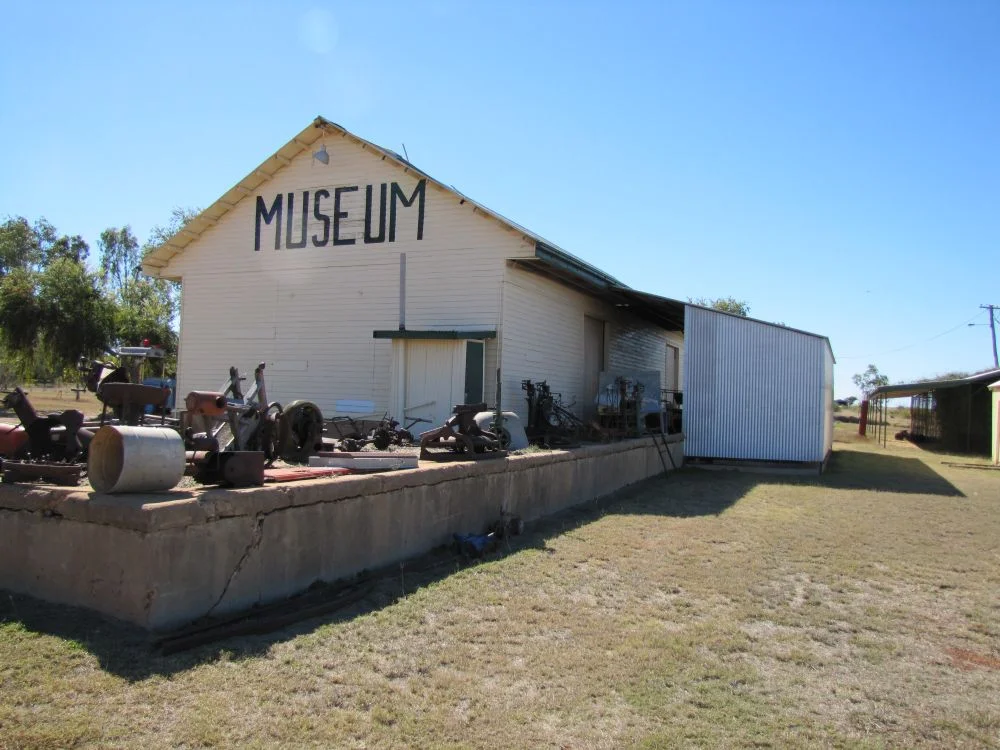
Most railways were built by governments or by companies with deep pockets. The line that once ran into Aramac was built by a town council made up of sheep farmers and shopkeepers, who suddenly found themselves in the unfamiliar business of running a railway. For 62 years they wrestled with timetables, coal prices, derailments and floods, keeping their forty-one-mile tramway alive long after common sense said to let it go. When it finally closed on the last day of 1975, the community refused to let the memory die with it. The old goods shed, built in 1913 and never replaced, is now the Aramac Tramway Museum, and inside it sits the railmotor the whole district loved enough to give a name.
A Town That Built Its Own Railway
When the main line went to Barcaldine instead of Aramac, the wool-rich district found itself stranded forty-one miles from the rails. So the Aramac Shire Council did something extraordinary: it built and owned the connecting tramway outright. Construction ran from 1912 to 1913, and in September 1913 the first train steamed across the bridge over Aramac Creek and into the station. The effect was immediate. Wool, the lifeblood of the district, reached market faster; goods, passengers and business that had once trekked overland to Longreach or Jericho now converged on Aramac. In 1915 alone the little line carried over 4,000 tons of wool, more than 250,000 sheep, and nearly 7,000 passengers. Every arriving train brought a burst of bustle, and a row of taxicabs waited in the street outside.
Sixty-Two Years on a Knife's Edge
Running a railway turned out to be relentless. Even in the boom of 1915, revenue beat costs by a mere eight percent, and council meetings filled with arguments over freight claims, locomotive repairs and mail contracts. Drought, war and the rise of motor trucks ground traffic down. To save money the council cut maintenance to the bone, leaving the cheaply built, un-ballasted track to deteriorate into a rough ride punctuated by derailments. When cyclonic rains flooded the district in 1928, the damage and lost revenue pushed the accounts deep into the red. By the 1940s the line limped along on a single ageing locomotive, the Queensland Government quietly subsidising it because that was cheaper than building a road. Yet in flood, when the road to Barcaldine drowned, the tramway became the town's only link to the outside world.
Aunt Emma
After fifty years and four locomotives, the council finally found the perfect machine for its battered track. In 1963 it bought a second-hand railmotor, RM 28, from Queensland Railways for one hundred pounds. Built at the Ipswich workshops back in 1928, this self-propelled rail carriage was light, spread its weight evenly, and almost never derailed. The district took to it so completely that locals christened it Aunt Emma, the way you might name a reliable old aunt who always turns up. When wet weather bogged everything else, Aunt Emma kept running. She stayed in service until the very last day the tramway operated, and today she is the heart of the museum, a passenger carriage still coupled behind her, parked inside the very shed where the line's freight once piled up.
What the Shed Still Holds
The goods shed is the most substantial relic of the whole enterprise, a timber-framed, corrugated-iron building thirty metres long, its interior walls lined with opened-out wool bales that still show the brands of the stations whose fleeces once rode the line. The light is dim, slanting in over the tops of the walls. One corner has been set up as the old Tramway Office, complete with safe, desks, original tickets and waybills, and a handwritten felt-pen notice from December 1975 warning that all goods must be collected before the tramway shut for good. Two schoolteachers galvanised the town into creating the museum, which opened in 1994, and the collection has since grown into a window on outback life. Outside, the timber bridges over Aramac Creek still stand, their rails long gone, and the cattle yards, wool platform and rusting remains of old Engine No. 1 mark where a community kept its railway running on stubbornness and pride.
From the Air
Aramac Tramway Museum sits at 22.975°S, 145.246°E on Boundary Street in the small outback town of Aramac, on the flat black-soil plains of Central West Queensland. From the air, look for the town's compact grid beside Aramac Creek, the old tramway alignment running south to the creek bridges. A viewing altitude of 1,500 to 3,000 feet AGL gives the best sense of how the line once threaded into town. The nearest major airport is Longreach (YLRE), about 65 nautical miles south-west; Barcaldine (YBAR), the tramway's old destination on the main line, lies roughly 35 nautical miles to the south. The country is wide and treeless, so the town stands out clearly; visibility is typically excellent outside the summer wet season, when thunderstorms and flooding can close in fast, just as they once stranded the tramway.
Nearby Stories
- Edgbaston Reserve 3.4 km away
- Mount Cornish Homestead 27 km away
- Beaconsfield Station Sheep Wash 33 km away
- Shearers' Strike Camp Site, Barcaldine 37 km away
- Bexley Station 60 km away
- Augustus Charles Gregory 155 km away
- Brigalow Belt 241 km away
- Cullin-la-ringo Massacre 252 km away