
Bexley Station
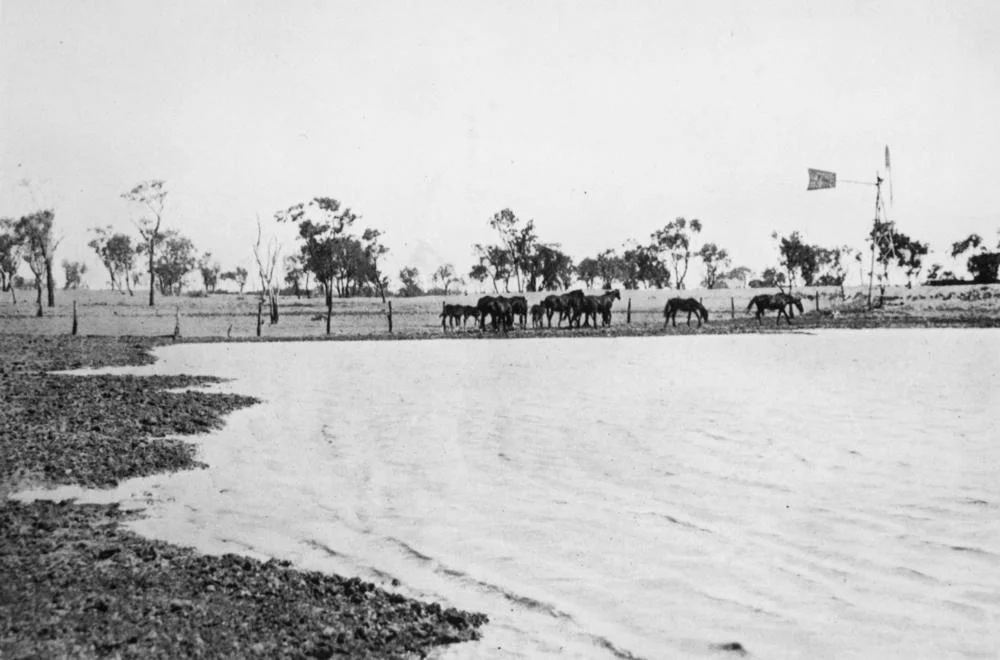
In 1950 the floodwaters that swept across Bexley Station drove the snakes indoors. By the time the family had finished, twenty-seven of them had been counted in the homestead alone. It is the kind of detail that captures life on a sheep station north of Longreach, where the country can be generous and merciless in the same season. Established before 1890 and still a working pastoral lease today, Bexley has measured out more than a century in wool bales, dry paddocks, and the occasional disaster that the outback delivers without warning.
Fire at the Beginning
Bexley began under hard conditions. Edward Goddard Blume took up the property some time before 1890, and almost at once the country tested him: the paddocks burned out that same year, destroying most of the feed and some of the fencing before the station had properly found its feet. Fire is the oldest hazard of these plains, where a dry season turns the Mitchell grass to tinder and a single careless spark can run for miles. He stocked it with sheep anyway, and the wool began to flow in modest quantities, 68 bales in 1892 and 71 the following year. Those small early clips are the signature of a station finding its footing, where success was counted not in dramatic harvests but in steady, hard-won returns season after season, each bale hauled out across the long flat country toward the railhead at Longreach and the markets beyond.
Changing Hands on the Plains
Blume held Bexley for nearly half a century. When he finally sold in 1939, the transaction itself told a story of how these vast leases were carved and kept: he passed roughly 39,800 acres, completely unstocked, to T. Scanlan, while holding back the 44,215-acre Yanburra portion for himself. Ownership moved on through the decades, the Allen family running the place in the early 1950s, and eventually the McPherson family. Each change of hands marked another generation taking on the same gamble, betting their labour against drought, fire, and flood on a property roughly 29 kilometres north of Longreach and 70 south of Muttaburra.
Weather That Makes the History
On the outback plains the weather is not background; it is the main character. The 1950 flood and its plague of snakes were one chapter, the brown waters pushing every living thing toward the high ground of the house. Another came in November 2001, when a single storm dumped 200 millimetres of rain across the property in nearly twenty-four hours, the sort of deluge that can isolate a homestead for days and reshape a season in an afternoon. Between such events lie the long dry stretches that define this country far more often than the floods do, when the plains crack and the feed thins and survival is a matter of patience. Through all of it the station endured.
Still a Working Run
What makes Bexley remarkable is precisely that it is not remarkable, that it simply kept going. There is no grand homestead in the heritage registers here, no famous owner, only the unbroken thread of a pastoral lease worked through fire, flood, and drought for more than a century. Still owned by Ross and Michelle McPherson as of 2011, Bexley remains what it has always been since Blume first put sheep on the burnt paddocks: a working sheep run on the plains north of Longreach, its long quiet story punctuated now and then by the dramatic days the land insists on writing for it.
From the Air
Bexley Station lies at 23.20°S, 144.32°E, on the open plains roughly 29 km north of Longreach and about 70 km south of Muttaburra in outback central western Queensland. The nearest scheduled airfield is Longreach Airport (ICAO: YLRE, IATA: LRE), some 30 km to the south; Muttaburra has a small airstrip to the north. The surrounding terrain is flat Mitchell-grass plain crossed by ephemeral channels that can flood broadly after summer rain, exactly the conditions behind the station's 1950 and 2001 deluges. From the air the homestead reads as a small cluster of corrugated-iron roofs, sheds, and stock yards against pale grassland, with station tracks radiating outward; use the Longreach-to-Muttaburra road as your guiding line. Visibility is excellent in the dry season, with heat haze likely on summer afternoons and standing water possible across the plains in the wet.
Nearby Stories
- Longreach Airport 7.2 km away
- Central Queensland 7.7 km away
- Aramac Tramway Museum 44 km away
- Mount Cornish Homestead 45 km away
- Edgbaston Reserve 54 km away
- Bladensburg National Park 78 km away
- Lochern National Park 106 km away
- Lark Quarry Dinosaur Trackways 143 km away