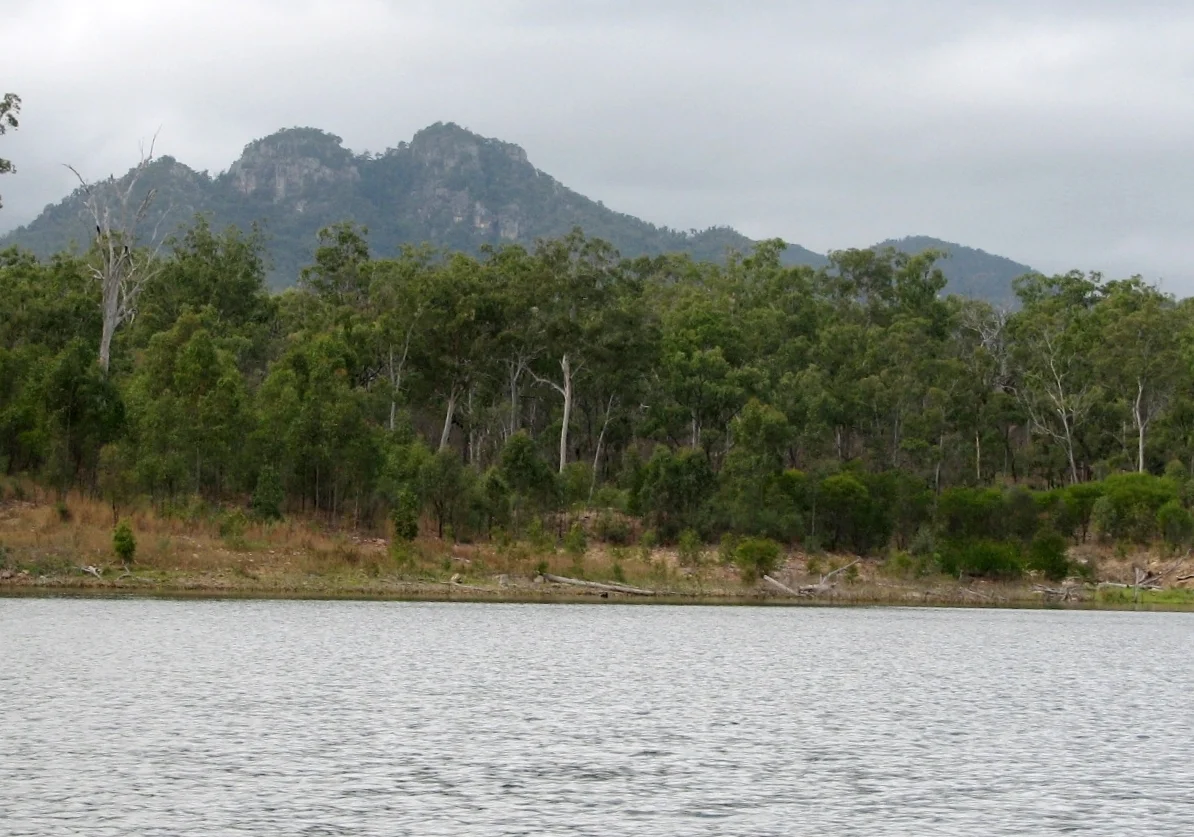

Central Queensland
Draw a line around the middle of the Earth where the sun stands directly overhead at the southern solstice, and that line, the Tropic of Capricorn, runs straight through the heart of this region. Central Queenslanders embraced it as a name: Capricornia. The label fits a place that refuses to be one thing. On the coast, turtles haul ashore to lay eggs on protected beaches; a few hundred kilometres inland, fossickers sift the red dirt of the Gemfields for sapphires, while to the north the Bowen Basin is gouged open for some of the world's finest coking coal. From the Capricorn Coast at Yeppoon to the sandstone cliffs of Carnarvon Gorge, this is a region defined less by a clean border than by a shared sense of being magnificently, defiantly far from anywhere else.
The First Peoples of Capricornia
Long before any of the modern names were drawn on a map, this was the country of many Aboriginal nations whose languages still carry the shape of the land. The Gungabula people belong to the headwaters of the Dawson River. The Wadja country reaches across the Blackdown Tablelands, the Comet River and the Expedition Range. The Yagalingu, the Yambina and the Yetimarala each held their own territory across the central highlands, the ranges and the river valleys, from the Belyando to the Fitzroy. These were not vague regions but precisely known homelands, mapped in story and language by people who had lived here for tens of thousands of years. Their descendants live in Capricornia still, and the names of the rivers and ranges remain a quiet record of who knew this country first.
Coal, Beef, and Sapphires
Capricornia runs on what comes out of the ground and off the land. The German explorer Ludwig Leichhardt noted coal here in 1845, and the region grew into one of the world's leading exporters of black coal, hauled from the Bowen Basin by rail to the deepwater port at Gladstone and the terminals at Hay Point and Abbot Point. Gladstone alone handles a huge share of the state's export earnings and runs a major aluminium smelter. Inland, Rockhampton calls itself the beef capital of Australia, a title New South Wales disputes, and stakes the claim every three years at the national Beef Australia exposition. And in the Gemfields around Emerald and Sapphire, prospectors still wash gravel by hand, chasing the blue and yellow stones that have drawn hopefuls to this dry country for generations.
The State That Never Was
Distance breeds resentment, and Central Queensland has long felt forgotten by its own capital. Brisbane sits in the far southeastern corner of a state so enormous it dwarfs most of Europe, and in 1889 the citizens of Rockhampton decided they had had enough. They founded the Central Queensland Territorial Separation League, arguing that the region was neglected, its wealth drawn south while its needs went unmet. The women of Rockhampton formed their own league in 1892 and prepared a petition to Queen Victoria, noting that Queensland was twelve times the size of England and Wales and larger than France, Germany, Spain and Portugal combined. Capricornia never became a state. But the impulse behind the movement, the sense of a frontier overlooked, never quite went away.
Where the Land Turns to Stone
For all its industry, the region's strangest wonders are natural. In the west, the white sandstone walls of Carnarvon Gorge rise from the central highlands, sheltering ancient cycads, rare plants and Aboriginal rock art within a green, spring-fed cleft in the dry country. Kroombit Tops National Park is the only home of the Kroombit tinker frog, a creature found nowhere else on Earth. And the land has kept its dangers, too: the coal-mining town of Moura suffered three underground disasters between 1975 and 1994 that together took thirty-six lives, a sober reminder of the cost beneath the export figures. Capricornia is a region of extremes held in a single frame, where reef-edge beaches, sapphire gravel, coal seams and sandstone gorges all answer to the same tropic line drawn across the middle of the world.
From the Air
Central Queensland is a vast region straddling the Tropic of Capricorn; this overview point sits inland near 23.44 degrees south, 144.88 degrees east, in the western downs country, though the region sweeps east across the Bowen Basin and central highlands to the Capricorn Coast. For coastal and city flying, Rockhampton Airport (YBRK) is the principal hub, with Gladstone (YGLA) to the south and Emerald (YEML) serving the central highlands and Gemfields. Westward, Longreach (YLRE) and Barcaldine (YBAR) anchor the inland plains. Distances are large and terrain varies dramatically: flat brigalow and speargrass plains inland, the rugged sandstone of Carnarvon Gorge in the highlands, and reef-fringed islands like Great Keppel off Yeppoon. Watch for industrial airspace and traffic around Gladstone's port and smelter, and for afternoon thermals and seasonal dust inland. Dry-season visibility is generally excellent.
Nearby Stories
- Bexley Station 17 km away
- Wellshot Station 18 km away
- Longreach Airport 22 km away
- Aramac Tramway Museum 34 km away
- Alice River (Barcoo River tributary) 37 km away
- Yalleroi 43 km away
- Lake Dunn 68 km away
- Augustus Charles Gregory 136 km away