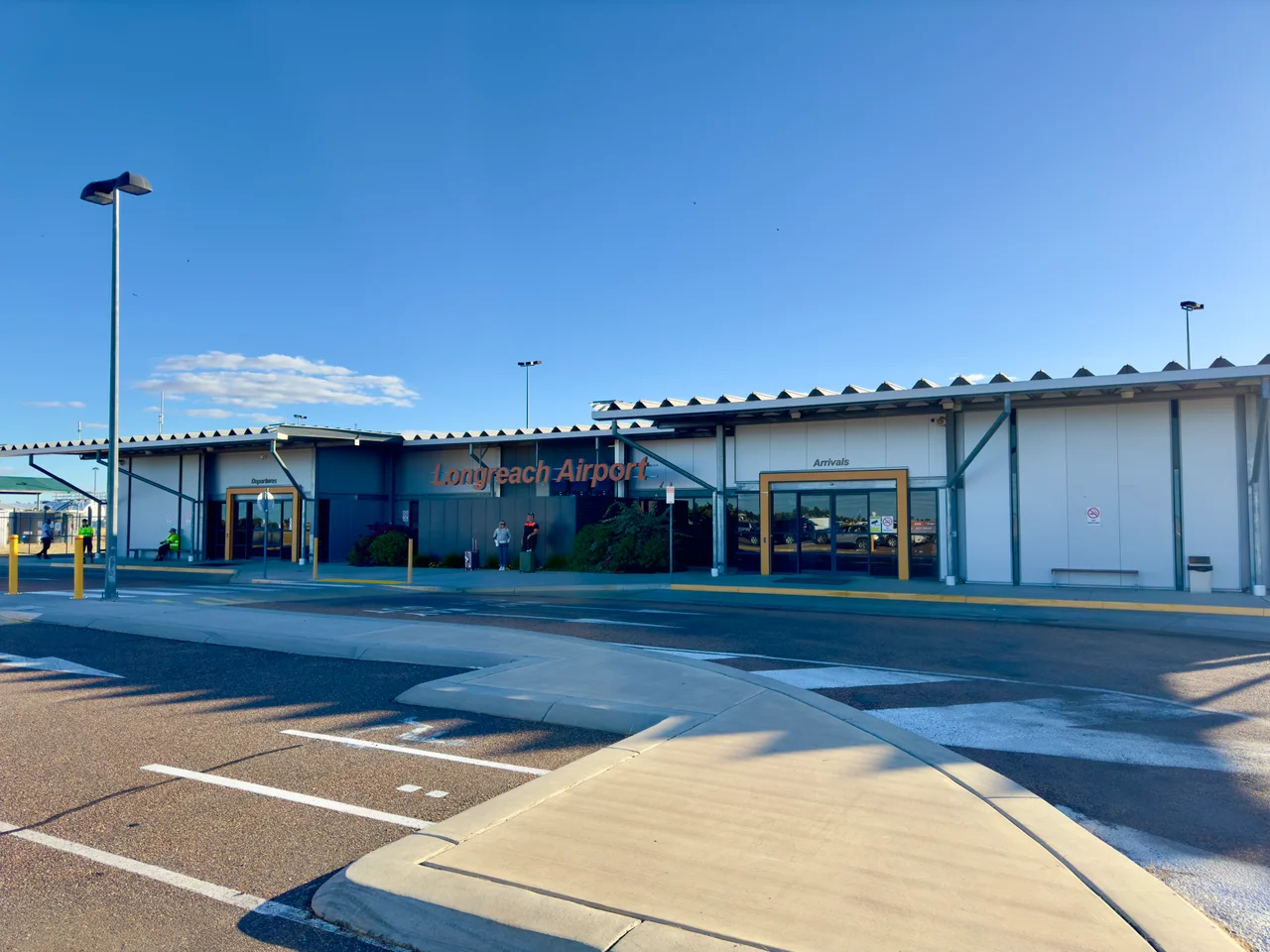

Longreach Airport
Qantas, the airline that now flies kangaroo-tailed jets across oceans, learned to fly from a dirt strip on the edge of Longreach. The Queensland and Northern Territory Aerial Services was founded in Winton in November 1920, but it was here, at this remote airfield in the central-west, that the company set up its first operational base and began stitching the vast Australian interior together by air. One of those original Qantas hangars still stands beside the runway, a corrugated-iron survivor from the dawn of an industry. For a stretch of the early twentieth century, the future of Australian aviation ran straight through this small inland town.
The Survey That Started an Airline
It began with a long, dusty drive. In August 1919, a small party left Longreach to survey overland a route for competitors in the first great air race from England to Australia. Among them were Hudson Fysh and Paul McGinness, two pilots trained in the Australian Flying Corps during the First World War. Bouncing across trackless country, they saw what aviation could mean for a continent where towns lay days apart by road. That December a Vickers Vimy, flown by Ross and Keith Smith, landed at Longreach on its way to Melbourne, having just completed the first England-to-Australia flight, the first aircraft to use the very route Fysh and McGinness had mapped. The seed of an airline had been planted.
Where Qantas Took Root
In late 1920, Fysh and McGinness, who had seen the opportunity so clearly during their survey, helped found the Queensland and Northern Territory Aerial Services, soon known to the world as QANTAS. Although the company was established at Winton, its first operational base was Longreach, and from here it began carrying mail and passengers into country that had never known anything faster than a horse or a camel. The original hangar that survives at the airport today is one of the most important pieces of fabric in Australian aviation history, the physical birthplace of an airline that would eventually span the globe. Few small-town airfields anywhere can claim to have launched a national flag carrier.
A Procession of Pioneers
Longreach became a waypoint for the heroes of aviation's golden age. The first overland flight across the continent, Melbourne to Darwin, passed through in 1919, flown by Captain Henry Wrigley and Sergeant Arthur Murphy in a B.E.2. In 1920 came Ray Parer and John McIntosh in an Airco DH.9, the first single-engined aircraft to fly from England to Australia. Charles Kingsford Smith touched down in 1927 in a Bristol Tourer during a circuit of the continent. And in 1930, Amy Johnson landed her Gipsy Moth here, fresh from becoming the first woman to fly solo from England to Australia; she was guest of honour at a dinner thrown by Shell at Longreach's Imperial Hotel before continuing to the east coast.
War, Decline and Return
In 1941 the Department of Civil Aviation opened the Longreach Aeradio station, giving pilots ground-to-air radio across the country. The next year the war arrived. For a short time in 1942, Longreach became a base for United States Army Air Forces B-17 bombers of the 93rd and 30th Bombardment Squadrons; the field was strengthened to bear their weight and grew to three runways. In May those aircraft flew out to fight in the Battle of the Coral Sea, and spent shell casings from their guns can still be found beside the runways. After a 1960s heyday as one of Australia's busiest inland airports, drought and rural decline thinned the traffic. Qantas came home in 2002, flying in a Boeing 747 to join a 707 on static display at the Qantas Founders Outback Museum, which now sits beside the strip where it all began.
From the Air
Longreach Airport (ICAO YLRE) lies at 23.43°S, 144.28°E, about 1.5 nm northeast of Longreach township in flat central-west Queensland. It is a sealed regional airport with regular RPT service, so expect a controlled traffic environment and check current charts, frequencies and the AIP for runway details before operating. The Qantas Founders Outback Museum sits on the field itself, its parked Boeing 747 and 707 unmistakable from the air and a superb visual landmark. The Australian Stockman's Hall of Fame is immediately adjacent. Recommended pattern altitude per the chart; terrain is dead flat with the Thomson River channels nearby. Winter brings excellent visibility, while summer afternoons can deliver fierce heat haze, thunderstorms and dust.
Nearby Stories
- Bexley Station 1.2 km away
- Central Queensland 4.7 km away
- Wellshot Station 22 km away
- Alice River (Barcoo River tributary) 33 km away
- Aramac Tramway Museum 48 km away
- Lochern National Park 73 km away
- Bladensburg National Park 97 km away
- Warbreccan 134 km away