.jpg)
Boulia Stone House
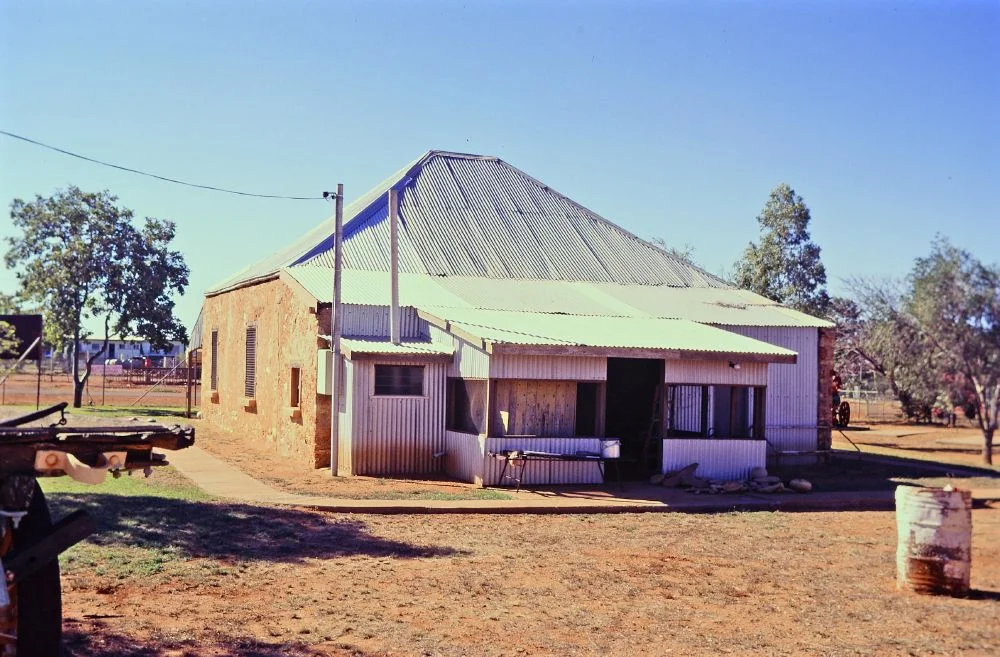
Almost nothing in Boulia is made of stone. The town that grew on the bank of the Burke River was a place of canvas, then timber, then corrugated iron, materials you could cart in and throw up fast against the heat. So the cottage on the corner of Pituri and Hamilton Streets is an anomaly: thick walls of honey-coloured sandstone and limestone, quarried from a ridge nearby and laid by three stonemasons who came all the way from Armidale in New South Wales. They worked for roughly four years, somewhere in the early 1880s, and according to local tradition they used no nails at all. More than a century later, it is the only stone building left standing in town.
Built to Last in a Place That Wasn't
The Stone House went up just as Boulia was finding its feet. A store had opened on the Boulia Waterhole in 1877, a town reserve was proclaimed in 1879, and the surveyors arrived in 1882. By 1891 the directories listed Boulia as a pastoral town of a hundred and fifty souls, with a police magistrate, two hotels, a saddler and three storekeepers. Building anything permanent here was an act of stubborn faith. The timber for the roof was cut at a local saw pit; the iron sheeting travelled by rail to Hughenden and then the last stretch to Boulia by horse-drawn dray. Every component was a small logistical victory in a place hundreds of kilometres from the nearest supplier.
The Jones Family Cottage
Local tradition holds that the house was built for James Edward Jones, a storekeeper in the firm of Burnell and Jones. The records are tangled in a way that suits a frontier town: Jones did not actually purchase the block until 1897, and there is a theory the building started life as a store, with two doorways and a cellar dug for perishable goods. Whatever its origin, the Jones family made it their own for generations. They held the property for at least seventy of its first ninety years, the last resident being Mabel Sarah Jones, who lived there until 1977. James himself moved through trades as the town did, listed as a storekeeper, then a butcher, and finally a gardener coaxing green from the red soil.
Random Rubble and a Hidden Cellar
The craftsmanship is plain and honest. The external walls are laid as random rubble, roughly coursed and neatly squared at the corners and around the openings, the lime mortar slowly stained by the region's red sand. A core of four stone rooms opens through glazed French doors onto a stone-paved verandah. Inside, there is no ceiling: the bolted timber roof framing is left exposed, the top plates still bearing the marks of being pit-sawn by hand. Lift a timber trapdoor at the rear and steps lead down to a basement of low headroom, bare stone and an earth floor. Conservation work in the late 1970s, funded by a National Trust grant, brought a Brisbane plasterer named Gino Sandrin out to repair the masonry.
A Museum, and the Town's Strange Glowing Mystery
Since the mid-1980s the cottage has served as Boulia's museum, its rooms filled with the saddlery, machinery and surgical instruments of early outback life, alongside a striking display of marine fossils from a time when this desert lay beneath an inland sea. The Stone House anchors a town that trades, too, on the uncanny. Boulia calls itself the Land of the Min Min Light, after a ghostly glow that locals have reported following travellers across the plains since at least 1912, though Aboriginal accounts hold that it is far older. The Pitta Pitta people, traditional custodians of this country, gave Boulia its name, from a word for a waterhole near the town. Stone, story and spirit all share the same few streets.
From the Air
Boulia Stone House stands at roughly 22.91°S, 139.91°E, one block back from Herbert Street in the township, on the floodplain of the Burke River in far western Queensland. From the air the town reads as a small grid of streets and tin roofs against a vast red plain, with the river's tree-lined channels the dominant feature. Boulia Airport (ICAO: YBOU) is on the edge of town; the nearest major airport is Mount Isa (ICAO: YBMA), about 300 km north. The Channel Country offers superb long-range visibility, especially in the dry winter months. Recommended viewing altitude 1,500-3,000 ft AGL to make out the town grid and the river course.
Nearby Stories
- Marion Downs Station 20 km away
- Elizabeth Springs 35 km away
- Glenormiston Station 43 km away
- Coorabulka 88 km away
- Cannington Mine 112 km away
- Ethabuka Reserve 121 km away
- Moonah Creek Hanging Tree 134 km away
- Mount Elliott Mining Complex 149 km away