.jpg)
The Etheridge Line: The Town That Took a Train Hostage
In December 1994, the entire population of Einasleigh - all forty of them - blockaded their railway and took a train hostage. The train was the Forsayth Mixed, marketed without irony as the "Last Great Train Ride," and Queensland Rail wanted to shut most of its route down. For four days the townspeople held the line, and the passengers and crew along with it. They were not cruel hostage-takers. They fed the stranded passengers, housed them, and made their point until the police negotiated an end to the standoff. It worked: irresistible political pressure kept the line open, and the train that runs it today, the Savannahlander, still rattles down to Forsayth. It is a fitting last chapter for the Etheridge railway - a line that was always built on stubbornness as much as engineering.
Moffat's Empire
The Etheridge line was one thread in the business empire of John Moffat, a Scottish-born storekeeper who became the most important industrialist in north Queensland. From 1880 onward, much of the region's economy ran on the mining towns and railways that Moffat's enterprises created. He built his fortune on the tin of Herberton and Irvinebank - he named Irvinebank for his Scottish birthplace, and his Loudoun mill there was at its peak the largest tin battery and smelter in Australia - then expanded into silver and copper, and finally into the copper field at Chillagoe. To feed a central smelter he needed railways, and his Chillagoe Railway and Mining Company laid them: first the line from Mareeba to Chillagoe, then, between 1907 and 1910, a branch driven south toward the Etheridge goldfield. The man who built it died in 1918, six years after retiring, having turned mining into the foundation of a whole region's economy.
Built to Be Cheap
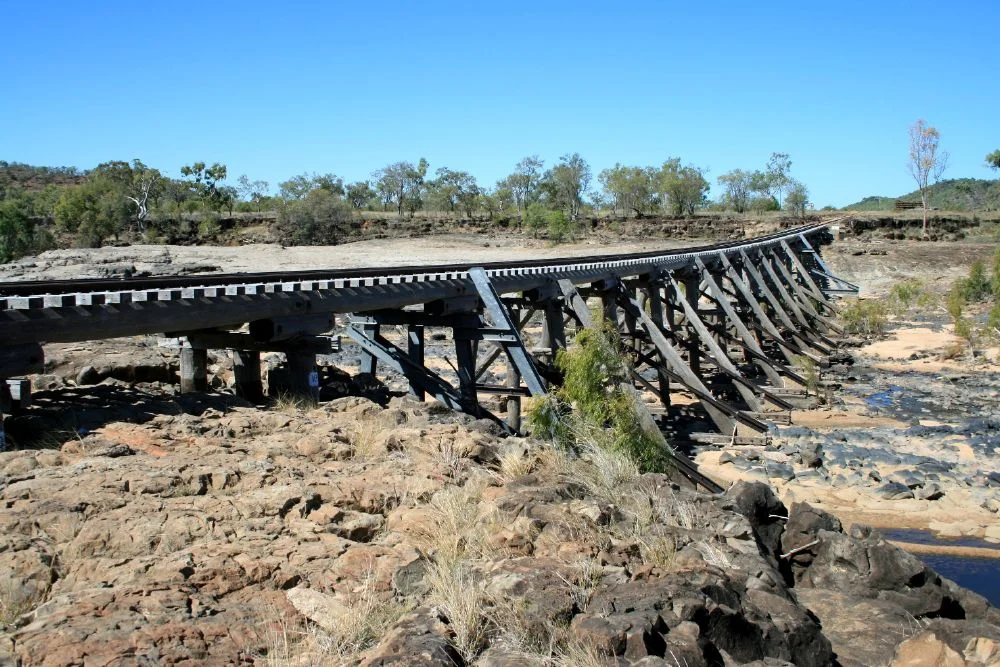
The Etheridge railway was constructed in the most economical way possible, and it shows. Where the Chillagoe line had 60-pound rails, the Etheridge line dropped to 41-pound rail soon after branching off at Almaden - the change so abrupt that passengers feel the noise and vibration jump. The bridges were timber, the curves sharp, the grades steep, the earthworks minimal, and the sleepers laid almost straight onto the soil with barely any ballast beneath them. The engineer in charge was Archibald Smith Frew, who had learned his trade as an assistant to George Phillips on the Normanton-to-Croydon line - so the two great isolated railways of the Gulf Savannah share a lineage in the same surveyor's office. Frew built cheaply because copper ore had to be hauled at a profit, and there was never quite enough of it.
Copper That Never Came
The whole enterprise rested on a bet that the country south of Chillagoe held enough copper to keep the smelters fed. It did not. The line reached Mount Surprise in 1908, then Einasleigh in 1909, where an old copper mine first found by Richard Daintree in the 1860s was reopened - by 1901, before the rail even arrived, copper matte was being carried out by camel train. The railway let Einasleigh boom for a few years. But ore reserves had been overestimated everywhere, fuel was dear, metal prices were low, and the company had over-capitalised on railways and smelters it could not fill. When the government refused a loan in 1914, the Chillagoe Company shut its smelting and ore-buying down. In a final irony, metal prices rose during the First World War - while the smelters sat idle and cold.
Cattle, Floods, and the Long Survival
What kept the Etheridge towns alive was not copper but cattle. From the start the line trucked livestock, and as mining declined that traffic became its reason to exist. The railway endured a punishing run of floods - six bridges were destroyed in January 1927 alone, and the Copperfield River bridge has been washed away in 1927, 1980 and 2002 - and each time the cheap timber bridges were rebuilt rather than mourned, exactly as they had been designed to be. A bituminised "Beef Road" from Georgetown to Cairns finally undercut the line for cattle from the late 1960s, setting up the showdown of 1994. Today the Mount Surprise-to-Forsayth section is heritage-listed, its stations at Mount Surprise, Einasleigh and Forsayth preserving the most intact group of frontier railway buildings on the line - and over four unhurried days, the Savannahlander still carries travellers down it to the end of the rails at Forsayth.
From the Air
The Etheridge line runs roughly 230 km from Almaden south to Forsayth across the Gulf Savannah of far north Queensland; the heritage-listed section from Mount Surprise to Forsayth is about 121 km long. The locality coordinates here are 18.38 degrees south, 143.96 degrees east, near Einasleigh, roughly midway along the line. From the air the railway is a thin, wandering line - not the dead-straight track of the Croydon plain but a route that follows the lie of the land, tightening into sharp curves and heavier earthworks where it climbs the Newcastle Range and threads the Delaney Gorge between Einasleigh and Forsayth. Look for the river crossings - the Copperfield and Einasleigh rivers among them - where timber trestle bridges carry the line. Nearest airfields are Forsayth (ICAO YFSA) at the southern terminus and Georgetown (YGTN) to the west; Cairns (YBCS) is the regional hub far to the east, and the Savannahlander itself begins its run there. Best viewed at lower altitudes in the clear, warm air of the dry season (April to mid-November); the wet season can flood the gorges and river crossings.
Nearby Stories
- Undara Volcanic National Park 22 km away
- Mbabaram language 101 km away
- Mungana Archaeological Area 121 km away
- Croydon: The Gold Town the Outback Kept 126 km away
- Normanton to Croydon Railway Line 189 km away
- Mount Spec Road and Little Crystal Creek Bridge 191 km away
- Porcupine Gorge 204 km away
- Millungera Station 240 km away