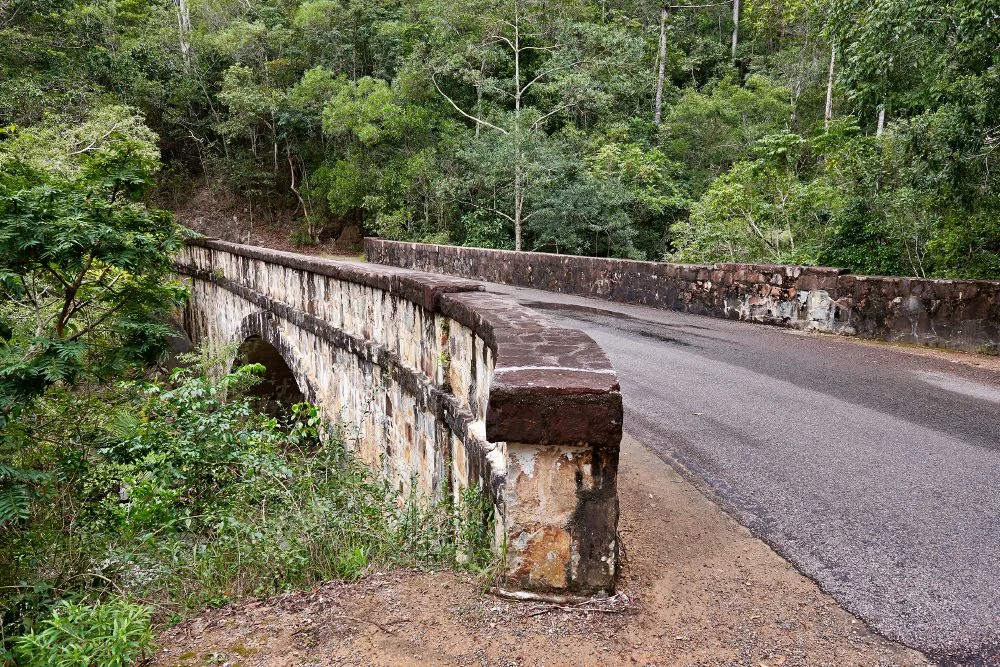

Mount Spec Road and Little Crystal Creek Bridge
A single stone arch leaps the gorge at Little Crystal Creek, so neatly composed against the rainforest that it has become one of the most photographed spots in the Townsville district. It looks almost decorative. It is anything but. The arch and the winding mountain road it carries were clawed up the Paluma Range during the worst years of the Great Depression, by hundreds of out-of-work men paid relief wages to blast granite and shift earth with little more than hand tools, horses and explosives.
A Road Argued Over for Thirty Years
People had wanted a way up to Mount Spec for decades. Tin had been found west of Paluma in 1875, timber-cutters and farmers wanted access, and from the early 1900s the cool, scenic ranges were promoted as a tourist retreat and a health resort - somewhere to escape Townsville's summer heat. A Mount Spec tin miner named Phillip Foxlee wrote to the Queensland Premier in 1925 describing a gorge "crammed full of waterfalls on every side" and predicting people would come "from all parts of the world." The lobbying ran for thirty years amid genuine controversy over cost and benefit. In 1929 the route was gazetted as one of Queensland's earliest official Tourist Roads, and the long argument finally tipped toward construction.
Built by the Unemployed
What pushed the project over the line was the Depression itself, and the government's urgent need to put men to work. Construction began in November 1930 and became the largest Unemployment Relief project in the region. The labour was mostly unskilled - the region's jobless, drawn into isolated camps along the range. Conditions were hard. With only a few trucks, a pair of tractors and two air compressors to help, cuttings were blasted through granite with gelignite while most of the work was done by hand, with picks, shovels, horse-drawn ploughs and scoops. One camp, at The Saddle, housed more than a hundred men for three years; three old ship's water tanks still mark the spot. The job took some six years, and hundreds of men passed through it before the full road opened in 1937.
The Bridge That Cost Too Much
The bridge over Little Crystal Creek was meant to be an ordinary timber span. The local Main Roads engineers thought otherwise. In June 1931 the District Engineer in Townsville argued that "from the aesthetic point of view a masonry arch should be considered, as it would harmonise with a rather picturesque spot." Brisbane approved the change in 1932, and four stonemasons were brought in to face the concrete arch in dressed stone. It cost more than planned - the District Engineer grumbled in 1933 about "too much work dressing stone" - but the result spoke for itself. The Commissioner of Main Roads called it "an illustration of the high quality of work which can be achieved by such labour skilfully directed." It is reportedly the only stone-faced concrete arch road bridge of its kind still in service in Queensland.
The Drive Today
Mount Spec Road still climbs roughly 18 kilometres from the coastal plain to the edge of Paluma, rising some 885 metres up the range. Remarkably, it has never been widened; the original route and character survive, threading the same curves the relief gangs cut by hand. Along the way the same craftsmanship repeats in smaller forms - dry stone walling, stone-paved gutters, and a string of little concrete arch culverts built in the bridge's image. The road opens onto sweeping views of Halifax Bay and the coastal plain as it twists upward, and at the bottom of the gorge Little Crystal Creek still tumbles past its arch into the clear pools below, a swimming hole that remains one of Townsville's favourite escapes.
From the Air
The Little Crystal Creek Bridge sits at roughly 19.00°S, 146.26°E, about halfway along Mount Spec Road as it climbs the Paluma Range some 61 km north of Townsville. The range rises steeply - around 885 m over 18 km - off a narrow coastal plain, with Halifax Bay to the east, so the escarpment edge and the switchbacking road are the key visual cues from above. Dense rainforest hides the bridge itself until you are close. Nearest major airport is Townsville (YBTL / TSV) to the south-southeast; Ingham (YIGM) lies to the north. Best viewed at low altitude in clear conditions; cloud and rain frequently shroud the ranges in the summer wet season.
Nearby Stories
- Herveys Range Heritage Tea Rooms 3.5 km away
- Cape Cleveland Light 14 km away
- Fantome Island Lock Hospital and Lazaret Sites 17 km away
- Bindal People 42 km away
- The Great Barrier Reef: The Living Structure Visible from Space - Now Dying 90 km away
- Undara Volcanic National Park 153 km away
- Mount Bartle Frere 188 km away
- Porcupine Gorge 195 km away