
Herveys Range Heritage Tea Rooms
It once took a bullock team four days just to reach the foot of Hervey Range from the port of Townsville, and a fifth hard day to haul the wagons up to the gap at the top. Waiting there, at the crest of the climb, was a low building of split logs and a publican ready to pour. That building still stands. Charles Saville Rowe raised it in 1865 as the Eureka Hotel, only a year after Townsville itself was settled, and today it serves Devonshire tea to travellers who arrive by car in twenty minutes rather than by ox in a week.
The Road to the Goldfields
This was the Georgetown Road, and for decades it was the main artery west out of Townsville, running toward the goldfields and the pastoral runs of the interior. Bullockies cracked their whips up the grade through Thornton's Gap; Cobb & Co coaches rattled the same track, swapping horses and dust for refreshment at the top. The Eureka Hotel was the natural place to stop, water the teams, and sleep before pushing on. North Queensland was being opened by men hauling supplies in and gold and wool out, and inns like this one were the punctuation marks of that journey. The building is a slab-sided structure - timber split lengthwise and stood upright - and it survives as one of the very few of its kind left standing in Australia, reportedly the oldest building of its type in North Queensland.
A View Worth the Climb
Hervey Range rises roughly a thousand feet above the coastal plain, and the air at the top carries the cooler edge that drew weary travellers up the grade in the first place. The country here is dry tropical woodland, alive with birdsong - more than 150 species of birds have been recorded in the surrounding bush, a draw for those who come now with binoculars rather than bullock whips. From the gap, the scenic drive continues inland with road access toward Charters Towers and, further on, the Atherton Tablelands. The view that once meant relief at journey's end is now the destination itself, a place people drive up to precisely for the climb and the outlook it rewards.
The World's Strangest Cup
Then there is the coffee. The tea rooms became known as the only cafe in Queensland to serve kopi luwak, frequently billed as the most expensive coffee on Earth, at prices that have run into the thousands of dollars per kilogram. Its origin is famously unappetising: in Indonesia, beans are collected after passing through the digestive tract of the Asian palm civet, then cleaned, dried and roasted. Curiosity made it briefly famous here. In July 2007 the television program Border Security followed a shipment of the beans through Australian customs, who deliberated and then cleared it as no threat to local agriculture. The next morning the breakfast show Sunrise broadcast its weather from these very tea rooms, and for many Australians it was the first they had ever heard of a coffee with such an unlikely pedigree.
Saved and Set for Tea
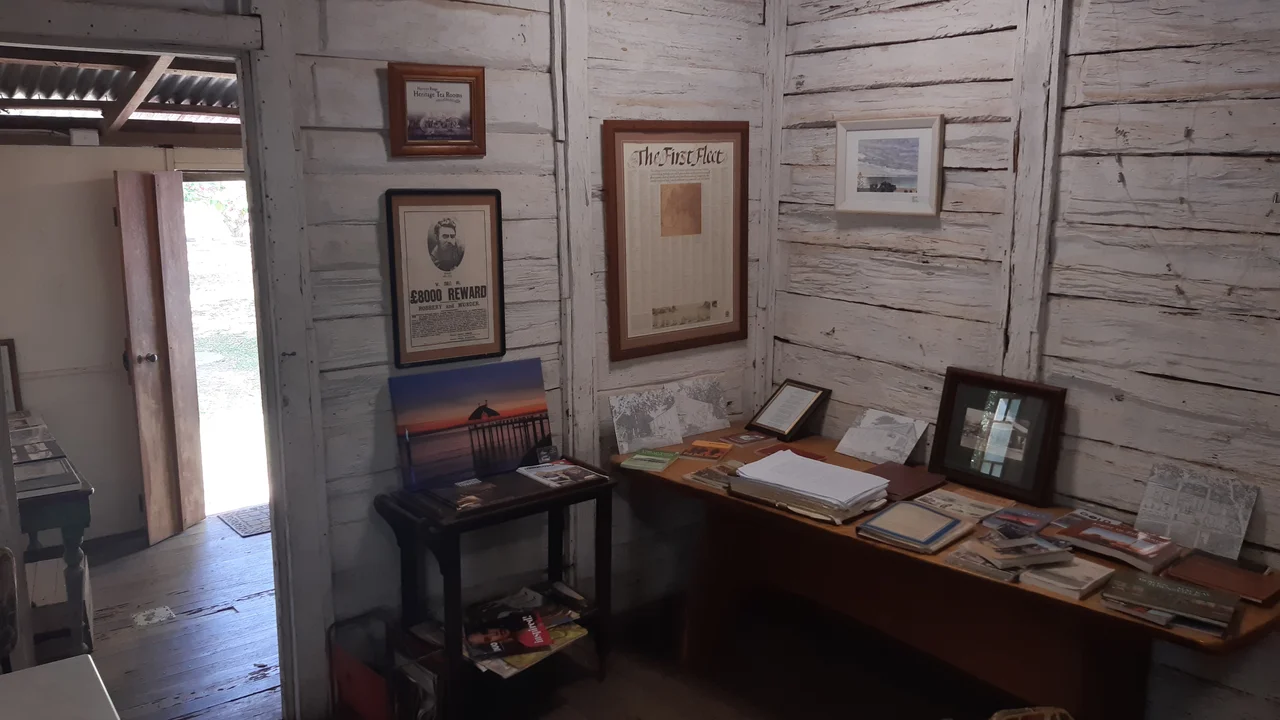
That a timber building from 1865 still stands at all is the real wonder. Slab inns were cheap and rough, thrown up for a frontier that moved on; almost all of them rotted, burned or were pulled down once the bullock teams gave way to railways and trucks. This one endured the long quiet decades after the goldfields traffic faded, and it has since been restored with care, the old split logs preserved and the rooms turned over to scones, jam and cream rather than rum and road dust. The shift from rough watering hole to genteel tea room is its own small comedy of history. Where teamsters once stamped in caked with mud after five days on the track, visitors now linger over Devonshire tea on a building that has watched North Queensland change around it for more than a century and a half.
From the Air
The Herveys Range Heritage Tea Rooms sit at roughly 19.35°S, 146.45°E, atop Hervey Range about 32 km north-west of Townsville. The range crest stands around 1,000 feet (300 m) above the surrounding coastal plain, a clear escarpment edge that reads well from the air with the lower country falling away to the east toward Cleveland Bay. The nearest major airport is Townsville (YBTL / TSV), with Charters Towers (YCHT) to the west-southwest. Best viewed at lower altitudes in clear, dry-season conditions; afternoon cloud can build over the range in the wet.
Nearby Stories
- Mount Spec Road and Little Crystal Creek Bridge 25 km away
- Cape Cleveland Light 28 km away
- Charters Towers 46 km away
- Radar Station, Charlie's Hill 54 km away
- The Great Barrier Reef: The Living Structure Visible from Space - Now Dying 129 km away
- Porcupine Gorge 173 km away
- Undara Volcanic National Park 174 km away
- Mount Bartle Frere 227 km away