
Mbabaram language
When the linguist Bob Dixon finally tracked down a man who still spoke Mbabaram, he started where field linguists always start — with simple words. What was the word for "dog"? Albert Bennett answered: dúg. Dixon assumed he had misheard, or that decades of English had crept into Bennett's memory. But he had not misheard. The Mbabaram word for dog really was dúg, sounding almost exactly like the English word, and the resemblance was sheer coincidence — two languages on opposite sides of the planet arriving at the same small sound across tens of thousands of years. It is a famous story in linguistics. But the more important story is the one underneath it: that by the time anyone came to listen, there was almost no one left to ask.
The People of the Tableland
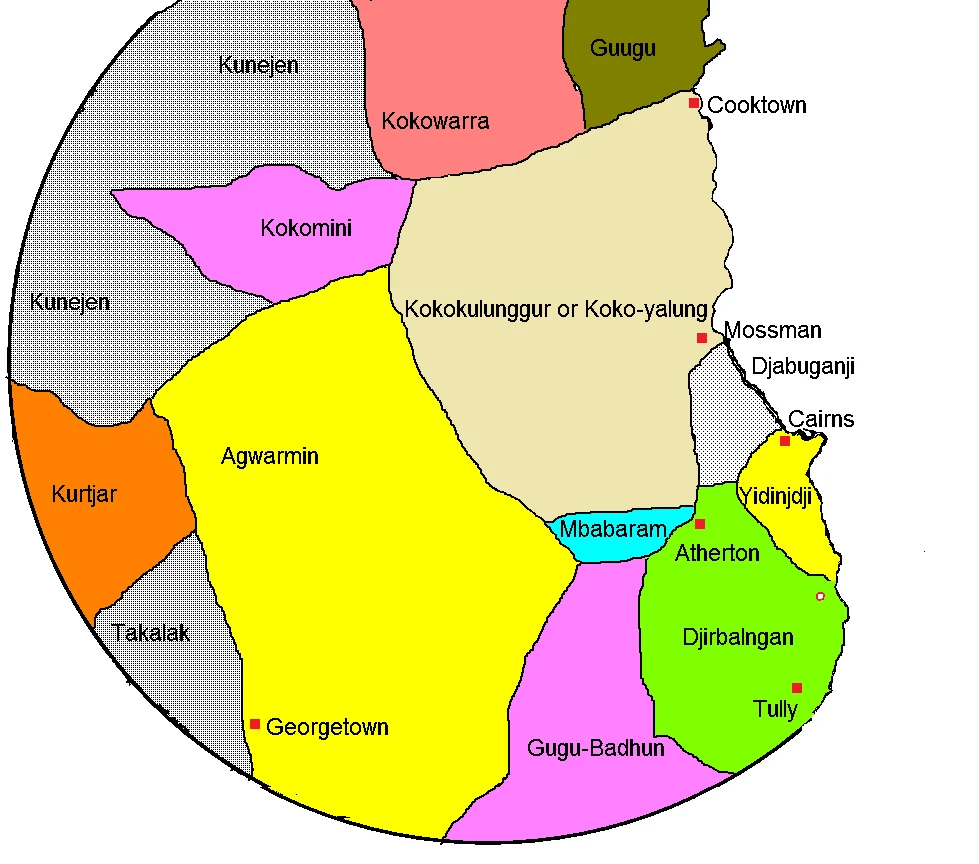
Mbabaram was the language of the Mbabaram people, whose country lay on the southern Atherton Tableland, in the rainforest and open woodland southwest of Cairns. They were one people among many in a crowded linguistic map — neighbours to the Yidiny, the Djabugay, the Dyirbal-speaking groups, and others, some of whose tongues were close enough to half-understand. Mbabaram was not among them. It had drifted so far from its neighbours that none could follow it, and so it was usually the Mbabaram who learned everyone else's language rather than the other way around. To live here was to be multilingual by necessity, holding your own words while carrying your neighbours' as well.
The Word That Wasn't a Loan
For a long time, outsiders took Mbabaram's strangeness as evidence that it stood apart from Australia's great Pama–Nyungan language family. Dixon's research changed that. He showed that beneath the surface oddities lay a familiar skeleton, reshaped by waves of sound change that had worn the language into something new. The word for dog is the perfect illustration. The ancestral form was something like *gudaga — preserved almost intact as gudaga in Yidiny, worn down to guda in Dyirbal. In Mbabaram, the same word lost its first consonant and shifted its vowels until it came out as dúg. The likeness to English is an accident of erosion, nothing more. The linguist Bernard Comrie has pointed to it ever since as a warning: a handful of similar-sounding words proves nothing about whether two languages are kin.
Searching for the Last Voices
By the time Dixon arrived in the 1960s, Mbabaram was already slipping away — its speakers scattered by the same forces of removal and displacement that silenced Aboriginal languages across the continent. He recounted the search in his memoir, *Searching for Aboriginal Languages: Memoirs of a Field Worker*. Nearly everything we know of Mbabaram comes from his sessions with Albert Bennett, one of a tiny handful of people — among them Alick Chalk, Jimmy Taylor, and Mick Burns — who still held the language in living memory. They were the end of a chain that stretched back thousands of years.
What an Archive Holds, and What It Can't
Today Mbabaram is classed as extinct, no longer spoken by any community as a first language. What survives sits in the Audiovisual Archive of the Australian Institute of Aboriginal and Torres Strait Islander Studies in Canberra: recordings of Bennett's voice, Dixon's notebooks, a bibliography of a vanished tongue. It is a strange and incomplete inheritance — enough to know how the language sounded, what its grammar did, why its word for dog made a linguist blink, but not enough to bring it back whole. For the Mbabaram people, who remain on and connected to their country, that archive is not a curiosity. It is what is left of a way of naming the world that was very nearly lost without a trace. The famous word for dog is the part outsiders remember; for the people whose language it was, the loss was the whole vocabulary — every word for the plants, the seasons, the kin, and the country they had named for tens of thousands of years.
From the Air
Mbabaram country lies on the southern Atherton Tableland, around 17.33°S, 145.00°E, in the elevated rainforest-and-woodland hinterland southwest of Cairns. From the air, this is high green tableland — cooler and more open than the coastal jungle, cut by ranges and dotted with crater lakes. There is no single landmark; the country itself is the subject. Nearest airfields are Atherton (YATN) and Mareeba (YMBA) on the tableland, with Cairns International (YBCS) about 60–80 km north-east beyond the escarpment. The dry winter (May–September) gives the clearest views across the plateau. Approach this as a story of a people and their language, not a place to photograph.
Nearby Stories
- Andrew Leon 23 km away
- Mungana Archaeological Area 26 km away
- Mount Mulligan Mine Disaster 28 km away
- Mount Bartle Frere 30 km away
- Paronella Park 44 km away
- OK Mine & Smelter 56 km away
- Undara Volcanic National Park 83 km away
- The Etheridge Line: The Town That Took a Train Hostage 106 km away