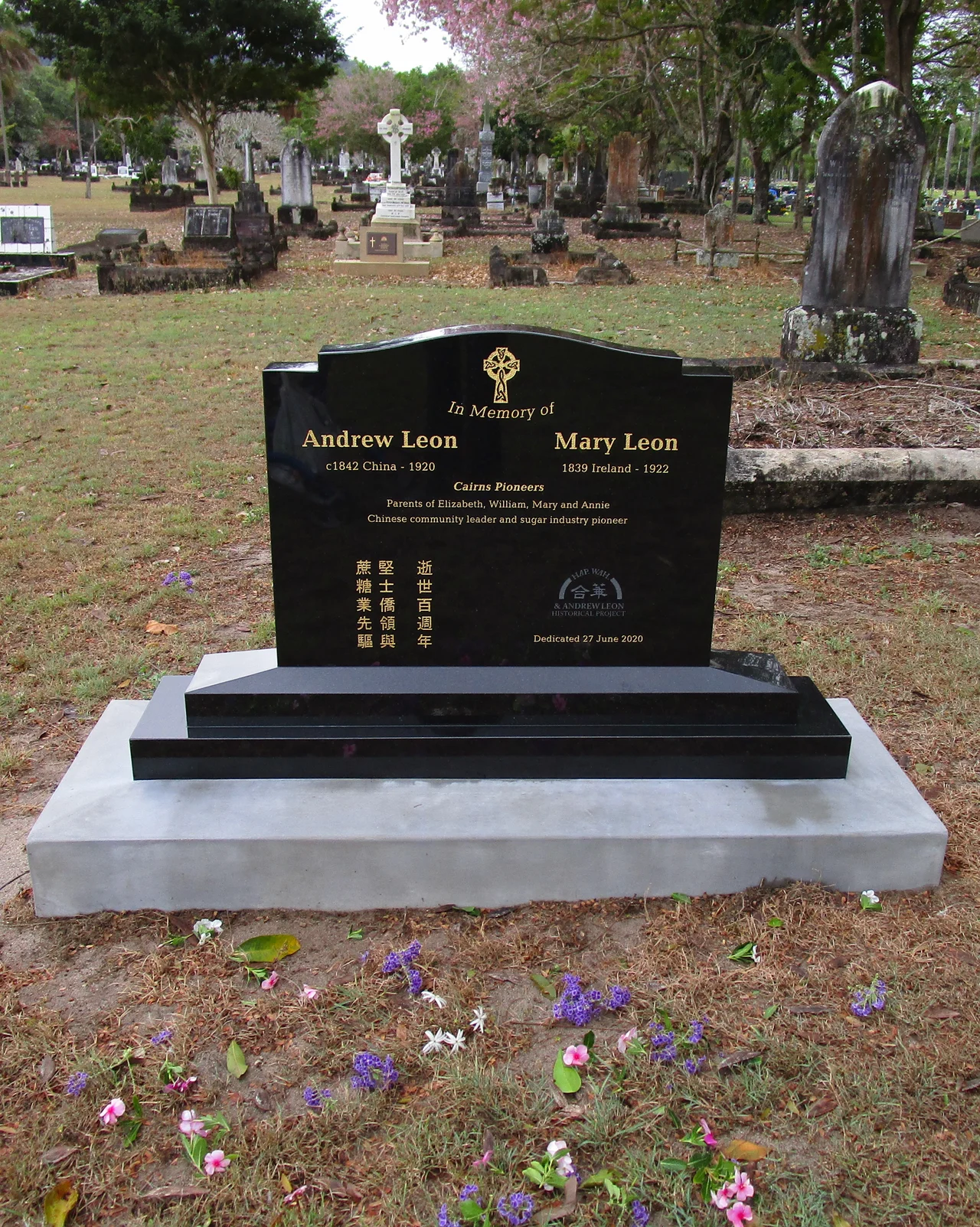

Andrew Leon
No photograph of Andrew Leon is known to survive. For a man who shaped a city, that absence is its own kind of injustice. He arrived in colonial Queensland in 1866, a Cantonese merchant's son from Zhongshan who had already learned the sugar trade in the cane fields of Cuba. Over the next half-century he would plant the crop that built the Cairns district economy, lead its Chinese community through decades of suspicion, and stand at the centre of the city's public life - and yet his face, and even his Chinese name, have been lost to history. What remains is the record of what he did, and it is considerable.
Following the Gold, Building a Life
Leon's first Australian years traced the restless map of the goldfields. Baptised at Bowen in 1868, he married Irish-born Mary Piggott there in 1869, and over the next six years the couple had four children, each born in a different North Queensland town as the family chased work from Bowen to Townsville to Millchester to Cooktown. He held miner's rights at Ravenswood and, crucially, began interpreting in court - a skill that would define his standing for the rest of his life. By 1875 the family had settled in Cooktown, the bustling port for the Palmer River goldfields, where Leon signed the petition for the town's incorporation and managed Chinese trading stores. He was learning to move between two worlds at once.
The Cane That Started an Industry
Leon reached the raw new settlement of Cairns in 1876 and quickly helped establish some of its first Chinese-owned buildings. Then, in 1878, he launched the venture that would matter most. Backed by Chinese traders in Hong Kong and local businessmen who together poured 45,000 pounds into the Hap Wah Company, Leon selected 1,250 acres south of town and planted sugar cane. It was the first large-scale sugar cultivation in Far North Queensland. By the end of 1879's first full season, 110 tons of Hap Wah sugar had been shipped out. At its 1884 peak the plantation worked some 200 Chinese labourers. When world sugar prices collapsed by a third, Hap Wah folded in 1886 - but it had proven the crop, and cane would go on to define the entire region for the next century.
Leader of a Community Under Pressure
By the mid-1880s, Chinese migrants made up the backbone of the district's farming - 60 percent of its farmers and gardeners, 90 percent of its farm labourers - and Cairns had a thriving Chinatown along Sachs Street, with merchant houses, temples, and gaming halls. Leon built there too. In late 1886 he funded the Lit Sung Goong temple, which opened for Chinese New Year in 1887; one of the shops he raised nearby still stands at 99 Grafton Street, listed on the Queensland Heritage Register. His fluency in English, his Western dress and manners, and his reputation for absolute reliability made him the natural bridge between the Chinese community and the colonial establishment. When governors visited, it was Leon who presented the formal Chinese address of welcome. When the courts needed an interpreter for serious cases, even murders, they called for him.
A New Country, a Closed Door
Then the rules changed. In 1901 the Australian colonies federated, and almost the first act of the new Commonwealth was the Immigration Restriction Act - the legal heart of the White Australia policy, designed to keep non-Europeans out. For the Leon family it was a quiet catastrophe. William, Andrew's only son, had been sent to China to be educated in 1878. Illness delayed his return until 1903, by which point the new law was firmly in force. Though William had been born in Townsville and was legally a British subject, officials now treated him as an alien, subject to a dictation test in any European language an officer chose to pick - a trap built to be failed. Despite a customs official vouching that he had known Andrew Leon for 25 years, the Secretary of External Affairs would not waive the test. No record can be found that William ever came home.
What Remains
Andrew Leon did not return to China to retire, as many of his countrymen did. He stayed in the city he had helped build, dying of cancer at his McLeod Street home in June 1920, aged 80. For a century his grave lay unmarked. Then, on 27 June 2020 - exactly one hundred years after his death - a headstone was finally placed over Andrew and Mary Leon, its Chinese inscription naming him a community leader and a pioneer of the cane sugar industry. A plaque now stands at the Earlville shopping centre built atop the old Hap Wah fields, and a suburban street carries his name. The man left no portrait. He left something harder to erase: the foundations of a city, and a record that refuses to let his contribution be forgotten.
From the Air
Andrew Leon's Cairns sits at 16.94 degrees S, 145.73 degrees E, on the tropical coast of Far North Queensland. The former Hap Wah plantation lay south of the modern city centre, in what are now the suburbs of Earlville, Woree, and Bayview Heights; the surviving heritage shopfront stands at 99 Grafton Street in central Cairns. Cairns Airport (ICAO YBCS) is right at the city, a few kilometres north of the historic Chinatown. From the air the cane fields that Leon's venture pioneered still quilt the Mulgrave and lower Barron valleys in green and gold, framed by the coastal ranges to the west and the Coral Sea to the east. Visibility is generally good year-round, though tropical buildup and wet-season storms are common from November to April.
Nearby Stories
- Mount Bartle Frere 20 km away
- Mbabaram language 24 km away
- HMS Mermaid (1817) 27 km away
- Mount Mulligan Mine Disaster 37 km away
- Nuggety Gully Water Race and Chinese Camp 85 km away
- Cyclone Yasi 92 km away
- Kapa Kapa Trail 779 km away