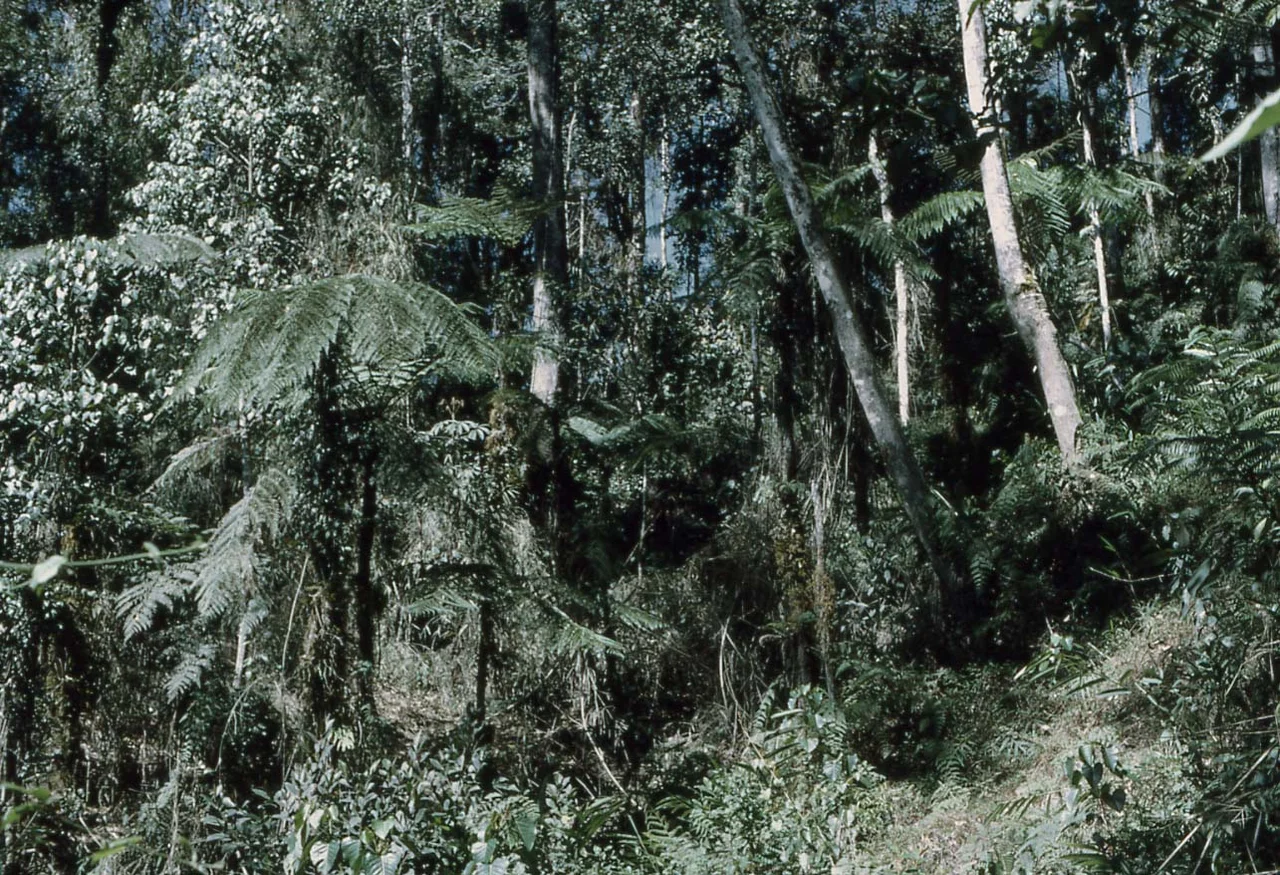

Kapa Kapa Trail
The local people called it Suwemalla. Nobody wanted to go there. The trail across the Owen Stanley Range, over a 9,100-foot pass near the 3,080-meter peak of Mount Obree, was avoided by the nearby villagers, who believed the crest was haunted. No white man had used the route since 1917. And yet in October 1942, General Douglas MacArthur's staff decided that more than 900 men of the U.S. 126th Infantry Regiment, 32nd Infantry Division would cross it on foot, in 42 days, carrying 80-pound packs, to flank the Japanese. They called the summit Ghost Mountain. Seventy percent of them came out of the jungle with malaria. Not a single one of them fired a shot at an enemy along the way.
A Name Misheard
The trail begins at Gabagaba, a coastal village on the south coast of Papua New Guinea. When English speakers first wrote the village's name, they heard "Kapa Kapa," and the trail running inland from it carried the mispronunciation into the history books. From Gabagaba the trail climbed north over the Owen Stanley Range - 84 miles long, with more than 17,000 meters of total ascent and descent, its high point 510 meters above the better-known Kokoda Track's 2,190-meter pass. Because it was steep, unimproved, and truly difficult, almost no outsiders had ever walked it. In 1942, that obscurity was exactly what MacArthur wanted.
MacArthur's Flanking Idea
By early September 1942, Australian troops on the Kokoda Track were under heavy pressure. Japanese forces had advanced to within 30 miles of Port Moresby. General Sydney Rowell thought he could hold them with the reinforcements arriving from Australia. MacArthur wanted more. He asked his staff to plan a flanking maneuver that would push the Japanese off the mountains faster. Colonel Leif Sverdrup was sent first with a reconnaissance party - one American, two Australians, ten native police of the Royal Papuan Constabulary, and 26 native carriers - to scout a route from Abau. After eight days scaling 5,000-foot heights, Sverdrup turned back. He reported that the route was difficult for marching, impossible for pack animals. The Allies canceled their plan to send the 127th Infantry Regiment over it. And then they decided to send the 126th anyway.
Rain, Heat, Uniforms That Held Heat
The men learned the hard lessons first. Their uniforms, dyed in Australia, turned out to trap heat. Quinine pills, water chlorination tablets, vitamin pills, and salt tablets began disintegrating almost as soon as the men put them in their pockets, because the men were always wet. It rained hard every afternoon at three o'clock. Beginning 15 October they were drenched by five days of steady rain. Temperatures at the higher altitudes dropped rapidly after sunset. They carried packs weighing up to 36 kilograms - about 80 pounds - over razor-sharp hogback ridges and through forest so dense that daylight barely reached the floor. "One of the most harrowing marches in American military history," one account called it. Malaria, dengue fever, bush typhus, tropical dysentery: the sick list read like a tropical medicine textbook.
Ghost Mountain
On the shoulder of Mount Obree, in the cold, dense forest at the crest, the men gave the peak its English name: Ghost Mountain. The local porters would not cross the border at the top of the range. To cross, they would have become illegal combatants in the League of Nations mandate territory of New Guinea, whose laws against local combatants the Australians enforced strictly. The Americans were left to shoulder their own packs the rest of the way. Major Garnet J. Burlingame, commanding 2nd Battalion, fell along the trail and fractured his spine. Major Herbert Smith, who replaced him on 30 October, later said of the men he inherited: "They were even lucky to be alive." On 25 October 1942, 29 days after setting out, the lead elements reached Jaure on the north side. They spent more than a week drawing rations, helmets, and boots before pushing on to Gora and Bofu.
No Japanese Found, Then Too Many
They never saw a single Japanese soldier during the whole crossing. The flanking maneuver they had marched 42 days to execute was already moot - the Japanese had been pushed back along the Kokoda Track by the Australians while the 126th was still in the jungle. Meanwhile, on 14-18 October, the U.S. 128th Infantry Regiment had simply been flown from Port Moresby to Wanigela. Aircraft could do in hours what the 126th had done in weeks at a terrible cost. By the time the 2/126th reached Soputa, they were in no condition to fight. MacArthur was desperate for men. After one week of recuperation, he ordered them into the line at Buna-Gona on 20 November against battle-hardened Japanese troops dug into hundreds of well-concealed bunkers. They ran short of ammunition, weapons, medicine, and food. General Edwin Harding was relieved of command after only 13 days, because MacArthur thought the men were unwilling to fight. What they were, mostly, was sick and starving. They fought anyway.
From the Air
Coordinates 9.80 degrees south, 147.52 degrees east, in the Owen Stanley Range of central Papua New Guinea. The trail runs from Gabagaba village on the south coast, over the 9,100-foot pass near Mount Obree, to Jaure on the north side of the peninsula - a distance of 84 miles with more than 17,000 meters of cumulative elevation change. Jacksons International Airport at Port Moresby (AYPY / POM) is the nearest major field. The terrain is among the most rugged in the Pacific: razor-edged ridges, dense mountain forest, and sudden 3,000-meter peaks. Clouds build against the range almost daily. Morning offers the best visibility; by afternoon the pass is usually obscured.
Nearby Stories
- Battle of Ioribaiwa 22 km away
- Kokoda Track 45 km away
- 1951 Eruption of Mount Lamington 91 km away
- Milne Bay Province 220 km away
- Battle of Wau 241 km away
- Wau 270 km away
- Ss Peter and Paul Cathedral, Dogura 285 km away
- HMS Pandora (1779) 358 km away