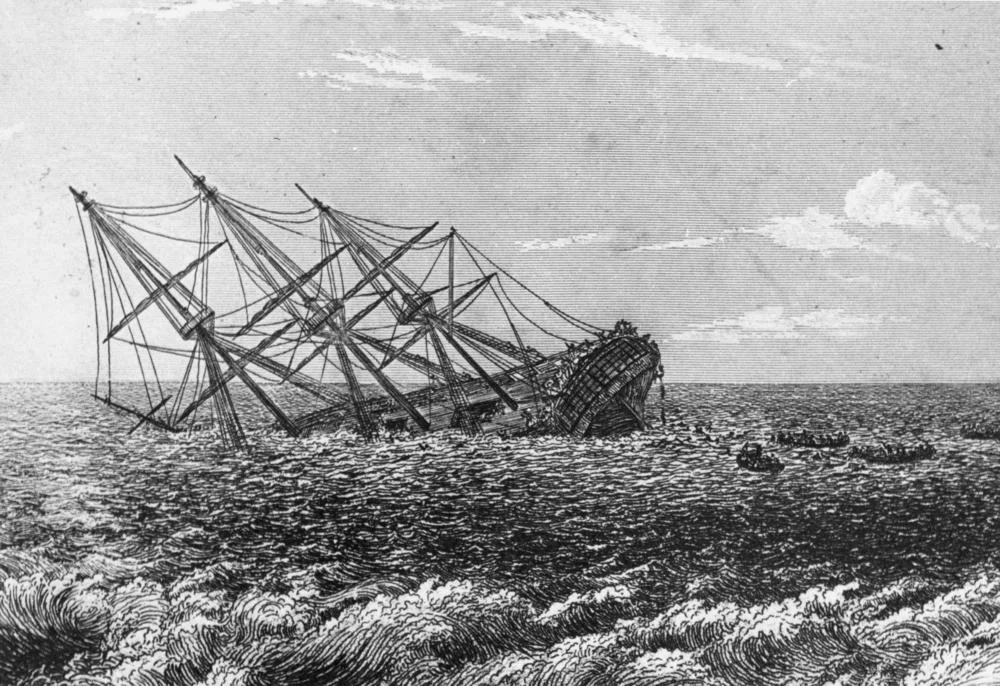

HMS Pandora (1779)
There was a cage on the quarterdeck, and the men inside it called it Pandora's Box. Eleven feet by eighteen, iron-barred, baking under the tropical sun, it held fourteen prisoners taken from Tahiti - the men the Royal Navy had sailed halfway round the world to recover after the most famous mutiny in the history of the sea. Below them, the warship HMS Pandora was running west toward home through uncharted reef. On the night of 29 August 1791, on the outer edge of what we now call the Great Barrier Reef, she ran onto coral and began to die. Some of those men in the box would never get out.
The Hunt for the Bounty
Pandora was a 24-gun frigate, launched at Deptford in 1779, already a veteran of the American war when the Admiralty gave her a new and singular purpose. Word had reached London of the mutiny aboard HMS Bounty - of how Fletcher Christian had set Lieutenant William Bligh adrift in an open boat and seized the ship. In 1790 the Navy dispatched Pandora under Captain Edward Edwards to find the mutineers, wherever they had scattered, and bring them back for trial. Edwards sailed via Cape Horn and reached Tahiti in March 1791. Christian and his core followers had long since vanished to a hidden island called Pitcairn, but fourteen of the Bounty men still lived on Tahiti as beachcombers, many with Tahitian wives and children. Some rowed out and surrendered. Others fled to the mountains and were hunted down. Edwards took them all.
The Men in the Box
Edwards has come down through history as a hard man, and the box he built tells you why. Guilty or innocent, surrendered or captured, the fourteen were locked together in irons in a cramped wooden roundhouse on the open deck. They ate, slept, and relieved themselves where they sat, hands and feet shackled, for months. Peter Heywood, one of the youngest, later wrote to his mother that they were kept 'with both hands and both legs in irons,' forced 'to eat, drink, sleep, and obey the calls of nature, without ever being allowed to get out of this den.' Whatever these men had done aboard the Bounty - and the courts would later find that several had done nothing wrong at all - they were human beings, and they were treated as freight. For three months Pandora searched the South-West Pacific in vain for Christian's vanished ship, then turned for the Dutch East Indies. The box and its prisoners went with her.
The Reef in the Dark
Heading for the Torres Strait, Pandora struck the reef as night fell. Water poured in faster than the pumps could fight it. Through the long hours of darkness the prisoners begged to be let out of their irons while the ship settled beneath them. As dawn came and Pandora finally went down, the armourer's mate, Joseph Hodges, was lowered into the box to strike off the shackles; it was William Moulter, a boatswain's mate, who at the last moment threw open the scuttle hatch and freed the men still trapped inside. Without him, every prisoner would have drowned in the cage. Thirty-five men died that morning - thirty-one of the crew and four of the prisoners: George Stewart and John Sumner, killed as a gangway broke loose, and Richard Skinner and Henry Hillbrandt, who went under still manacled. James Morrison's hands were bound too, and he lived to tell it. The cay where Moulter's name endures still rises a few kilometres from the wreck.
What the Sea Kept
The eighty-nine surviving crew and ten surviving prisoners crawled onto a small treeless sand cay, then crossed the Arafura Sea to Timor in four open boats - an ordeal that echoed Bligh's own famous voyage. Sixteen more died before reaching home; of the 134 who had left England, only 78 returned. Edwards was exonerated by court martial. The prisoners faced their own trials: four were acquitted of mutiny, and of the six convicted, three - Millward, Burkitt and Ellison - were hanged at Portsmouth in 1792, while Heywood and Morrison were pardoned. The wreck itself lay undisturbed until 1977, when explorers Ben Cropp, Steve Domm and John Heyer located it about five kilometres north-west of Moulter Cay, the reef having preserved roughly a third of the hull in the sand. Nine seasons of Queensland Museum excavation between 1979 and 1999 raised thousands of artefacts - and human bones - now studied and displayed at the Museum of Tropical Queensland in Townsville. It remains one of the most significant shipwrecks in the Southern Hemisphere, and a grave.
From the Air
The Pandora wreck site lies at approximately 11.37 degrees south, 143.98 degrees east, on the outer Great Barrier Reef about 5 kilometres north-west of Moulter Cay, on the edge of the Coral Sea off Cape York Peninsula. The wreck rests on a sandy bottom roughly 30-33 metres down and is a protected historic site - it cannot be seen from the air, but the surrounding reef line, Moulter Cay, and nearby Raine Island make useful visual references. Nearest airfields are Lockhart River (YLHR) on the Cape York coast to the south-west, Horn Island (YHID) in the Torres Strait to the north, and Weipa (YBWP) to the west; all are remote far-north Queensland strips. Clearest viewing of the reef structure is in the dry season (May to October), when trade-wind skies are most stable; wet-season convection and cloud frequently obscure the outer reef.
Nearby Stories
- Somerset Graves Site 99 km away
- Kutini-Payamu (Iron Range) National Park 118 km away
- RMS Quetta 120 km away
- Lockhart River, Queensland 148 km away
- Cape York Telegraph Line 164 km away
- Japanese submarine Ro-33 329 km away
- Lizard Island 356 km away
- Naval Base Port Moresby 356 km away