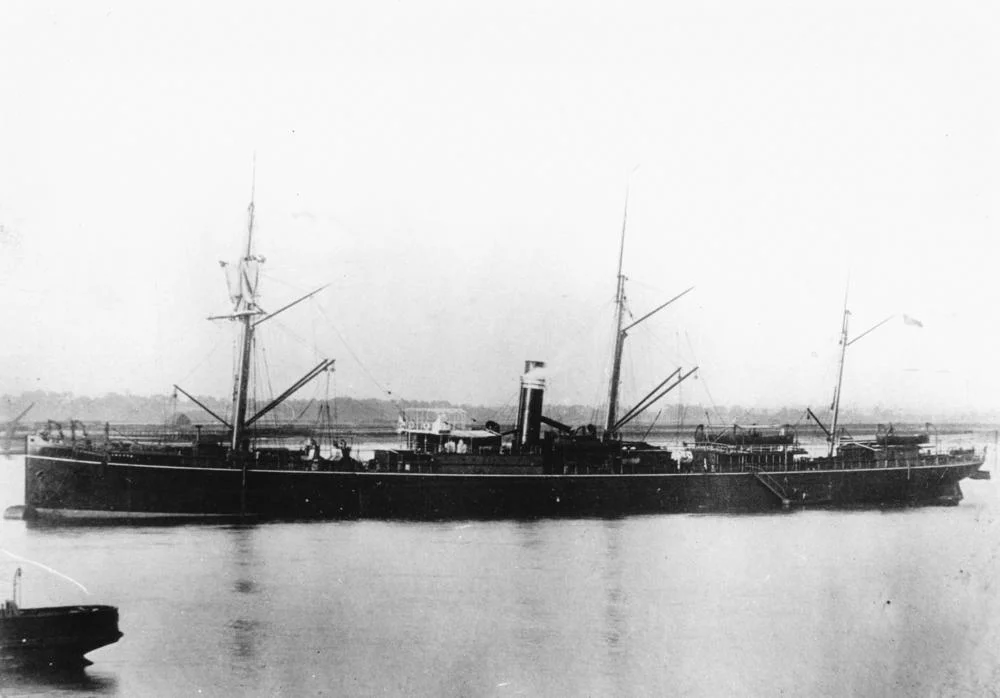

RMS Quetta
Three minutes. That was all the time between the moment RMS Quetta's hull split open on an uncharted rock in the Torres Strait and the moment she disappeared beneath the surface. At 21:14 on the night of 28 February 1890, the iron-hulled steamship was following the Admiralty's recommended course through the Adolphus Channel near Albany Island when she struck a submerged pinnacle that no chart had ever recorded. The rock tore her hull from bow to engine room. She settled by the bow, listed to port, raised her stern out of the water, and was gone. Of the passengers and crew aboard -- families returning to Britain, migrants, Javanese laborers, lascars, and Queensland colonists -- 134 did not survive.
A Ship Built for Empire
William Denny and Brothers built Quetta at Dumbarton on the River Leven in 1881, launching her on 1 March and completing her by 18 May at a cost of 70,119 pounds. She was an iron-hulled, three-masted barquentine with a single screw driven by a two-cylinder compound engine rated at 500 horsepower, giving her a speed of twelve knots. Her black hull carried a slender white line tracing the main deck, and her funnel bore two thick white bands -- the distinctive markings of British India Associated Steamers. First class cabins occupied the upper deck alongside dining, music, and smoking rooms. Below, in steerage, migrant families shared the main deck with luggage and cargo. At the stern, temporary shelters were erected for Javanese laborers returning to Batavia from Queensland's sugar cane fields. The ship also carried electric lighting and refrigerated storage -- advanced technology for 1881 -- and a hydraulic system that drove her cargo winches, steering gear, and anchors.
Queensland's Lifeline to London
Most mail ships between Britain and Australia served the southern route, calling at Fremantle or Albany, Adelaide, Melbourne, and Sydney. Queensland's capital, Brisbane, was a secondary stop at best, leaving the colony with a mail and passenger connection that was slower and less frequent than what the other Australian colonies enjoyed. In 1881, Premier Thomas McIlwraith secured parliamentary authority to offer a mail contract for a direct London-to-Brisbane service via the Suez Canal and Torres Strait. British India Associated Steamers won the contract. Quetta was transferred to the route in 1883, and on 8 April that year she left London on her first Brisbane-bound voyage, calling at Plymouth, Port Said, Aden, and Batavia before reaching Cooktown and continuing down the Queensland coast. By 1890, she had completed eleven round trips. On her final voyage, she carried passengers bound for Batavia, Singapore, and Colombo.
The Night the Channel Betrayed Them
Quetta embarked an experienced pilot, Captain Eldred P. Keatinge, to navigate the Torres Strait. The weather was fine, visibility good, and Keatinge was steering the course the Admiralty charts prescribed. None of it mattered. The rock that tore Quetta apart was unknown, unmarked, invisible. The subsequent Marine Board inquiry, held in April 1890, exonerated both Captain Sanders and pilot Keatinge, finding the wreck purely accidental and noting that the rock appeared on no chart. The ship had carried eight life buoys and more than six hundred life belts, but three minutes gave almost no one time to reach them. Among the roughly thirty children aboard was young Mary Copeland, traveling with her widowed mother and siblings back to Britain. Mrs. Copeland and her other children perished. The girl was rescued by a Captain Brown, who renamed her Cecil Quetta Brown and raised her as his own. Her true identity was not confirmed until 1927. Emily Lacy, another survivor, was found still swimming in the sea thirty-six hours after the sinking.
Rescue from the Edge of the Map
Captain Keatinge led a party of survivors to Somerset, the near-abandoned settlement on Cape York. Frank Jardine, the frontier settler who by then was virtually Somerset's sole permanent European resident, organized a rescue with his own boats and sent messengers fifteen miles to the nearest telegraph station to summon help from Thursday Island. The telegram arrived at about two in the afternoon on 1 March. John Douglas, the government resident, dispatched the steamer Albatross, which picked up nearly a hundred survivors from Mount Adolphus Island. The Marine Board later commended Jardine for his rescue effort. It also recommended that ships carry speaking tubes between bridge and engine room -- the Quetta's crew had been forced to send runners back and forth during the emergency, a system that cost precious seconds when the ship had almost none to spare.
A Cathedral Built from Grief
The wreck of RMS Quetta now lies on its port side in eighteen meters of water, protected by Australia's Underwater Cultural Heritage Act 2018. Its hull has become coral-encrusted, a flourishing ecosystem where marine life grows to unusual size -- a consequence of the Torres Strait's rich currents flowing over the artificial reef. On Thursday Island, the Quetta Memorial Precinct stands as a monument to the 134 who died. Construction began in 1892, and the Anglican church was consecrated in 1893; it is now a cathedral. Artifacts recovered from the wreck are displayed inside. The ship's bell hangs in the Cooktown Museum. A brass binnacle sits in Brisbane's Commissariat Store Museum. In Aslockton, England, St Thomas Church was built in memory of a passenger, Reverend Thomas Hall, and features a stained-glass window depicting the Quetta and the Thursday Island church. The rock that caused it all still bears the ship's name: Quetta Rock, finally charted, finally marked, decades too late.
From the Air
Coordinates: 10.61S, 142.62E, in the Adolphus Channel near Albany Island at the tip of Cape York Peninsula. The wreck site lies in approximately 18 meters of water. From altitude, the Torres Strait's shallow waters and numerous islands are clearly visible, with the Adolphus Channel identifiable as a passage between Cape York and Albany Island. The nearest airport is Horn Island (ICAO: YHID) serving Thursday Island. The Quetta Memorial Precinct is located on Thursday Island itself. Visibility is typically excellent during the dry season (May-October).
Nearby Stories
- Booby Island Light 14 km away
- Asia (1818 ship) 36 km away
- Jardine River 37 km away
- HMS Pandora (1779) 111 km away
- All Saints Anglican Church, Darnley Island 114 km away
- Raine Island Beacon 148 km away
- Janszoon Voyage of 1605–1606 150 km away
- Wasur National Park 237 km away