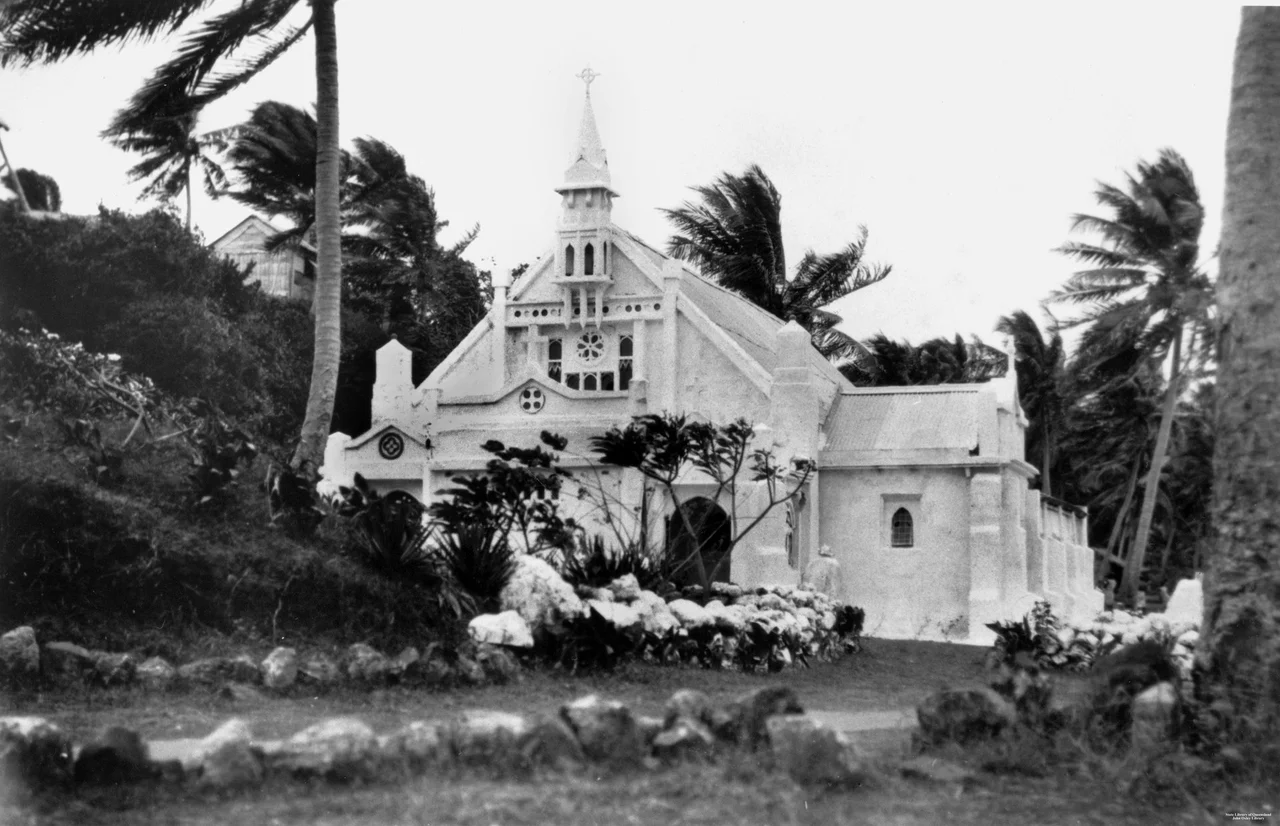
All Saints Anglican Church, Darnley Island
The inscription on Dabad's Monument at Badog reads: 'In loving memory of Dabad 1871: A man who denied his tribal laws and accepted the good news of salvation.' It was Dabad, a tribal elder of Erub, who met the missionaries at Kemus Beach on 1 July 1871 and introduced them to Amani and the rest of the island's people. That date became the most significant in Torres Strait Islander spiritual history, celebrated annually as the Coming of the Light. All Saints Anglican Church stands near the spot where that meeting happened, built from the same coral and basalt that form the island itself, a monument not just to faith but to the moment an entire region's identity began to transform.
Eight Evangelists from the Loyalty Islands
The Coming of the Light did not begin with Europeans. When the French Government expelled the London Missionary Society from the Loyalty Islands and New Caledonia in 1869, eight Lifu evangelists and their wives were redirected to the Torres Strait. Tapeso, Elia, Mataika, Guchong, Kerisidui, Wauaded, Sevine, and Josaia reached Erub (Darnley Island) on 1 July 1871. They arrived with a complication: Rotuma Islanders working in the beche-de-mer and pearl industries, who had encountered Christian missions on their own island and believed missionaries capable of cruelty and even selling people into slavery, had warned the Erub community against them. Dabad chose to welcome the newcomers anyway, a decision that rippled outward across the entire Torres Strait.
Ziona: A Church of Coral and Basalt
In 1919, construction began on what was originally called the Ziona church, rising on the former site of the LMS mission house and school. The builders used locally produced lime from burnt coral and basalt, working under the direction of Manai, an Erub Islander, and Ware, a South Sea Islander. The building covers approximately 250 square metres, with a central nave flanked by side wings. Walls of concrete, varying in thickness, are plastered inside and out, with columned arches connecting the nave to the wings. The facade facing east features a niche, projecting columns, beams, and a frieze that give the building a dignity beyond its remote setting. In 1963, the Church of England remodelled the structure with limestone from surrounding coral reefs, raising the roofline and extending the internal walls.
Erosion and Endurance
All Saints sits on a small level area between Badog Beach and the northeast headland, surrounded by mature coconut palms and natural forest. Its proximity to the water has always been both its distinction and its vulnerability. Beach erosion over decades threatened the building's foundations, and in 1976 a stone sea wall was constructed approximately 15 metres from the church to hold back the strong tides. The timber-framed roof, clad in red corrugated asbestos cement and galvanized steel, speaks to pragmatic repairs across the decades. Buttressed external walls and the mass concrete construction that characterizes Torres Strait church architecture give the building its visual weight. The vernacular style, with projected corners and beams and buttressed corners, appears in churches across the strait, but All Saints carries a particular authority as the first place of contact between Torres Strait Islanders and the LMS missionaries.
Where the Light Arrived
All Saints was listed on the Queensland Heritage Register on 21 October 1992, recognized for its historical significance, its aesthetic prominence on Erub, and its deep association with Torres Strait Islander Christian identity. Every 1 July, the Coming of the Light festival brings the community to this spot to celebrate the anniversary of the missionaries' arrival. The heritage listing notes that Erub has 'a strong and special religious significance with Torres Strait Islander Christians as the first place of contact between Torres Strait Islanders and London Missionary Society missionaries.' The church itself, constructed mainly from materials gathered within sight of its walls, embodies that contact. It is simultaneously a building, a landmark, and a living memory of the day eight Loyalty Islander evangelists stepped off a ship and changed everything.
From the Air
All Saints Anglican Church is located on the southwest side of Erub (Darnley Island) at 9.60S, 143.76E, near Badog Beach. The church is a prominent landmark visible from the water. Erub is a volcanic island in the eastern Torres Strait, approximately 45 km south-southwest of Bramble Cay. Horn Island Airport (YHID) is the main regional gateway. Approach from the southwest for views of the church's position between the beach and the headland, with coconut palms framing the structure.
Nearby Stories
- Bramble Cay 35 km away
- Yam Island 35 km away
- Gebar Island 54 km away
- Torres Strait Islands 112 km away
- Gulf of Papua 161 km away
- Goaribari Island 201 km away
- Western Papua New Guinea 226 km away
- Cape Melville 482 km away